Solar Buyer's Guide
NEM 3.0 Explained for California Homeowners (2026)
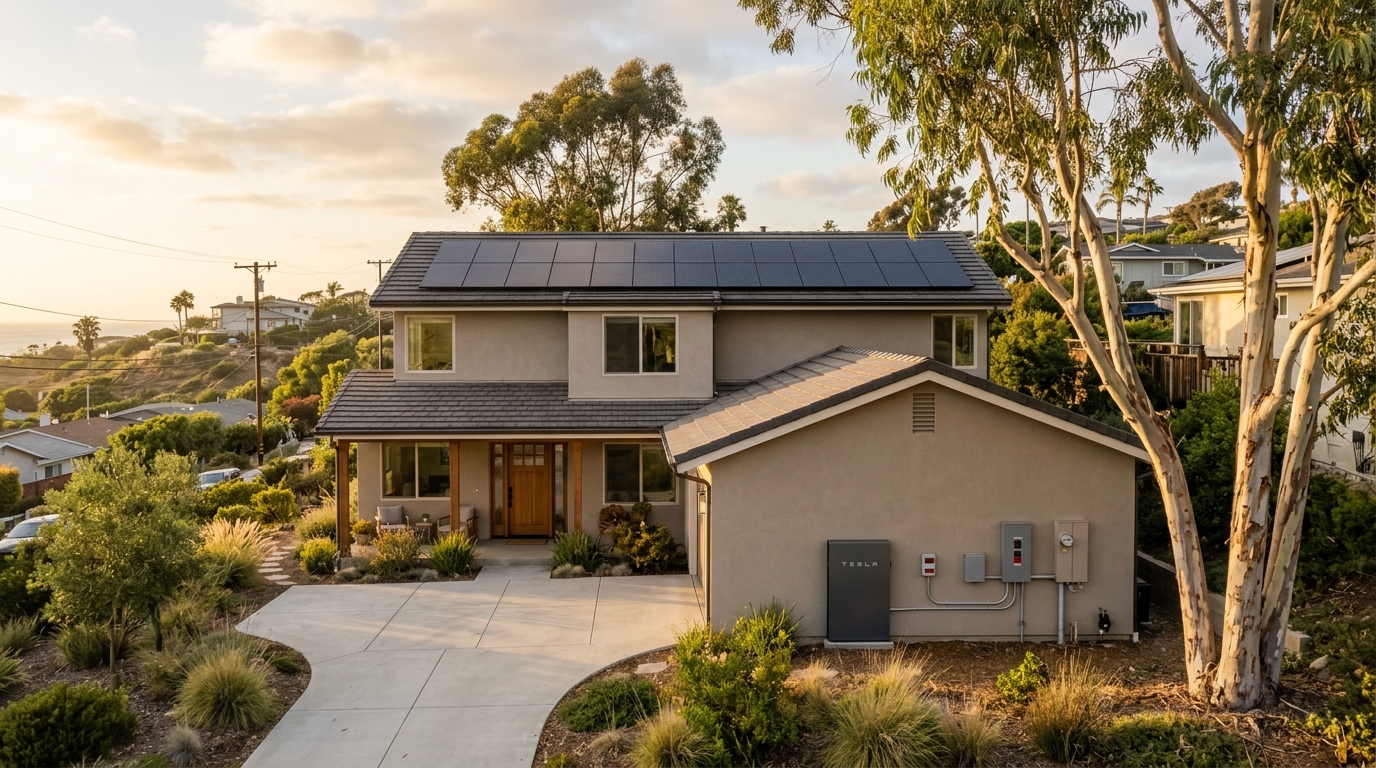
If you're a California homeowner thinking about solar in 2026, the most important number in your install quote isn't the price — it's whether you're under NEM 2.0 or NEM 3.0. That single distinction can flip your payback period from 6 years to 14 years on otherwise-identical hardware. Here's what the rule change actually does, with the math on a typical Bay Area install.
What is "net metering"?
Net Energy Metering (NEM) is the policy that says: when your solar panels produce more electricity than your home uses (typically midday), the excess flows back to the grid, and your utility credits your account. When you draw from the grid (typically evening and night), you spend down those credits.
Under NEM 2.0 (the rule that governed 2016 - April 2023 California installs), exported solar was credited at the retail rate — the same ~30¢/kWh a customer would otherwise pay PG&E, SDG&E, or SCE for grid electricity. This made solar payback in California 5-8 years for most homes.
Under NEM 3.0 (the successor tariff effective April 15, 2023), exported solar is credited at the avoided cost rate — what the utility says it would otherwise pay a wholesale generator. That's about 6-8¢/kWh on average across the day, with time-of-use multipliers. Effectively a 75% cut in export compensation.
Side-by-side math on a 7 kW Bay Area install
Assume: 11,000 kWh annual production. Home uses 7,000 kWh. Exports 4,000 kWh.
| Cash flow | NEM 2.0 | NEM 3.0 (no battery) |
|---|---|---|
| Self-consumed solar (7,000 kWh × 32¢) | $2,240/yr | $2,240/yr |
| Exported solar credit (4,000 kWh × rate) | $1,280/yr (@ 32¢) | $280/yr (@ ~7¢ avg) |
| Annual bill savings | $3,520 | $2,520 |
| Install cost (after 30% federal ITC) | $17,500 | $17,500 |
| Simple payback | 5.0 years | 6.9 years |
| With 0.7% panel degradation + 3%/yr utility rate inflation | 5.8 years | 10-14 years |
The simple-payback number understates the gap; once you model panel degradation and utility-rate compounding, NEM 3.0 payback is typically 10-14 years for solar-only installs.
Why batteries are now mandatory for good NEM 3.0 economics
Under NEM 3.0, the way to recover the retail-rate value of your solar is to STORE it and use it yourself during high-rate evening hours (4pm-9pm PG&E peak window). A battery effectively converts the 7¢/kWh export rate back into the 32¢/kWh self-consumed rate — for every kWh you can shift from export to evening use.
Add a Tesla Powerwall 3 (~$16K installed) and the math becomes:
| Cash flow | NEM 3.0 + battery |
|---|---|
| Self-consumed solar (7,000 kWh × 32¢) | $2,240/yr |
| Battery-shifted solar (3,000 kWh × 32¢ instead of 7¢) | +$750/yr |
| Exported solar credit (1,000 kWh × 7¢) | $70/yr |
| Annual bill savings | $3,060 |
| Install cost: solar + battery, post-ITC | $28,700 |
| Simple payback | 9.4 years |
| With panel degradation + utility-rate inflation | 7-9 years |
Add the battery and effective payback drops back to 7-9 years — recoverable, but still worse than NEM 2.0's 5-6 year payback. The 30% federal ITC applies to BOTH solar and battery so the after-tax math is reasonable.
The grandfathering trap
Existing NEM 2.0 customers (interconnection approved before April 15, 2023) get to keep NEM 2.0 rates for 20 years from their interconnection date. This is a massive grandfathering benefit — about half of California's installed residential solar capacity is grandfathered.
But: any system EXPANSION (adding panels, replacing the inverter with a different capacity, etc.) typically RE-RATES the whole system to NEM 3.0. If you're a grandfathered NEM 2.0 owner thinking about expanding, the expansion may trigger a downgrade. Ask your installer to write the proposed expansion's grandfathering implications into the contract.
Selling your house also triggers a re-rate decision: NEM 2.0 grandfathering generally transfers with the property to the new owner, but the new owner has to formally accept the existing system. This is a real point of friction in California home sales since 2023.
Time-of-Use (TOU) rates make this worse — and the battery better
California utilities have aggressively pushed customers onto Time-of-Use rates where peak (4-9pm) electricity costs 2-3× off-peak. Under NEM 3.0, batteries become more valuable because:
- Midday solar (low export rate) charges the battery for free.
- Battery discharges at peak (high avoided cost).
- The "spread" between charge and discharge rates is your effective return.
Without a battery, NEM 3.0 + TOU is the worst of both worlds: low export credit AND you have to import expensive grid electricity in the evening.
The 4-point decision checklist for California solar in 2026
- Roof has > 15 years of remaining life. (See roof cost calculator.)
- You're sizing the system to YOUR USAGE, not maxing out roof space. Oversizing under NEM 3.0 is brutally penalized.
- You're including a battery (10-15 kWh sized to evening peak hours), not skipping it to save up front.
- You're OWNING the system (cash or home equity loan) rather than leasing. Lease economics under NEM 3.0 are worse than ownership in nearly every scenario.
What if I'm grandfathered NEM 2.0?
Don't touch the system. Don't expand it. Don't replace the inverter with a different capacity. Maintain it as-is and ride the 20-year grandfathering window. You're in a materially-better position than any new install in 2026.
Run your numbers
- Solar panel cost calculator — California-adjusted install estimate.
- California home equity loan calculator — pre-filled with CA median home value for the "own the system" financing math.
- What nobody tells you before solar — the broader 9-issue checklist.
- Solar buyback in Texas, Florida 1:1 net metering, and Arizona APS / SRP / TEP export rates — sister-state breakdowns for readers comparing markets.
- Roof cost calculator — for the roof-age gate that must clear before solar makes sense.
More cost guides for California
Planning multiple projects? Every other 2026 California cost guide carries the same state-specific labor and pricing detail.
- Cost GuideBasement Finishing Cost in California 2026
- Cost GuideBathroom Remodel Cost in California 2026
- Cost GuideDeck Construction Cost in California 2026
- Fence InstallationFence Installation Cost in California 2026 — WUI Fire Rules, Labor Premium & HOA Reality
- Cost GuideFlooring Installation Cost in California 2026
- Cost GuideHardscape Installation Cost in California 2026
- HiringHiring a Contractor: A Homeowner's Checklist
- HVACHVAC Cost in California 2026 — Title 24, Heat-Pump Mandate, and the True Cost After TECH Rebates
- Pool InstallationIn-Ground Pool Cost in California 2026 — Why CA Pools Cost 30-45% More
- PaintingInterior & Exterior Painting Cost in California 2026 — Why CA Painting Runs 25-40% More
- Cost GuideKitchen Remodel Cost in California 2026
- Cost GuideLandscaping Cost in California 2026
- RoofingRoof Replacement Cost in California 2026 — Title 24, Cool Roofs, and the WUI Zone Surcharge
- Solar PanelsSolar Panel Cost in California 2026 — What 8 kW Systems Actually Run (Post NEM 3.0)
- Cost AnalysisWe Analyzed 47 LA Contractor Quotes in 2026 — Here's What We Found
- Window ReplacementWindow Replacement Cost in California 2026
Cost by state for this project
State-adjusted ranges with local labor and material multipliers.