Solar Buyer's Guide
Solar Net Metering in Florida (2026): FPL, Duke & Why 1:1 Retail Credits Still Work
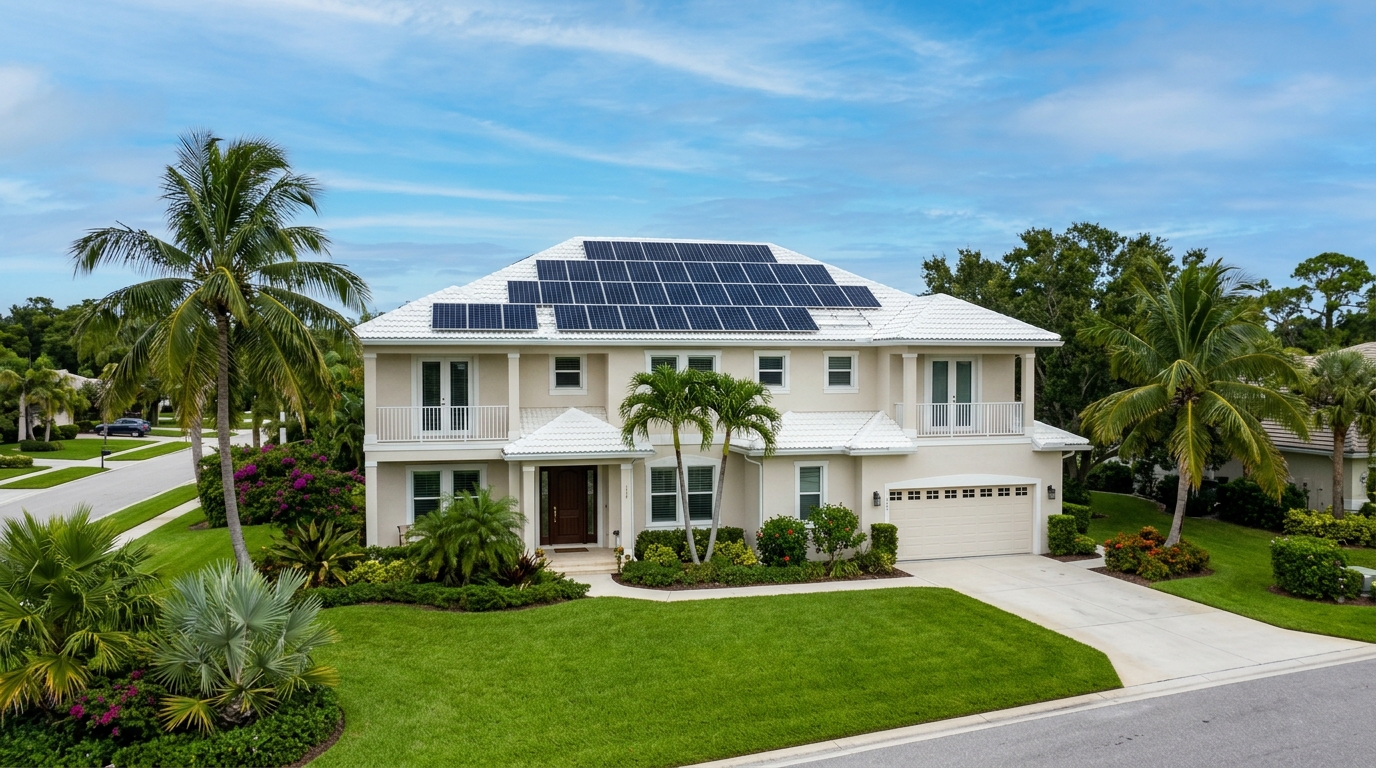
If you're a Florida homeowner thinking about solar in 2026, the news is uncharacteristically good: Florida still has 1:1 retail-rate net metering for residential solar customers. That's a meaningful tailwind for payback compared with California (post-NEM 3.0) or Arizona (Resource Comparison Proxy export rates). But there's a political shoe still hanging in the air — here's what the rule actually says, the math on a typical FPL install, and how to protect yourself from a future tariff shift.
The SB 1024 veto and what it means for 2026
In 2022, the Florida legislature passed Senate Bill 1024, which would have phased down residential net-metering credits over 2024-2028 until they hit avoided-cost rates (essentially Arizona-style buyback at ~3-4¢/kWh). Governor DeSantis vetoed the bill. That veto is the load-bearing wall under current Florida solar economics — and it has held through 2026.
The Florida Public Service Commission rule (F.A.C. 25-6.065) requires investor-owned utilities to:
- Credit residential customers at the full retail rate for exported solar.
- Roll over monthly net excess generation as a kWh credit (no expiration during a calendar year).
- Settle annual excess at the avoided-cost rate (rare for properly-sized systems).
- Limit any standby/grid-access fee to a level approved by the PSC (currently $0 for most utilities).
Investor-owned utilities subject to the rule: FPL, Duke Energy Florida, TECO (Tampa Electric), Florida Public Utilities. Munis (JEA, OUC, Lakeland Electric) have their own programs but most mirror retail-rate net metering as well.
Side-by-side math on a 9 kW Orlando install (Duke Energy)
Assume: 14,200 kWh annual production. Home uses 12,500 kWh (typical Florida AC-heavy load). Exports 1,700 kWh. Install cost $25,500 before 30% federal ITC = $17,850 net.
Duke Energy Florida residential rate is ~14.5¢/kWh all-in (energy + delivery + customer charge averaged across a typical bill) as of mid-2026.
| Cash flow | Florida (1:1 net metering) |
|---|---|
| Self-consumed solar (12,500 kWh × 14.5¢) | $1,813/yr |
| Exported solar credit (1,700 kWh × 14.5¢) | $247/yr |
| Annual bill savings | $2,060/yr |
| Install cost (after 30% federal ITC) | $17,850 |
| Simple payback | ~8.7 years |
| With panel degradation + 3.5%/yr utility-rate inflation | ~7.0-7.5 years |
Florida solar payback in 2026 lands at 7-9 years for typical owner-financed installs — one of the strongest in the country. The combination of cheap labor, 14¢/kWh retail rates, abundant sun, and intact 1:1 net metering is rare.
Why batteries are OPTIONAL in Florida (unlike CA)
Under 1:1 net metering, every exported kWh is worth exactly as much as every self-consumed kWh. The math reason to add a battery in California (the 75% export-rate haircut) doesn't exist in Florida. Batteries in FL are bought for resilience, not economics.
The Florida battery case rests on three resilience pillars:
- Hurricane season (June 1 - November 30). The average Florida grid customer loses power 2.3 times per year, with one outage in the 12-72 hour range being typical during Atlantic-basin hurricane years. See our 2026 hurricane preparation checklist.
- Time-of-Use migration risk. Florida utilities are slowly rolling out optional TOU rates. If you migrate (or are forced to), a battery converts midday solar into evening peak credit — but TODAY this is not material.
- Tariff-change insurance. If SB 1024 (or a successor) eventually passes and 1:1 net metering ends, batteries become essential overnight (Arizona-style economics). A battery installed today is "future-proofing" your system at a 30% federal tax-credit discount.
The grandfathering protection — and how to lock it in
Florida hasn't enacted explicit grandfathering legislation (because the tariff hasn't been cut). But ALL prior state-level net-metering rollbacks (CA, NV, AZ, NH) have included grandfathering provisions of 10-20 years for systems interconnected before the rule change. The conservative planning assumption is:
- Install + interconnect by year-end 2026 → likely grandfathered for ≥10 years if the rule changes.
- System EXPANSIONS may trigger a re-rate under future rules — keep sizing accurate at install.
- Ask your installer to write the interconnection date into the contract as a DOCUMENTED milestone. This date becomes the grandfathering anchor.
The 5-point Florida solar checklist for 2026
- Hurricane mitigation FIRST. Roof must be shingled or tile to current FBC wind-uplift code AND less than 12 years old for most insurers to keep covering you with solar on top. See our Florida roof & hail cost guide.
- Get the install permitted and interconnected before any future SB 1024-style rule change. Grandfathering protection is the BIG hedge.
- Size the system to your annual usage (12-month bill review). Florida's annual-settlement at avoided cost (~3¢/kWh) penalizes oversized systems.
- OWN the system (cash or Florida home equity loan) rather than leasing. Lease economics are weaker even in Florida's favorable tariff environment.
- Choose a battery for resilience even if not strictly required by the math. Hurricane season + tariff-change insurance + 30% federal ITC = strong case in Florida.
Run your numbers
- Solar panel cost calculator — Florida-adjusted install estimate.
- Florida home equity loan calculator — pre-filled with FL median home value for the "own the system" financing math.
- What nobody tells you before solar — the broader 9-issue checklist (hurricane gotchas included).
- NEM 3.0 explained for California — contrast with what Florida could look like if SB 1024-style rules pass.
- Roof cost calculator — roof age + condition is a HARD insurance gate before solar in FL.
More cost guides for Florida
Planning multiple projects? Every other 2026 Florida cost guide carries the same state-specific labor and pricing detail.
- Cost GuideBasement Finishing Cost in Florida 2026
- Cost GuideBathroom Remodel Cost in Florida 2026
- Cost GuideDeck Construction Cost in Florida 2026
- Fence InstallationFence Installation Cost in Florida 2026 — HVHZ Wind Ratings, Pool-Code Fencing & Why Vinyl Wins
- Cost GuideFlooring Installation Cost in Florida 2026
- DisasterHail Damage Roof Replacement Cost Florida 2026 — Tile, Insurance Caps, and the Citizens Reality
- Cost GuideHardscape Installation Cost in Florida 2026
- HVACHVAC Cost in Florida 2026 — Humidity-Dominated Sizing, FPL/Duke/TECO Rebates, and Why FL Heat-Pump Math Beats Both Texas and Georgia
- Pool InstallationIn-Ground Pool Cost in Florida 2026 — What $55-$95K Actually Buys
- Kitchen RemodelKitchen Remodel Cost in Florida 2026 — Miami, Tampa, Orlando, Jacksonville Pricing
- Cost GuideLandscaping Cost in Florida 2026
- Cost GuidePainting Cost in Florida 2026
- Cost GuideRoof Replacement Cost in Florida 2026
- Solar PanelsSolar Panel Cost in Florida 2026 — Net Metering, Hurricane Codes, and FPL vs. Duke vs. TECO
- Cost GuideWindow Replacement Cost in Florida 2026
Cost by state for this project
State-adjusted ranges with local labor and material multipliers.