Solar Panels
Solar Panel Cost in Florida 2026 — Net Metering, Hurricane Codes, and FPL vs. Duke vs. TECO
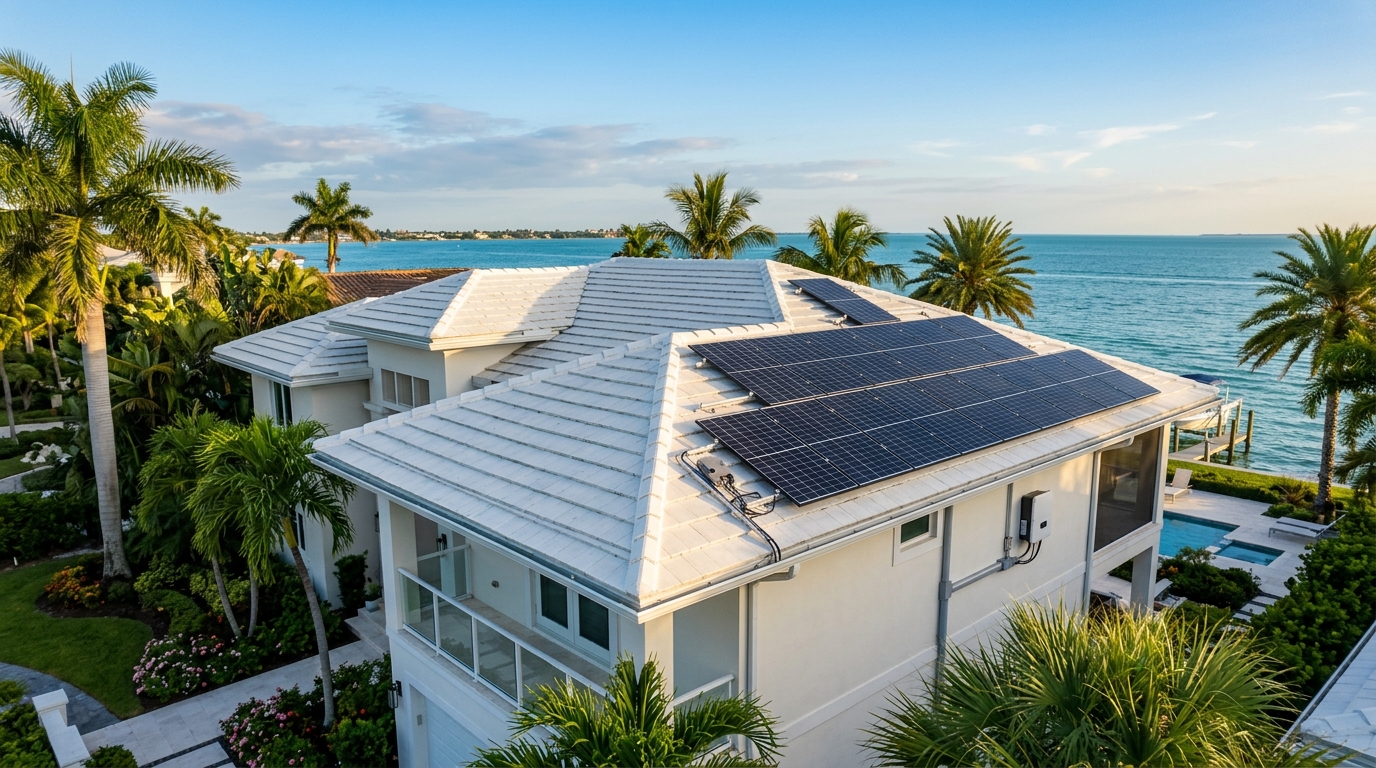
Florida is the #3 solar state by installed capacity, with two huge tailwinds and one ongoing risk: strong sun (4.7-5.5 peak sun hours/day statewide), genuine net metering (1:1 credit at retail rates — among the best policies in the U.S.), and the policy fragility (FPL has lobbied for net-metering rollbacks several times since 2022; 2026 status remains net-metering-intact but watch for legislative changes). Plus hurricane-zone wind-load requirements that add $1,200-$2,800 to most systems. Here's the 2026 Florida solar math.
The 2026 Florida solar baseline (typical 8 kW system)
- Gross cost (before incentives): $14,000-$21,000 ($1.75-$2.65 per watt).
- Federal tax credit (30% §25D): reduces cost by $4,200-$6,300.
- Net cost after federal credit: $9,800-$14,700.
- With battery added (10 kWh): add $9,000-$13,000 gross / $6,300-$9,100 net.
- Typical payback period: 7-10 years (most favorable in the FPL territory).
State-adjusted by system size and roof condition: Florida solar cost calculator.
The Florida net-metering policy (current as of 2026)
- Status: 1:1 net metering at retail rates remains in effect statewide for residential systems under 10 kW (most homes).
- How it works: Every kWh you export to the grid is credited at the same rate your utility charges you. Annual true-up.
- Risk: Florida HB 741 (2022) tried to roll back net metering — vetoed by Governor DeSantis. Industry watchers expect renewed legislative attempts in 2027-2028. The 30-year warranty period on your panels won't necessarily be locked into current net-metering terms — most policies grandfather but it's not guaranteed.
- Hedge: Some homeowners are adding battery storage now to reduce dependence on net-metering. If policy rolls back, batteries become more valuable.
Utility-by-utility math (the biggest factor in your payback)
- FPL (Florida Power & Light) — 12 million customers, residential rate ~$0.14-$0.16/kWh. Best 1:1 net-metering territory. Typical 8 kW system payback: 7-9 years.
- Duke Energy Florida — 1.9M customers (Central + North FL), residential rate ~$0.13-$0.15/kWh. Same 1:1 NEM. Payback 8-10 years.
- TECO (Tampa Electric) — 800K customers (Tampa metro), residential rate ~$0.14-$0.16/kWh. 1:1 NEM. Payback 7-9 years.
- Gulf Power (now part of FPL) — Panhandle. Same FPL terms.
- Municipal utilities (JEA Jacksonville, Lakeland, Orlando OUC, Gainesville GRU): Vary widely. Most offer 1:1 NEM but check specific terms. Orlando OUC and JEA are solar-friendly; Lakeland Electric is less so.
- Co-ops (Lee County Electric, Sumter Electric): Solar friendliness varies. Get current terms in writing.
Hurricane wind-load requirements
Florida Building Code requires solar racking to withstand specific wind speeds based on location and zone:
- High Velocity Hurricane Zone (HVHZ — Miami-Dade + Broward): Racking rated for 175 mph winds. Adds $1,800-$3,200 over standard racking.
- Wind Zone 2 (most coastal counties): Rated for 150 mph. Adds $800-$1,800.
- Wind Zone 3 (inland — Orlando, Lakeland, Gainesville): Rated for 130 mph. Standard racking, minimal premium.
- Roof attachment: Florida code requires 4 attachment points minimum per panel; most installers use 6. Adds labor cost vs. simpler 2-point systems used in non- hurricane states.
- Tile-roof penalty: Miami-Dade/Broward tile roofs require flashed standoffs (not penetrating tile attachment). $200-$400 per attachment extra.
Florida solar pricing by region
- Orlando metro: Baseline FL pricing. Most installers, most competition.
- Tampa-St. Pete: -2 to +3% vs Orlando.
- Jacksonville: -5 to +0% vs Orlando. JEA's solar-friendly terms favorable.
- Miami-Fort Lauderdale: +12-22% over Orlando. HVHZ requirements drive costs.
- Naples-Fort Myers: +5-12%. Wind Zone 2 + premium clientele.
- Panhandle (Pensacola, Panama City): 0 to +8%.
- Florida Keys: +20-35%. HVHZ + island logistics.
Where the money goes (typical $17K 8 kW Orlando system)
- Panels (~20 panels @ 400W): $4,400-$6,400
- Inverter (string or microinverters): $1,500-$3,200
- Racking + hurricane-rated attachments: $1,600-$2,800
- Labor + installation: $3,500-$5,200
- Permits + interconnection: $300-$1,000
- Design + engineering: $500-$1,000
- Sales + overhead + warranty: $2,800-$4,200
Permits + interconnection (Florida specifics)
- Permit cost: $200-$900 most jurisdictions; $400-$1,500 Miami-Dade + Broward.
- Permit review: 1-4 weeks; Miami-Dade can take 6-10 weeks for HVHZ approval.
- Interconnection (FPL, Duke, TECO): 2-8 weeks for PTO.
- Inspections: Building (roof attachment + electrical), final.
The 4 line items that surprise Florida homeowners
- Tile-roof attachment premium. If you have S-tile, barrel-tile, or flat concrete tile, expect $200-$400 per panel attachment surcharge ($4,000-$8,000 on a typical system). Composite-shingle roofs avoid this.
- Roof replacement timing. Same as Texas — Florida installers won't put panels on a 15+ year asphalt roof, or a 20+ year tile roof. Replace first OR plan to remove/ reinstall ($1,800-$5,500).
- Insurance increase. Some FL home insurers raise premiums when solar is installed (cite hurricane-debris risk). Increase: typically $200-$800/year. Check with your insurer BEFORE signing the install contract.
- HOA approval. Florida statute 163.04 prevents HOAs from banning solar but allows aesthetic restrictions (placement, screens). Get HOA approval in writing BEFORE permitting.
Best time of year to install in Florida
- October-May: Standard FL install season. Dry, cool, no hurricane risk. January-March most expensive.
- June-September (hurricane season): Installers offer 5-12% discounts. Risk: hurricane delays mid-project. Most installers carry weather-delay buffer in their contract.
Trusted Florida-specific guidance
- Florida solar cost calculator
- Florida renovation cost drivers
- Florida roof replacement — pair with solar
- Energy efficiency upgrades — what pays back fastest
Bottom line
A typical 8 kW Florida solar system in 2026 runs $14,000-$21,000 gross / $9,800-$14,700 net after the 30% federal tax credit. Florida's combination of strong sun + 1:1 net metering delivers some of the best payback in the U.S. (7-10 years typical). The biggest cost drivers vs. other states are hurricane wind-load requirements (especially in Miami-Dade HVHZ) and tile-roof attachment premiums. Verify your utility's net-metering terms in writing, check homeowner-insurance impact BEFORE signing, and coordinate any roof replacement first. Run our Florida solar calculator for your scope.
More cost guides for Florida
Planning multiple projects? Every other 2026 Florida cost guide carries the same state-specific labor and pricing detail.
- Cost GuideBasement Finishing Cost in Florida 2026
- Cost GuideBathroom Remodel Cost in Florida 2026
- Cost GuideDeck Construction Cost in Florida 2026
- Fence InstallationFence Installation Cost in Florida 2026 — HVHZ Wind Ratings, Pool-Code Fencing & Why Vinyl Wins
- Cost GuideFlooring Installation Cost in Florida 2026
- DisasterHail Damage Roof Replacement Cost Florida 2026 — Tile, Insurance Caps, and the Citizens Reality
- Cost GuideHardscape Installation Cost in Florida 2026
- HVACHVAC Cost in Florida 2026 — Humidity-Dominated Sizing, FPL/Duke/TECO Rebates, and Why FL Heat-Pump Math Beats Both Texas and Georgia
- Pool InstallationIn-Ground Pool Cost in Florida 2026 — What $55-$95K Actually Buys
- Kitchen RemodelKitchen Remodel Cost in Florida 2026 — Miami, Tampa, Orlando, Jacksonville Pricing
- Cost GuideLandscaping Cost in Florida 2026
- Cost GuidePainting Cost in Florida 2026
- Cost GuideRoof Replacement Cost in Florida 2026
- Solar Buyer's GuideSolar Net Metering in Florida (2026): FPL, Duke & Why 1:1 Retail Credits Still Work
- Cost GuideWindow Replacement Cost in Florida 2026
Cost by state for this project
State-adjusted ranges with local labor and material multipliers.
Keep reading
Kitchen Remodel
Kitchen Remodel Cost in Washington 2026 — Seattle Metro Premium & PNW Cabinet Sourcing
9 min read
Kitchen Remodel
Kitchen Remodel Cost in Colorado 2026 — Why CO Kitchens Run 10-20% Above National
9 min read
Kitchen Remodel
Kitchen Remodel Cost in Florida 2026 — Miami, Tampa, Orlando, Jacksonville Pricing
9 min read
From the pillar series
See how your state ranks for 2026 solar payback →
All 50 US states ranked by payback years on the same $200/mo baseline. Hawaii 3.1 yr, MA 3.7 yr, CT 4.1 yr down to ND 11.5 yr.
See the 50-state ranking →