Roofing
Roof Replacement Cost in California 2026 — Title 24, Cool Roofs, and the WUI Zone Surcharge
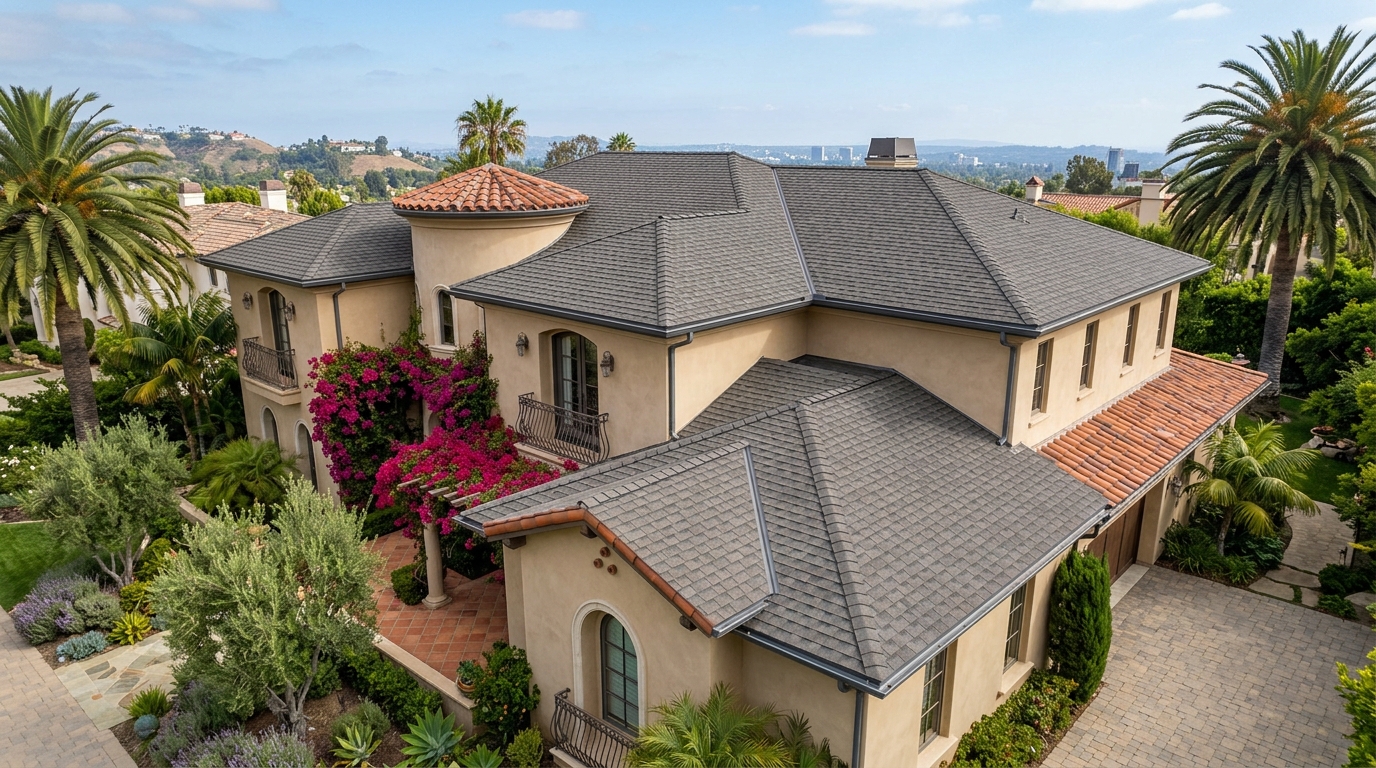
California roof replacements run 30-45% above the national average in 2026 for three concrete reasons: Title 24 cool-roof energy code drives material upgrades, WUI (Wildland-Urban Interface) zones require Class-A fire assemblies with specific underlayment and ember-protection details, and California labor runs 30-45% above national median. Here's exactly what a CA roof replacement costs in 2026, by metro and zone.
The 2026 California roof replacement baseline (typical 2,000 sqft home, ~22 squares)
- Title 24-compliant architectural asphalt: $14,000-$22,000.
- Class-A cool roof (light-colored asphalt or composite): $16,500-$26,000.
- Concrete tile (most common premium choice in CA): $24,000-$45,000.
- Clay tile: $30,000-$58,000.
- Standing-seam metal (cool roof): $28,000-$52,000.
- WUI-zone fire-resistive assembly add: +$1,500-$4,500 on top of any base option.
Tool with state + zone adjustments: California roofing cost calculator.
Title 24 cool-roof requirements (and what they cost you)
California's Title 24 Part 6 (energy code) requires cool-roof performance on most residential roof replacements in 14 of 16 climate zones. Specifically:
- Steep-slope roofs (≥2:12): need a 3-year-aged solar reflectance of 0.20 or higher and thermal emittance of 0.75 or higher (CRRC-rated product).
- Low-slope roofs (<2:12): stricter — 3-year-aged SR of 0.55 or higher.
- Practical impact: dark / black shingles are mostly out. Light gray, medium gray, tan, or "cool color" shingles with rated reflectivity are in. Cost premium: $300-$900 over the cheapest comparable dark shingle.
- Exemption: historic-district homes can sometimes use traditional dark tile. Verify with your jurisdiction's planning department.
WUI fire-zone surcharges (and where to check)
California Building Code Chapter 7A requires Class-A fire-resistant roof assemblies in all WUI zones. Specifics:
- Check your WUI designation: Cal Fire FRAP map (fhsz.fire.ca.gov) — type your address in. If you're in Moderate, High, or Very High Fire Hazard Severity Zone, Chapter 7A applies.
- Class-A assembly: requires fire-rated shingles or tile + fire-rated underlayment + non-combustible eave protection + 1/8"-or-smaller mesh on vents.
- Cost premium: +$1,500-$4,500 over a standard non-WUI replacement, depending on whether eave protection and venting need upgrade too.
- Insurance implication: California insurers are increasingly using Class-A vs. Class-B fire ratings as a renewal decision factor. Class-A roofing in a WUI zone is rapidly becoming a "must" for non-FAIR-Plan coverage.
California roof pricing by metro
- San Francisco / Bay Area: +18-30% over national. Steepest labor premium.
- Los Angeles metro: +12-22%. Most contractors, most competition.
- San Diego: +10-18%. Mild climate, easy roofing season.
- Orange County: +18-28%. Premium clientele + WUI overlap.
- Inland Empire (Riverside, San Bernardino): +5-12%. Cheaper than LA.
- Sacramento: +8-15%. Significant WUI zones in foothills.
- Fresno / Central Valley: -2 to +8%. Cheapest CA region.
- North Coast / Sierra: +20-35%. Drive-time premium + WUI requirements.
The California Solar Mandate angle
Title 24 Part 6 also requires solar PV systems on all new-construction single-family homes since 2020. For roof replacements, this matters because:
- If you already have solar: removal/reinstall during the replacement runs $1,800-$5,500. Schedule this when contracting — most solar installers won't do removal- only work cheaply.
- If you don't have solar and are 5+ years from selling: a roof replacement is the right time to add it. Tax credit (federal 30%) still active in 2026. NEM 3.0 makes payback longer (9-12 years) but still positive. See our California solar guide.
- "Solar-ready" roof spec: reinforced framing and conduit pre-runs cost $1,200-$2,800 added during a roof replacement; far cheaper than retrofit ($4,500+).
Where the money goes (typical $18K LA Title 24-compliant architectural)
- Tear-off + dump fees: $2,200-$4,000
- Title 24-rated cool architectural shingles: $4,500-$7,200
- Fire-rated synthetic underlayment: $700-$1,500
- Ice & water shield, drip edge, flashing, vents, ridge: $900-$1,800
- Labor (CA premium): $4,500-$7,500
- Permits + Title 24 documentation: $400-$1,500
- Contractor overhead + profit (18-25%): $3,000-$5,500
Permits + inspections (California specifics)
- Permit cost: $300-$1,500 depending on jurisdiction (LA County highest; smaller cities lowest).
- Title 24 documentation: required for permit; usually completed by the contractor. Verify it's included in the bid.
- Inspections (2-3): pre-shingle (decking + underlayment), final, sometimes mid-installation.
- Permit review time: 1-3 weeks in most CA jurisdictions; longer in SF Bay Area (3-6 weeks not uncommon).
The 4 line items that surprise California homeowners
- Cool-roof shingle color premium. The standard dark shingle you wanted may not be Title 24 compliant. Cool-color versions cost $300-$900 more.
- WUI ember-screen retrofit. If your home is in a WUI zone and the existing attic vents are too coarse (most pre-2008 vents are), they must be replaced with 1/8" mesh. Adds $300-$900.
- Solar removal/reinstall. If you have an existing solar system, plan for $1,800-$5,500 extra coordination.
- Asbestos abatement. Pre-1985 roofs sometimes have asbestos-containing materials in the underlayment or shingles. Testing + abatement: $800-$4,500. More common in older Bay Area and LA neighborhoods.
Best time of year to replace in California
- April-October: Standard CA roofing season. May-July most expensive.
- November-March: 8-15% cheaper but weather-dependent. Bay Area + North Coast: many delays. SoCal: usually fine.
Trusted California-specific guidance
- California roof replacement cost calculator
- Why California renovation is so expensive
- California solar — pair with re-roof
- Hiring a CA roofer — CSLB license verification
Bottom line
A Title 24-compliant architectural-shingle roof replacement in California runs $14,000-$22,000 — and add $1,500-$4,500 if you're in a WUI zone (check Cal Fire FRAP map). The biggest cost drivers vs. national: labor premium, cool-roof shingle requirement, and fire-zone assembly upgrades. If you have solar, coordinate removal/reinstall in the same contract. If you're 5+ years from selling and don't have solar, this is the right moment to add it. Verify CSLB licensing on every bidder. Run our California roofing calculator for your specific scope.
More cost guides for California
Planning multiple projects? Every other 2026 California cost guide carries the same state-specific labor and pricing detail.
- Cost GuideBasement Finishing Cost in California 2026
- Cost GuideBathroom Remodel Cost in California 2026
- Cost GuideDeck Construction Cost in California 2026
- Fence InstallationFence Installation Cost in California 2026 — WUI Fire Rules, Labor Premium & HOA Reality
- Cost GuideFlooring Installation Cost in California 2026
- Cost GuideHardscape Installation Cost in California 2026
- HiringHiring a Contractor: A Homeowner's Checklist
- HVACHVAC Cost in California 2026 — Title 24, Heat-Pump Mandate, and the True Cost After TECH Rebates
- Pool InstallationIn-Ground Pool Cost in California 2026 — Why CA Pools Cost 30-45% More
- PaintingInterior & Exterior Painting Cost in California 2026 — Why CA Painting Runs 25-40% More
- Cost GuideKitchen Remodel Cost in California 2026
- Cost GuideLandscaping Cost in California 2026
- Solar Buyer's GuideNEM 3.0 Explained for California Homeowners (2026)
- Solar PanelsSolar Panel Cost in California 2026 — What 8 kW Systems Actually Run (Post NEM 3.0)
- Cost AnalysisWe Analyzed 47 LA Contractor Quotes in 2026 — Here's What We Found
- Window ReplacementWindow Replacement Cost in California 2026
Cost by state for this project
State-adjusted ranges with local labor and material multipliers.
Keep reading
Kitchen Remodel
Kitchen Remodel Cost in Washington 2026 — Seattle Metro Premium & PNW Cabinet Sourcing
9 min read
Kitchen Remodel
Kitchen Remodel Cost in Colorado 2026 — Why CO Kitchens Run 10-20% Above National
9 min read
Kitchen Remodel
Kitchen Remodel Cost in Florida 2026 — Miami, Tampa, Orlando, Jacksonville Pricing
9 min read