Disaster
Does Homeowners Insurance Cover Roof Replacement? The 2026 Plain-English Answer
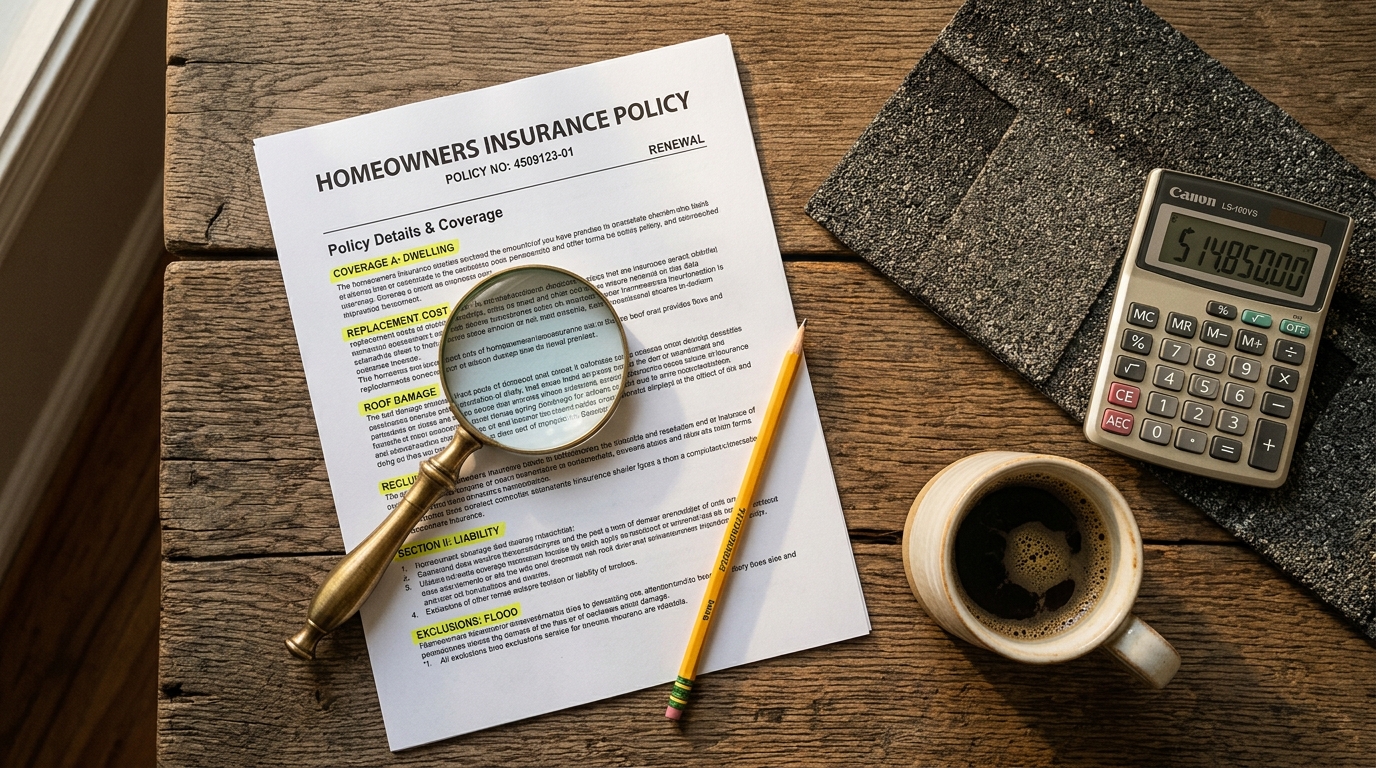
The short answer: your homeowners insurance covers a roof replacement ONLY if the damage was caused by a sudden, accidental, covered peril — hail, windstorm, fire, falling tree, vandalism. It does NOT cover wear-and-tear, age, neglect, or "the roof just got old." Beyond that, the answer depends on three things insurers rarely volunteer: ACV vs. RCV settlement, your roof age cap, and the wind/hail deductible structure. Get any of those three wrong and you'll be out $8K-$25K of an "insurance-covered" replacement. Here's the 2026 plain-English playbook.
The 4 covered causes (what triggers payment)
- Wind damage. Storms ripping shingles off or blowing trees onto the roof. The single most common covered cause in the U.S. — and the easiest to get approved if documented properly.
- Hail damage. Impact bruises and shingle granule loss from hailstones. Covered nationwide. See state-specific guides: Texas, Florida.
- Fire damage. House fires, wildfires, lightning strikes igniting the structure. Most policies cover the rebuild fully — see our wildfire rebuild guide.
- Falling-object damage. Tree limbs, neighbor's debris, aircraft (yes, really), even meteorites. Covered universally if the object was outside your control.
Get a state-adjusted roof cost estimate in 30 seconds
Same arithmetic this guide uses — adjusted for your roof size, pitch, and quality tier.
Calculate my roof replacement →The 3 exclusion traps that deny claims
- Wear-and-tear exclusion. Every U.S. homeowners policy excludes "gradual deterioration." If an adjuster classifies your damage as wear (e.g., curled shingles, granule loss from sun exposure, not impact), the claim is denied — even if a storm preceded the discovery.
- Maintenance exclusion. If you had a visible leak for 6+ months and ignored it, the resulting damage isn't covered. Document repairs promptly — keep contractor receipts as evidence of maintenance.
- Manufacturing defect exclusion. If shingles failed because of a known-defective production run, your homeowners insurance won't pay — you'll have to pursue the shingle manufacturer's warranty (typically 25-50 years, often pro-rated/limited).
ACV vs. RCV — the single biggest cost trap
This is the one most homeowners only learn about post-claim. Two policy types pay very different amounts:
- RCV (Replacement Cost Value): insurance pays the full cost to replace the roof with a like-quality new roof, minus your deductible. Total recoverable: $14,000 replacement → you get ~$12,500-$13,500 minus deductible. Best option. Costs ~$80-$200/year more in premium.
- ACV (Actual Cash Value): insurance pays "depreciated value" — replacement cost minus depreciation for the roof's age. $14,000 replacement on a 15-year-old roof at 60% depreciation = $5,600 minus deductible. You eat the rest. Most older policies and many low-premium policies default to ACV.
- Roof-age ACV trigger: A growing trap. Some insurers (Allstate, State Farm, Travelers in select states) auto-convert RCV to ACV when your roof is >10 or 15 years old. Read your declarations page — search for "ACV roof endorsement" or "Limited Roof Coverage."
If your policy is ACV, your $14,000 hail-damaged roof is suddenly a $5,600 insurance check and an $8,400 out-of-pocket bill. Switch to RCV before next storm season — most homeowners can upgrade for a few dollars per month.
Wind/hail deductibles — usually separate from your standard deductible
- Standard policy deductible: typically a flat $1,000 - $2,500.
- Wind/hail deductible: typically 1-5% of your dwelling coverage — NOT a flat number. $300,000 dwelling × 2% = $6,000 deductible for any wind/hail claim before insurance pays.
- Hurricane/named-storm deductible: some Gulf-coast states (FL, LA, MS, TX) have a separate even-higher deductible (2-10%) that triggers only on NOAA-named hurricanes. See our Mississippi storm damage guide.
- Implication: if your repair quote is <$3K above your wind/hail deductible, filing the claim is often a net loss after factoring in 8-15% premium increases on your next 5 renewals.
Roof age caps — the silent non-renewal trap of 2025-2026
Insurance companies are tightening roof-age policies aggressively due to climate-driven loss increases. In 2026:
- Florida: Most carriers won't write or renew roofs >15 years old. Citizens Property Insurance still will, but at much higher rates.
- Texas, Louisiana, Mississippi: >15-18 year roofs face non-renewal in coastal counties.
- Midwest tornado alley (OK, KS, MO, AR): >20-year roofs trigger ACV conversion or non-renewal.
- California: Wildfire-zone roofs >15 years face ACV conversion.
- The fix: proactively replace before the non-renewal letter hits. Your existing carrier will still pay an RCV claim for a 14-year-old roof; same carrier won't even quote a renewal at year 16.
What insurance will NOT cover even in a covered event
- Code upgrades — UNLESS you have Ordinance & Law coverage (a separate rider, typically 10% of dwelling coverage, ~$30-$60/year). Without it, you pay out-of-pocket to bring the roof up to current code (drip edge, ice & water shield, hurricane straps, etc.) — $1K-$5K typical.
- Solar panel removal + reinstall. Listed exclusion in most policies. Costs $1,500-$4,500 — you pay it.
- Cosmetic-only damage. Hailstones too small to affect roof integrity ("3/4 inch or less" per many policies) can be denied even if visible bruises exist.
- Pre-existing damage. Damage from a prior unreported event is excluded — one of the top reasons claims get partially denied.
Step-by-step: get your roof claim approved
- Document the damage IMMEDIATELY — date-stamped ground-level photos, NOAA storm report, interior water-stain photos. See our step-by-step claim-filing guide.
- Get a contractor inspection BEFORE filing. If they say "borderline," do NOT file (denied claims raise future premiums even when denied).
- File the claim within 30-60 days of the event (varies by state).
- Have your contractor present during the adjuster inspection — they spot damage adjusters routinely miss.
- File supplementals for code-upgrade items if you have Ordinance & Law coverage.
- After install, submit completion paperwork to recover RCV depreciation hold-back.
The 3 things to do right now (whether or not you have damage)
- Read your declarations page. Look for "ACV roof," "Roof age limitation," and your wind/hail deductible percentage. Most homeowners have never read it.
- Upgrade ACV → RCV if your roof is <15 years old. Cost: $80-$200/year. Saves potentially $5K-$15K on a future claim.
- Add Ordinance & Law coverage (typically 10% of dwelling). Cost: $30-$60/year. Pays for code upgrades that insurance otherwise denies.
Trusted roof insurance guidance
- How to file a roof insurance claim step by step
- Storm-chaser roofer scams — how to avoid them
- Texas hail damage guide
- Florida hail damage guide
- Tornado damage home repair cost
- How long does storm-damage roof replacement take?
Bottom line
Homeowners insurance covers roof replacement only for sudden, accidental damage from a covered peril — never wear-and-tear or age. Three policy structures determine whether you'll be made whole or out $8K-$25K: RCV vs. ACV settlement, your wind/hail deductible, and Ordinance & Law coverage. Read your declarations page today, upgrade to RCV if your roof is under 15 years old, and add Ordinance & Law before the next storm season. Run a real-world replacement estimate with our state-adjusted roofing calculators.
Get 3 free contractor quotes for your storm-damaged roof
Vetted local roofers who handle insurance claims. No spam, no obligation, no sales calls — we just send the quotes.
Most homeowners receive 3 quotes within 48 hours. Free service — funded by contractor referral fees, not by you.
Keep reading
Kitchen Remodel
Kitchen Remodel Cost in Washington 2026 — Seattle Metro Premium & PNW Cabinet Sourcing
9 min read
Kitchen Remodel
Kitchen Remodel Cost in Colorado 2026 — Why CO Kitchens Run 10-20% Above National
9 min read
Kitchen Remodel
Kitchen Remodel Cost in Florida 2026 — Miami, Tampa, Orlando, Jacksonville Pricing
9 min read