Disaster
Storm Chaser Roofer Scams — The 8 Red Flags (and How to Avoid Them) in 2026
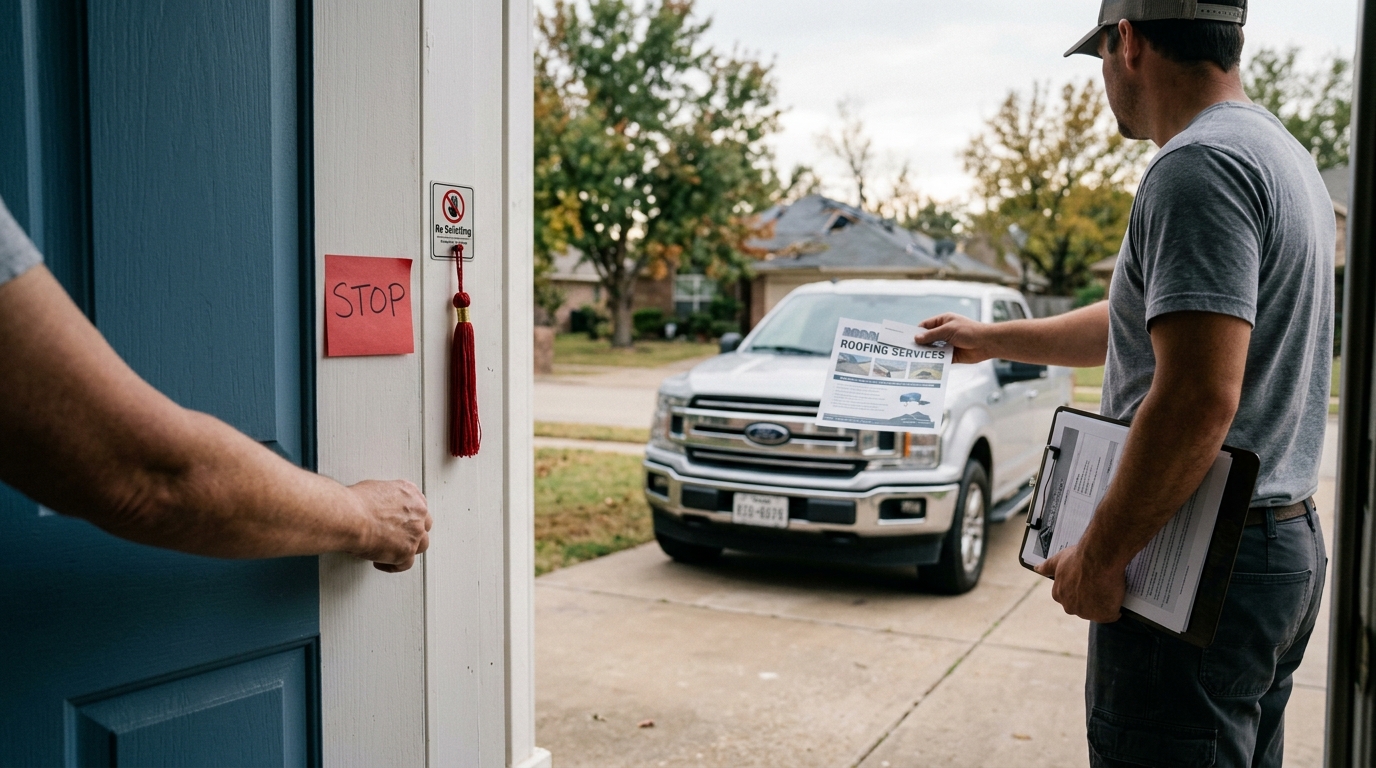
After every major storm — hail in DFW, hurricane in Pensacola, tornado in Tulsa — out-of-state pickups roll in within 48 hours. The drivers ("storm chasers") knock on every damaged door with the same pitch: "your insurance will cover everything, just sign here." Most are federally-prosecutable insurance fraud operations that hijack your claim, pocket the proceeds, and disappear before the warranty kicks in. Here are the 8 red flags of 2026 and the 6-step vetting checklist that protects you.
Red flag #1 — The post-storm door knock
Legitimate roofers don't door-knock. They get business from referrals, Google reviews, and their existing pipeline. If someone shows up unannounced within days of a storm, they're almost certainly a storm chaser.
- Out-of-state license plates on the truck
- Generic-looking marketing materials with no permanent local address
- "We were just doing free inspections in the neighborhood"
- Pressure to sign "today, before the price goes up"
Politely decline. Say "I already have a roofer" even if you don't — and verify the next roofer YOU call through proper channels.
Red flag #2 — Assignment of Benefits (AOB) contracts
The single most common storm-chaser scam in 2026. An AOB contract transfers your insurance claim rights to the contractor — they bill insurance directly, and you lose all leverage.
- They bill insurance for inflated work + materials they never installed
- They settle with insurance for less than the inflated bill and pocket the difference
- When the warranty issue arises 2-3 years later, they're out of business or unreachable
- You can't sue insurance over the dispute (you signed away rights) and can't easily sue a shell LLC
Refuse every AOB contract — universally. Florida and Texas have passed AOB reform laws making these less enforceable, but the best protection is never signing one in the first place. Reputable roofers don't require AOB — they let insurance pay you and you pay them.
Know your real replacement cost before any roofer quotes you
Same arithmetic this guide uses — adjusted for your roof size, pitch, and quality tier.
Calculate my real replacement cost →Red flag #3 — "We'll cover your deductible"
This is insurance fraud — a federal felony in some cases. When a roofer offers to "absorb your deductible" (either by billing insurance for more than the actual work, or by accepting only the insurance check as full payment), they're committing fraud on the carrier. By accepting, you become a co-conspirator.
- Illegal in Texas (Insurance Code §27.02)
- Illegal in Florida (Statute §817.234)
- Illegal in Mississippi (MS Code §97-15-3)
- Illegal nationally under federal mail-fraud + wire-fraud statutes for cross-state activity
If a roofer offers to "eat your deductible," walk away and report them to your state insurance commissioner.
Red flag #4 — Out-of-state license plates + no local presence
- Verify state contractor board registration with a permanent in-state business address.
- 5+ years in your specific county/city, not just "in the state." Storm chasers register an LLC in your state to look legit while operating mostly elsewhere.
- Google Maps the business address. If it's a UPS Store mailbox or a residential lot, they're not real.
- Check Better Business Bureau accreditation. Storm chasers commonly have either no BBB listing or many complaints.
Red flag #5 — Pressure to sign before inspection summary
Reputable roofers will:
- Inspect the roof + take photos
- Give you a verbal summary on-site
- Email a written estimate within 24-72 hours
- Let you compare bids from 2-3 roofers before signing anything
Storm chasers will:
- Pressure you to sign a contract IMMEDIATELY after inspection ("price is good today only")
- Combine the inspection with the contract signing
- Tell you they need to "lock in your spot" or "secure materials"
Red flag #6 — No physical estimate breakdown
Legitimate roofing estimates show line-item pricing for materials + labor + permits + contingency. Storm chasers prefer single-number "insurance scope" estimates that don't break down what they're actually doing.
- Demand a written line-item estimate before signing
- Compare to insurance's scope-of-loss line-by-line
- If they refuse to provide one, walk away
Red flag #7 — Workers compensation + general liability gaps
- Request Certificates of Insurance (COI) directly from their insurance broker — not from the contractor's email. The broker confirms it's active.
- Look for: General Liability ($1M+ recommended) + Workers Comp + Auto Liability.
- Without workers comp, if a roofer falls off your roof, you can be personally liable for their medical bills + lost wages. $50K-$300K typical claim.
- Storm chasers commonly carry only the minimum auto + general liability — no workers comp.
Red flag #8 — Vague warranty terms
- Workmanship warranty: reputable local roofers offer 10-25 years labor warranty. Storm chasers offer 1-5 years or vague "lifetime" promises with fine print.
- Manufacturer warranty: separate from contractor warranty. Must be filed properly with the shingle manufacturer to be valid. Storm chasers often skip the registration step, voiding your warranty.
- Workmanship + manufacturer registration certificate: demand a copy of the manufacturer warranty registration in your name before final payment.
The 6-step vetting checklist
- Verify state contractor license at your state's contractor board website. Confirm 5+ years active + no major complaints.
- BBB + Google Reviews check. Look for 50+ reviews, 4.5+ stars, and at least 3 years of review history. Many fake reviews are obvious in their consistency.
- Request 3 local references from work completed in your county within the past 12 months. Call all 3.
- COI directly from their broker. General Liability + Workers Comp + Auto. Confirm coverage dates are current.
- Line-item written estimate separate from the contract. Compare to insurance scope.
- Written contract with explicit terms: NO AOB, contingent on insurance approval, named manufacturer + product specs, 10+ year workmanship warranty, payment schedule (typically 0% deposit / 50% at start / 50% at completion — never 100% upfront or 50% deposit).
State-specific resources
- Texas: tdi.texas.gov — contractor verification, complaint filing, consumer alerts
- Florida: myfloridacfo.com — DBPR contractor lookup
- Mississippi: msboc.us
- Louisiana: Louisiana State Licensing Board for Contractors
- All states: FBI's IC3.gov for cross-state fraud reports + your state Attorney General's office
What to do if you've already signed with a storm chaser
- Right of rescission: most states give you 3 business days to cancel a door-to-door contract without penalty. Send written cancellation by certified mail.
- AOB revocation: in FL/TX, recent AOB reforms include explicit revocation rights. Consult a local attorney — most do free 30-minute consults for consumer-protection cases.
- Report to state Attorney General + your insurance carrier + state contractor board + BBB.
- Don't pay deposits beyond what's legally required. Hold any further payment until issues are resolved.
Trusted contractor guidance
- Does homeowners insurance cover roof replacement?
- How to file a roof insurance claim step by step
- Contractor financing scams to avoid 2026
- Hiring a contractor checklist
- How to read a contractor's estimate
Bottom line
The 8 storm-chaser red flags: post-storm door knock, AOB contracts, deductible kickbacks, out-of-state plates with no local presence, pressure to sign without summary, no line-item estimate, missing workers comp, vague warranties. The 6-step vetting checklist (license + BBB + references + COI + line-item estimate + clean contract) filters out 95% of fraud before you ever sign. If you've already signed with a chaser, you have 3 business days in most states to rescind — send certified mail TODAY. Run a real replacement-cost estimate on our state roofing calculators so you know what a fair quote looks like.
Get 3 free contractor quotes for your storm-damaged roof
Vetted local roofers who handle insurance claims. No spam, no obligation, no sales calls — we just send the quotes.
Most homeowners receive 3 quotes within 48 hours. Free service — funded by contractor referral fees, not by you.
Keep reading
Kitchen Remodel
Kitchen Remodel Cost in Washington 2026 — Seattle Metro Premium & PNW Cabinet Sourcing
9 min read
Kitchen Remodel
Kitchen Remodel Cost in Colorado 2026 — Why CO Kitchens Run 10-20% Above National
9 min read
Kitchen Remodel
Kitchen Remodel Cost in Florida 2026 — Miami, Tampa, Orlando, Jacksonville Pricing
9 min read