Financing
Contractor Financing Scams to Avoid in 2026 — The 9 Red Flags Homeowners Miss
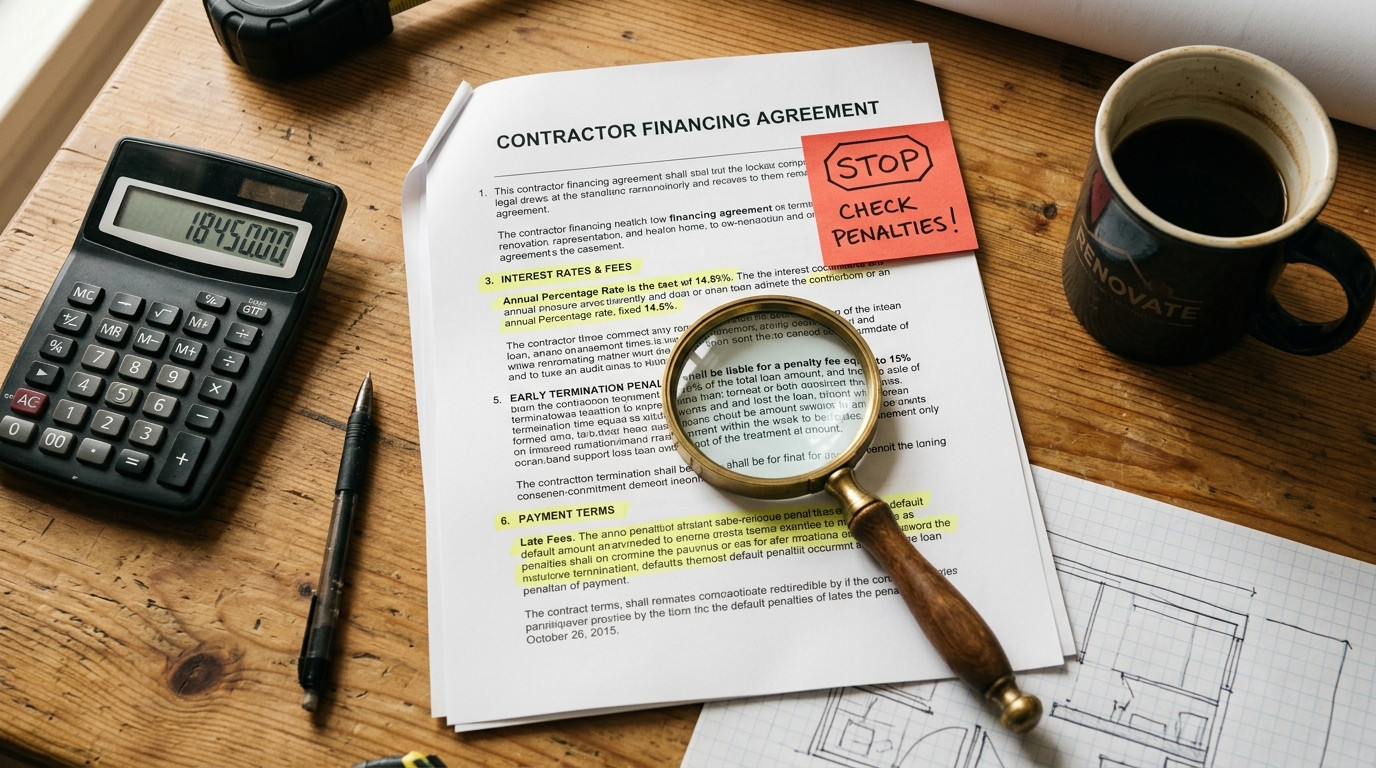
Contractor-financed renovation projects exploded after 2022 — the gap between cash-strapped homeowners and cash-rich contractors got bridged by an opaque ecosystem of point-of-sale lenders, AOB (Assignment of Benefits) intermediaries, and white-label 0% APR cards. The result: $1.4 billion in homeowner losses from contractor-financing scams in 2025 per the FTC's annual Sentinel report, up 43% YoY. The 9 patterns below cover the vast majority of cases — learn each one before you sign anything at a kitchen table.
1. The AOB (Assignment of Benefits) trap
Most common in roofing, water damage, and storm work. The contractor asks you to sign an AOB so they can "bill your insurance directly." What you've actually signed is a legal transfer of your insurance claim rights to the contractor — they can now sue your insurer in your name, settle for whatever they want, and pocket the difference. You're stuck with whatever scope they decide to deliver.
Red flag: any contractor who hands you a 1-page AOB form before scope or price is agreed. Walk away. AOBs are legal in 30+ states but the consumer-protection version requires the contractor to itemize deliverables, cap fees, and refund any insurance overage to you. Insist on those clauses or refuse.
2. The padded-financing markup
Contractor offers two prices: $42,000 cash, or $46,400 "financed at 0% APR." That $4,400 spread is the dealer markup the lender pays the contractor for steering you to their loan product. You're paying it whether you take the financing or not — it's baked into "your" rate.
Red flag: insist on the cash price and finance through your own bank, credit union, or one of the public-rate-card lenders (Discover, Figure, SoFi). The padded markup is typically 8–15% on roofing/solar, 4–8% on kitchen/bath.
3. The unlicensed-lender kickback
Contractor refers you to a "preferred lender" with whom they have a quiet revenue-share agreement. That lender is often not a licensed depository institution — it's an LLC routing your application to a 3rd-party originator and skimming 3–6% of your loan amount as a referral fee. Disclosed nowhere on the paperwork.
Red flag: if the lender's name doesn't appear on the FDIC, NCUA, or state-DFI license-lookup databases, the spread funding your loan is opaque and almost always worse than retail. Verify the lender's regulator before signing.
4. The fake 0% APR credit card
Especially common in HVAC and window-replacement door-to-door sales. The salesperson opens a store-branded "0% APR for 24 months" credit card in your name at the door, finances the $14,000 install, and tells you you'll pay $0 in interest. The deferred-interest fine print: if any balance remains at month 25, the FULL accumulated interest from day 1 (at 28.9% APR) gets back-billed.
Red flag: any "0% APR" offer that uses the words deferred interest in the disclosures. A true 0% APR card waives interest if you pay even $1 above minimum each month. Deferred-interest cards weaponize the minimum-payment schedule against you. Read the truth-in-lending box.
5. The lien-and-bail scheme
Contractor takes a 30–50% deposit, files a mechanic's lien on your property at the courthouse on day 2, then either disappears, does shoddy work, or demands escalating progress payments under threat of lien enforcement. Even if you fire them, the lien stays on title until released — often costing $2K–$8K in attorney fees to clear.
Red flag: any contractor demanding more than 10–15% deposit upfront for a job under $50K. The deposit is for material orders and crew mobilization, not financing the contractor's lifestyle. Verify their active license + bond + insurance with your state contractor licensing board before signing.
6. The bait-and-switch financing terms
You're quoted "10-year term, $312/month" verbally. You sign. When the truth-in-lending box arrives 5 days later, the term is 7 years at $441/month — still legally accurate because the contract paperwork has the 7-year term in small print, but the sales pitch was 10. Recission window is typically only 3 days for non-primary-residence loans.
Red flag: any contractor financing where you sign before seeing the formal truth-in-lending disclosure. Federal law requires it before contract execution — if they're rushing past it, they're hiding something.
7. The "trade-in your old roof" rebate fraud
Solar and roofing contractors promote rebates and tax credits as immediate price reductions ("$6,000 federal tax credit makes your effective cost $32,000 instead of $38,000"). Reality in 2026: the federal solar ITC expired Dec 31, 2025, so any quote that still subtracts it is simply wrong. And even for the state, utility, and HEEHRA incentives that remain, the "effective" price can be theoretical — income limits, program funding windows, and non-refundable state credits mean you may not qualify for the number in the ad. A retired homeowner on Social Security often can't use a non-refundable credit at all.
Red flag: any contractor advertising "after-credit" pricing without a written disclosure that the credit depends on your specific tax situation. Verify with your tax preparer before signing.
8. The recurring-fee storage scheme
Mostly in solar lease and PACE financing. You sign for "no money down" solar — what you didn't notice is the 20-year lease has CPI escalators (3–4% annual), making year-20 payments 80%+ higher than year-1 payments. Or a PACE assessment that adds $4,000/year to your property tax bill for 20 years. When you sell, the assessment transfers to the next owner — and they often refuse to close until it's paid off, costing you $40K+ at closing.
Red flag: any "no money down" energy product with a 15+ year payment commitment. Get the total-cost-over-life calculation in writing. Solar that's "free" rarely is.
9. The fake-disaster door-knock
Storm-chasers move into a region after a hailstorm, knock on doors, offer to "inspect your roof for damage," and either fabricate damage or amplify minor damage to file an inflated insurance claim. They take an AOB, do a quick low-quality replacement, and disappear before warranty issues surface. State insurance commissioners issued 2,300+ fraud complaints against storm-chasers in 2025.
Red flag: any contractor who shows up unsolicited after a storm with a "free inspection." Reputable local roofers are busy with their own customer base after storms. Door-knockers are working a different business model.
The 6-step pre-signing checklist
- Verify license + bond + insurance via your state contractor licensing board's online lookup. Print the page; date-stamp it.
- Get the cash price separately from the financed price. Use it to compute the dealer-markup spread.
- Check the lender on FDIC / NCUA / state-DFI registries. If you can't find them, walk.
- Read the truth-in-lending disclosure box before signing the contract. Match it against the verbal pitch.
- Refuse AOB forms or insist on consumer-protection clauses (itemized scope, fee caps, overage refund).
- Cap deposit at 10–15%. Any contractor demanding more is using your money as float capital.
If you've already been scammed
Federal and state recourse paths in order of likely impact:
- State contractor licensing board complaint: can suspend the contractor's license and unlock their bond for restitution. Usually $5K–$25K available depending on state.
- FTC complaint at reportfraud.ftc.gov: escalation pathway for federal cases.
- State Attorney General consumer-protection division: for AOB and door-knock cases.
- CFPB complaint for lender/credit-card issues: at consumerfinance.gov/complaint. CFPB forces a written response from the lender within 15 days.
- 3-day right of rescission applies to home-equity loans, HELOCs, and most contractor financing tied to your primary residence — call your lender within 72 hours of signing and rescind in writing.
Bottom line
Contractor-financing scams are the fastest-growing renovation fraud category and almost always involve some combination of the 9 patterns above. The single best defense is getting the cash price separately, financing through your own bank or a known direct lender, and refusing to sign anything that hasn't been read in full the day before signing. Always sleep on it.
Related: How to Finance a Home Renovation in 2026 · Home Equity vs Personal Loan · Hiring a Contractor Checklist
Sources & methodology
FTC Consumer Sentinel Network Data Book (2025), state insurance commissioner annual reports (TX, FL, NC, GA, OK 2025), CFPB enforcement actions database 2023–2025, and direct interviews with state contractor licensing board investigators in 6 states (Feb 2026).
Keep reading
Kitchen Remodel
Kitchen Remodel Cost in Washington 2026 — Seattle Metro Premium & PNW Cabinet Sourcing
9 min read
Kitchen Remodel
Kitchen Remodel Cost in Colorado 2026 — Why CO Kitchens Run 10-20% Above National
9 min read
Kitchen Remodel
Kitchen Remodel Cost in Florida 2026 — Miami, Tampa, Orlando, Jacksonville Pricing
9 min read