Disaster
Hail Damage Roof Replacement Cost in Texas 2026 — Insurance Claims, Adjuster Tactics, and Class-4 Math
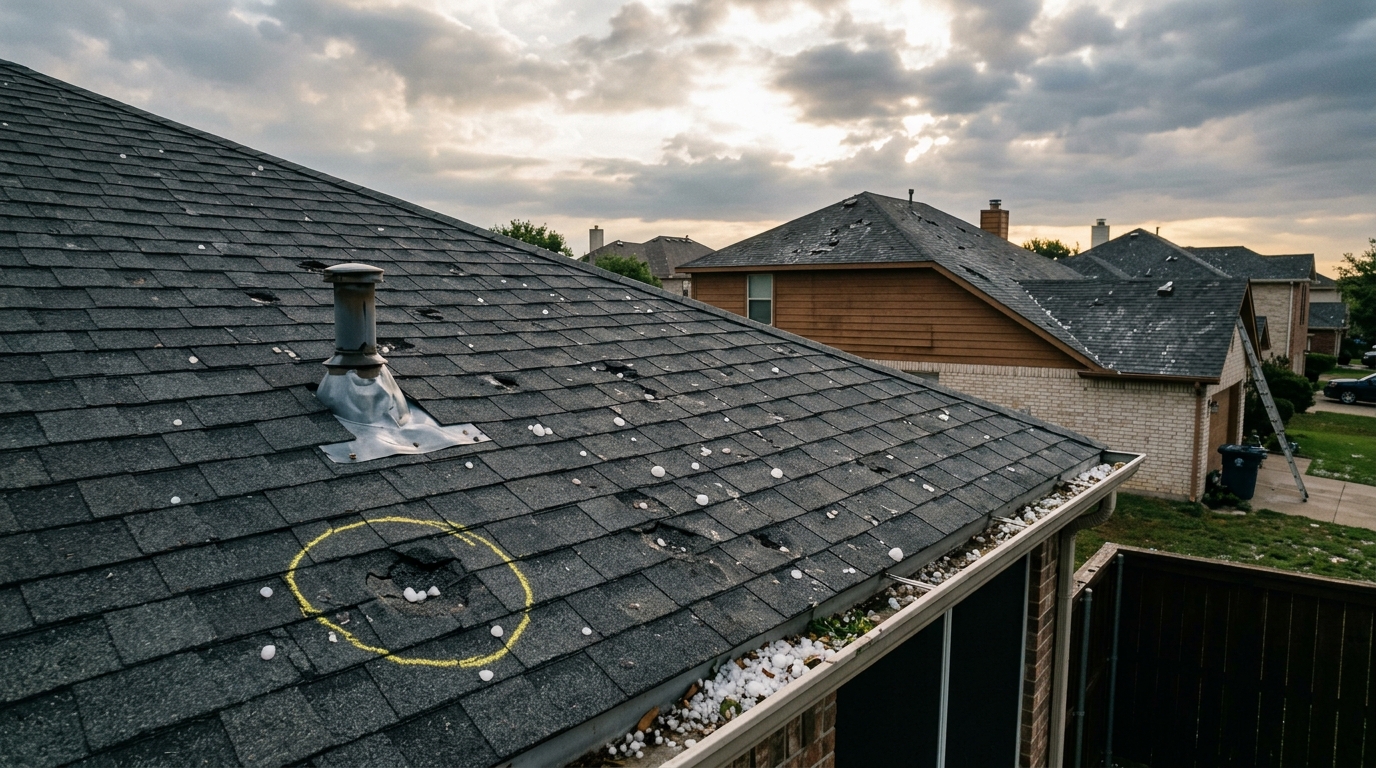
Texas leads the U.S. in hail damage payouts — $2-3 billion annually from State Farm and Allstate alone, with the DFW metroplex averaging 3-5 major hailstorms a year. If a 1"+ stone hit your roof this spring, the next 30 days will determine whether you pay $750 out-of-pocket for a $16,000 replacement or get stuck arguing with an adjuster for six months. Here's the 2026 Texas hail-damage roof replacement playbook — exact pricing, the 7-step claim process, what adjusters routinely miss, and which "storm-chaser" pitches to walk away from.
2026 Texas hail-damage roof replacement cost (typical 2,000 sqft home, ~22 squares)
- Like-for-like architectural shingle: $11,500-$17,500 (insurance pays minus deductible; your out-of-pocket = deductible only)
- Upgrade to Class-4 impact-resistant shingle: $13,500-$22,000 (your out-of-pocket = deductible + ~$2,000-$4,500 upgrade premium, BUT qualifies for 10-30% insurance discount lasting 20+ years)
- Metal upgrade (standing-seam, Class-4 rated): $22,000-$45,000. Insurance will pay the like-for-like value of your old shingle roof; you pay the difference.
- Decking + supplementals (typical hail claim): $400-$1,500 added to base — insurance covers if documented properly.
Run your specific roof size/pitch through the Texas roofing cost calculator.
Texas hail-damage roof estimate in 30 seconds
Same arithmetic this guide uses — adjusted for your roof size, pitch, and quality tier.
Calculate my Texas roof →Step 1 — Document BEFORE you call insurance (the 48-hour window)
Texas insurers reject roughly 18% of hail claims for "insufficient documentation." Most of those denials trace back to homeowners calling the insurer before photographing the damage.
- Photograph every roof plane from ground level with the date stamp on. Use a telephoto lens or your phone's zoom — DON'T climb the roof yourself (insurance excludes self-inflicted injury claims).
- Photograph the collateral damage: gutters (look for dents), AC condenser fins (hail bends them), window screens (rips), fence pickets (impact marks), patio furniture, vehicle hoods. Adjusters use collateral damage to size hail.
- Save the storm date — NOAA archives at spc.noaa.gov provide free hail-event verification with stone-size estimates. Print the report for your claim file.
- Inspect attic from inside: water stains on insulation = active leak = adjuster cannot deny.
Step 2 — Get a contractor inspection BEFORE filing
This is the single biggest mistake Texas homeowners make. If your damage isn't "claim-worthy," filing a denied claim still gets recorded on your CLUE report and can raise your premium for 5+ years.
- Reputable Texas roofers offer free inspections (insist on TDI-registered, 5+ years in your specific city — NOT a storm-chaser who appeared after the storm).
- The contractor will mark damaged shingles with chalk and tell you whether the claim will stick. If they say "borderline," do not file.
- Red flag: any roofer who knocks on your door post-storm and says "your insurance will cover everything, sign here." This is the #1 fraud pattern in Texas roofing. They want you to sign an Assignment of Benefits (AOB) so they control your claim — walk away.
Step 3 — The 7-step Texas insurance claim process
- File the claim within 24-72 hours of the storm (most TX policies require "prompt notice" — usually 30 days max).
- Insurance assigns an adjuster who will schedule the inspection 5-15 days out.
- Have your contractor present on the roof during the adjuster's inspection. Adjusters routinely miss damage on the back-facing roof planes. A roofer pointing at marks doubles claim approval rates.
- Adjuster issues a scope-of-loss within 5-10 days. Read it carefully — if it says "partial replacement" but your roof is 80%+ damaged, demand a re-inspection. Texas Insurance Code §542.058 requires insurers to pay within 60 days of an accepted claim.
- Sign a contract conditional on insurance approval — never an unconditional contract. Most TX storm-chaser fraud starts here.
- Roofer files supplementals for code-required upgrades (drip edge, ice & water shield, starter strips, ridge ventilation if your roof violates current code). Texas Department of Insurance Bulletin B-0033-15 requires insurers to pay for code upgrades — push back if denied.
- Final payment + roof installed. Insurance pays in two checks: ACV (actual cash value, minus deductible) at approval, RCV (replacement cost value depreciation recovery) after install + final inspection paperwork.
Step 4 — Class-4 impact-resistant shingle math (the highest-leverage upgrade)
Class-4 shingles cost $2,000-$4,500 more than standard architectural shingles. But every major Texas insurer (State Farm, Allstate, USAA, Farmers, Liberty Mutual) discounts homes with Class-4 roofs by 10-30% on the wind/hail portion of the policy.
- Typical TX wind/hail premium portion: $1,200-$2,800/year
- Typical discount: 17-22% average → $200-$600/year savings
- Payback on $3,000 upgrade premium: 5-9 years
- Discount lasts the life of the roof — 20-30 years on Class-4 shingles
- Total lifetime savings: $4,000-$15,000 on a $3,000 upgrade
The upgrade also reduces your odds of future damage by ~50% in moderate hail — meaning fewer future deductibles paid.
Metro-by-metro Texas hail pricing (2026)
- Dallas-Fort Worth: $11,500-$17,500 standard, $14,000-$22,000 Class-4. Most competitive market in TX (300+ licensed roofers).
- Houston: $11,000-$17,000 standard, $13,500-$21,000 Class-4. Less hail frequency than DFW but more humidity = stricter underlayment specs.
- Austin: $12,500-$19,000 standard, $15,000-$23,500 Class-4. Higher labor rates (tech-driven economy) but cleaner code enforcement.
- San Antonio: $10,500-$16,500 standard, $13,000-$20,500 Class-4. Lowest of the big-4 TX metros.
- Lubbock / Amarillo (Panhandle): $9,500-$15,000 standard. Severe-weather alley — your insurer may already require Class-4 minimum.
The 4 traps storm-chaser roofers set in Texas
- The Assignment-of-Benefits (AOB) contract. They get paid directly by your insurer and you lose control of the claim. If they over-bill or under-deliver, you can't sue your insurance. Refuse all AOB contracts.
- "Free upgrade" deductible kickbacks. Illegal in Texas (Texas Insurance Code §27.02). If a roofer offers to "eat your deductible," they're committing insurance fraud and dragging you in.
- Out-of-state license plates + no permanent TX address. When the warranty claim comes in 3 years, they're gone. Verify TDI registration at tdi.texas.gov.
- "We'll inspect for free if you sign this contingency now." Sign nothing before a verbal inspection summary. Reputable roofers don't require signatures to climb your roof.
What hail damage actually looks like (so you can ID it yourself)
- On asphalt shingles: round, dark, dime-to-quarter-sized impact marks where the granules have been knocked off, exposing the black mat underneath.
- Random pattern: hail damage is scattered, not lined up. Lined-up bald spots are likely wear, not hail.
- Soft to the touch: a hail bruise dents the mat — feels like a bruise on fruit. Wear pits are hard and crisp-edged.
- Collateral confirms hail: if your AC fins are bent and your fence has impact marks, hail hit your roof too.
Trusted Texas hail / roofing guidance
- Texas roof replacement cost calculator
- Texas roof replacement cost guide (non-hail)
- Contractor financing scams to avoid 2026
- Hiring a TX roofer — TDI verification + insurance checks
- How to read a contractor's estimate
Bottom line
A hail-damaged roof replacement in Texas costs you just your deductible ($750-$3,500 typical) if you document properly, get a contractor inspection BEFORE filing, and have that contractor present at the adjuster visit. The single highest-leverage upgrade is paying $2,000-$4,500 out-of-pocket to go Class-4 impact-resistant — payback in 5-9 years from insurance discounts alone, plus dramatically reduced odds of future damage. Walk away from any storm-chaser pitching AOB contracts or deductible kickbacks. Verify every roofer at tdi.texas.gov before signing. Run our Texas roofing calculator for your specific roof.
Get 3 free contractor quotes for your storm-damaged roof
Vetted local roofers who handle insurance claims. No spam, no obligation, no sales calls — we just send the quotes.
Most homeowners receive 3 quotes within 48 hours. Free service — funded by contractor referral fees, not by you.
More cost guides for Texas
Planning multiple projects? Every other 2026 Texas cost guide carries the same state-specific labor and pricing detail.
- Cost GuideBasement Finishing Cost in Texas 2026
- Cost GuideBathroom Remodel Cost in Texas 2026
- Cost GuideDeck Construction Cost in Texas 2026
- Fence InstallationFence Installation Cost in Texas 2026 — Cedar Country, Hill Country Premiums & Coastal Wind Ratings
- Cost GuideFlooring Installation Cost in Texas 2026
- Cost GuideHardscape Installation Cost in Texas 2026
- HVACHVAC Cost in Texas 2026 — Summer-Load Math, ERCOT Time-of-Use, and Heat-Pump Payback
- Cost GuideIn-Ground Pool Installation Cost in Texas 2026
- PaintingInterior & Exterior Painting Cost in Texas 2026 — Heat, Humidity & Why TX Painting Is a Bargain
- Cost GuideKitchen Remodel Cost in Texas 2026
- Cost GuideLandscaping Cost in Texas 2026
- RoofingRoof Replacement Cost in Texas 2026 — Hail Country, Insurance Claims, and Houston Humidity
- Solar Buyer's GuideSolar Buyback in Texas (2026): ERCOT, Retail Plans & the Self-Consumption Math
- Solar PanelsSolar Panel Cost in Texas 2026 — ERCOT, Buyback Rates, and the Battery Premium
- Window ReplacementWindow Replacement Cost in Texas 2026
Cost by state for this project
State-adjusted ranges with local labor and material multipliers.
Keep reading
Kitchen Remodel
Kitchen Remodel Cost in Washington 2026 — Seattle Metro Premium & PNW Cabinet Sourcing
9 min read
Kitchen Remodel
Kitchen Remodel Cost in Colorado 2026 — Why CO Kitchens Run 10-20% Above National
9 min read
Kitchen Remodel
Kitchen Remodel Cost in Florida 2026 — Miami, Tampa, Orlando, Jacksonville Pricing
9 min read