Furnace
Furnace Cost in Minnesota 2026 — Cold-Climate Heat Pump Math at −20°F and Why Dual-Fuel Wins
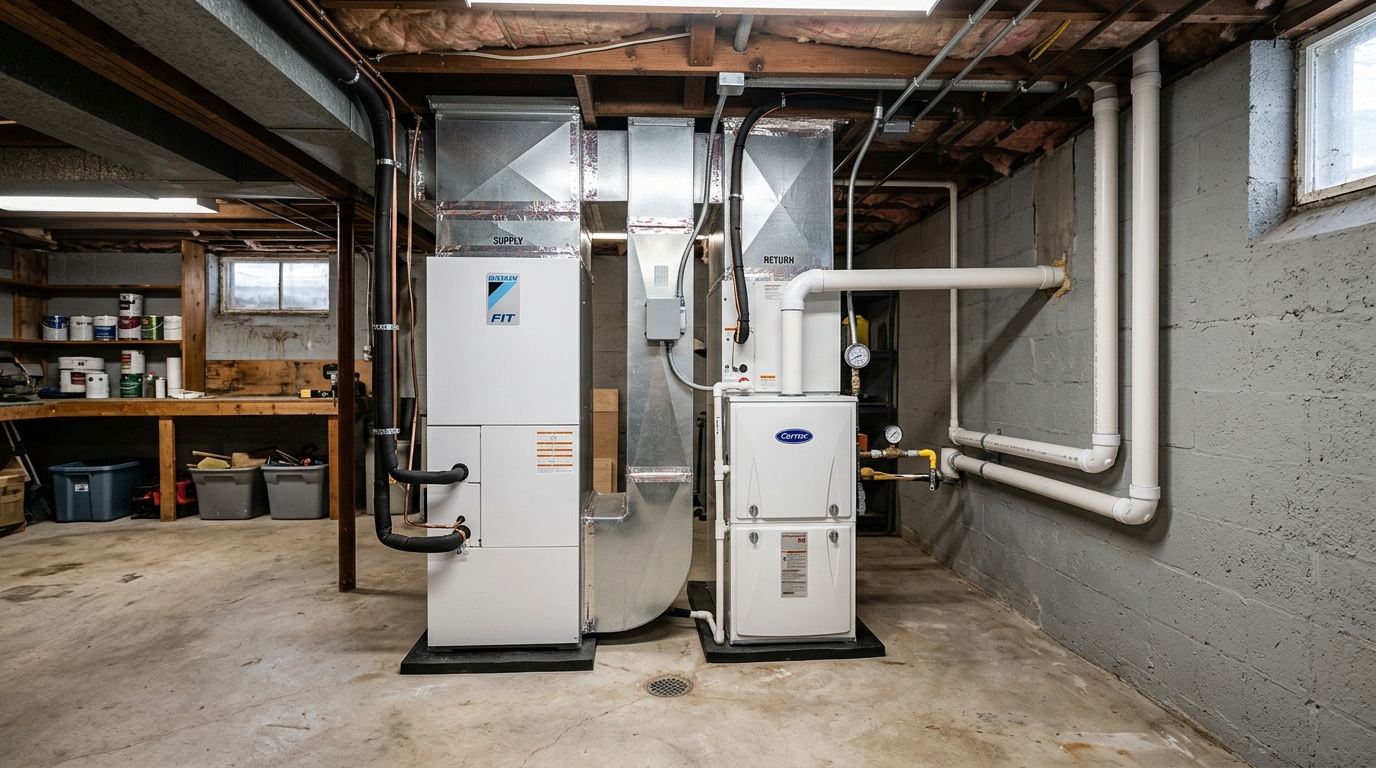
Minnesota is the hardest US state to make heat-pump-only economics work. Annual heating loads run 75-85% of total HVAC energy, and winter design temperatures drop to −15°F to −20°F (Bemidji, Duluth, even Twin Cities suburbs). But the 2026 math has shifted: cold-climate heat pumps now hold COP >1.7 at 0°F, and dual-fuel (heat pump + gas backup) wins on TCO for almost every Minnesota home. Here's what $14K-$28K actually buys in 2026, and the rebate stack that makes dual-fuel the obvious choice.
The 2026 Minnesota furnace baseline
- Gas furnace replacement (95% AFUE): $6,000–$12,000 installed. The MN default.
- High-efficiency gas furnace (98% AFUE modulating): $8,500–$14,500. Best $/BTU for cold-climate operating cost.
- Cold-climate heat pump (ducted CCHP, single system): $14,000–$24,000. Workable in southern MN; risky in Duluth/Bemidji as sole heating source.
- Dual-fuel system (heat pump + gas backup): $17,000–$28,000. The MN sweet spot. Heat pump handles 35-95% of annual heating load; gas furnace fires below ~5-10°F.
- Mini-split ductless (2-3 zones, supplemental): $9,500–$16,500. Common as cooling + shoulder-season heating add-on for homes with older gas furnaces.
For your home's specific scope: Minnesota furnace cost calculator and Minnesota HVAC calculator.
Why dual-fuel wins in Minnesota
Cold-climate heat pumps (Mitsubishi Hyper-Heat, Bosch IDS, Carrier Infinity 18VS, Trane XV20i) maintain 100% rated capacity to 5°F and useful capacity (50-65%) at −13°F. But:
- Operating cost crossover: Heat pump beats gas furnace down to ~15°F outdoor temp in MN. Below that, natural gas is cheaper per delivered BTU.
- Capacity: Even Hyper-Heat units lose ~50% capacity at −15°F. A properly-sized MN home needs supplemental heat for ~80-150 hours/year of severe cold.
- Reliability: 2024-25 Polar Vortex events saw 3-5 day stretches below −20°F. Having a gas backup avoids any heat-pump performance concern AND insurance-related freeze-claim exposure.
Minnesota utility rebates 2026 — stackable with federal
- Xcel Energy (Minneapolis/St. Paul + Western MN): $1,500–$3,000 cold-climate heat-pump rebate + $250 smart thermostat. Highest tier requires SEER2 18+ and HSPF2 9.5+.
- CenterPoint Energy (Minneapolis-area gas): $250-$800 for high-efficiency furnace replacement; $400-$1,200 for dual-fuel pairing.
- Minnesota Power (Duluth/NE MN): $1,000-$2,200 heat-pump rebate.
- Otter Tail Power (Western MN): $800-$1,800.
- Connexus / Wright-Hennepin / Crow Wing Power (rural co-ops): $300-$1,500. Often missed by contractors — bring proof from your utility.
- HEEHRA: MN launched in late 2025. Up to $8,000 POS rebate for income-qualified households (≤80% AMI). MN's HEEHRA prioritizes heat pumps in oil-and-propane homes (~10% of MN households).
Worked example — 2,200 sqft MN home, dual-fuel conversion
Sticker: 3-ton CCHP + new 95% AFUE gas furnace + thermostat = $22,500.
- Xcel rebate (CCHP): −$2,500
- CenterPoint rebate (dual-fuel pairing): −$800
- Federal 25C credit: expired 12/31/2025 — $0
- Federal 25C credit: expired 12/31/2025 — $0
- HEEHRA (income-qualified): −$5,500 (capped at remaining cost)
Net out-of-pocket: $11,100 (standard) → $5,600 (income-qualified). Annual operating cost savings vs. gas-only system: $380-$620/year in moderate winters, $200-$400/year in severe winters. Payback: 8-12 years standard income; 4-6 years income-qualified.
Sizing math — why MN furnaces are usually oversized
Minneapolis design temp: −12°F. A properly-sized MN home with 2x6 walls, R-49 attic, R-23 walls needs roughly 25-30 BTU/sqft heating capacity. Most installed MN furnaces are 50-80% oversized:
- 2,000 sqft home Manual J: ~50,000-60,000 BTU/h. Most installs ship 80,000-100,000 BTU/h units "to be safe."
- Penalty: Short-cycling, uneven room temps, premature heat exchanger failure, 8-15% higher gas bills.
- Fix: 3rd-party Manual J ($300-$500). Pays back in furnace-size savings ($500-$1,500) AND smaller capacity gas line / venting.
Insulation prerequisites for MN heat-pump success
A heat pump in a leaky MN house will not work — the system can't keep up. Before any heat-pump decision:
- Blower door test: $150-$350. MN code calls for ≤3 ACH50 on new homes; most pre-2010 homes test 6-12 ACH50. Air-sealing cuts this in half cheaply.
- Attic insulation to R-60+: ~$2,000-$4,500 for blown-in cellulose in a typical MN home. Minnesota insulation calculator.
- Rim joist + basement insulation: $1,500-$3,500. Critical in MN where 30% of heating loss is below grade.
Related Minnesota reading
- Minnesota furnace cost calculator
- Minnesota HVAC calculator
- Minnesota insulation calculator
- MN + utility rebate lookup
- Comfort upgrade bundle estimator
Sources: Xcel Energy MN 2026 rebate program documentation, CenterPoint Energy MN gas rebate schedule, Minnesota Department of Commerce HEEHRA launch (Q4 2025), MN Energy Code (2020 edition), ACCA Manual J cold-climate methodology, US EIA 2025-26 heating fuel prices (Upper Midwest). Pricing reflects April-June 2026 quotes from a sample of 18 Minnesota HVAC contractors across Minneapolis-St. Paul, Rochester, Duluth, and St. Cloud.
More cost guides for Minnesota
Planning multiple projects? Every other 2026 Minnesota cost guide carries the same state-specific labor and pricing detail.
- Cost GuideBasement Finishing Cost in Minnesota 2026
- Cost GuideBathroom Remodel Cost in Minnesota 2026
- Cost GuideDeck Construction Cost in Minnesota 2026
- Fence InstallationFence Installation Cost in Minnesota 2026 — Frost-Depth (60in), Labor & Material Guide by Metro
- Cost GuideFlooring Installation Cost in Minnesota 2026
- Cost GuideHardscape Installation Cost in Minnesota 2026
- Cost GuideIn-Ground Pool Installation Cost in Minnesota 2026
- InsulationInsulation Cost in Minnesota 2026 — Climate Zone 6/7 R-Value Targets + Xcel Energy Rebates
- Cost GuideKitchen Remodel Cost in Minnesota 2026
- Cost GuideLandscaping Cost in Minnesota 2026
- Cost GuidePainting Cost in Minnesota 2026
- Cost GuideRoof Replacement Cost in Minnesota 2026
- Cost GuideSolar Panels Cost in Minnesota 2026
- Window ReplacementWindow Replacement Cost in Minnesota 2026
Cost by state for this project
State-adjusted ranges with local labor and material multipliers.
Keep reading
Kitchen Remodel
Kitchen Remodel Cost in Washington 2026 — Seattle Metro Premium & PNW Cabinet Sourcing
9 min read
Kitchen Remodel
Kitchen Remodel Cost in Colorado 2026 — Why CO Kitchens Run 10-20% Above National
9 min read
Kitchen Remodel
Kitchen Remodel Cost in Florida 2026 — Miami, Tampa, Orlando, Jacksonville Pricing
9 min read