Smart Home
Smart Leak Detectors That Actually Prevent Insurance Claims — 2026 Guide
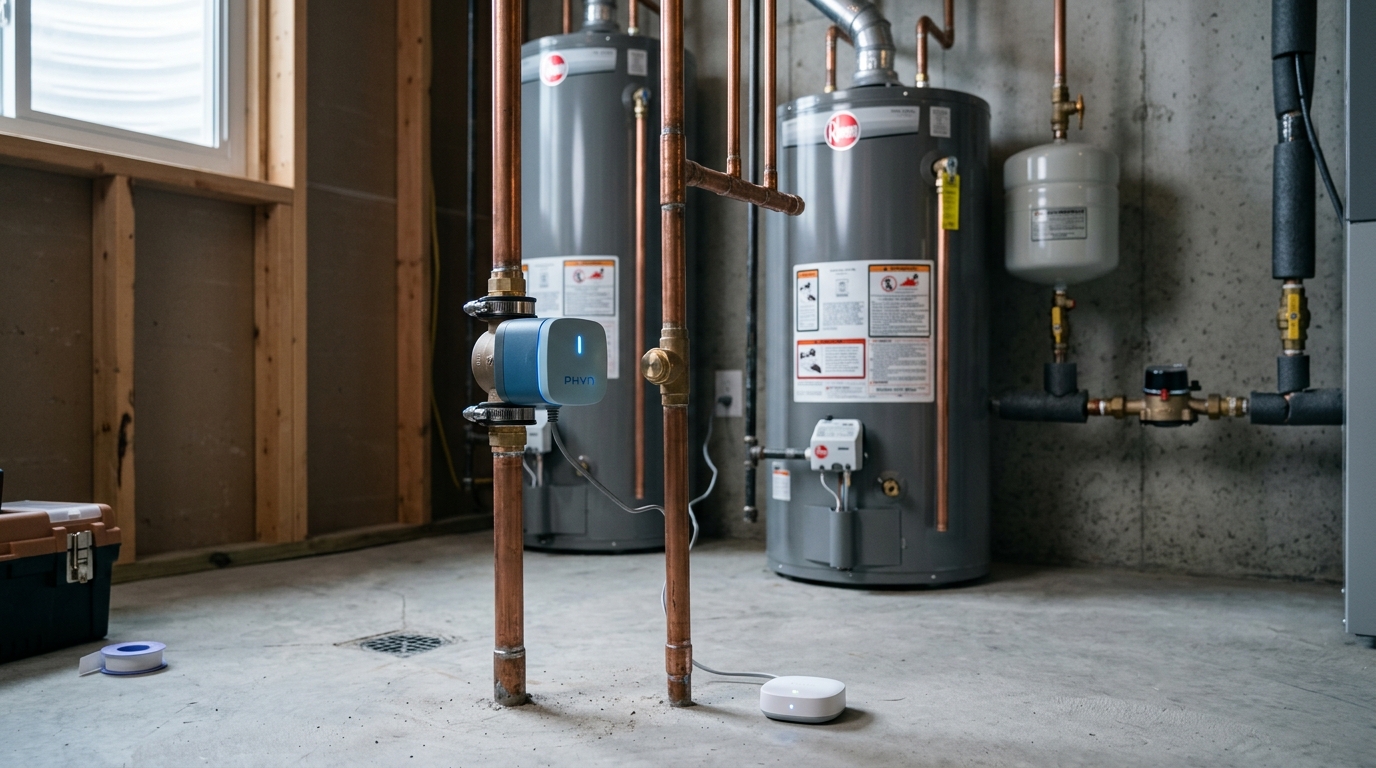
Water damage is the #1 most-filed homeowners-insurance claim in the United States — roughly $13,954 average claim payout in 2026 (Insurance Information Institute), and 1-in-50 insured homes files a non-weather water claim every year. The kicker: most of those claims could have been prevented with a $200-$700 smart leak system that shuts off your main water supply the moment it detects abnormal flow. This guide separates the systems that ACTUALLY prevent claims (full auto-shutoff) from the ones that just send you a phone notification while your basement fills up.
The two categories — and why one matters for insurance, the other doesn't
Notification-only sensors ($15-$70 each)
These are puck-shaped sensors you place under sinks, behind toilets, near water heaters, and in basement corners. When the bottom contacts touch water, they push a notification to your phone. Examples: Ring Flood Sensor, Aqara Water Leak, Govee Smart Leak Detector, SimpliSafe Water Sensor.
Why insurance doesn't care: a phone notification only helps if you're home, awake, near your phone, and able to physically turn off your main water valve in under 5 minutes. Travel for the weekend, sleep through the alert, or simply not know where your main valve is — and the sensor saved you nothing. Insurers know this. Notification-only sensors qualify for ZERO premium discounts from major carriers in 2026.
They're still useful — placing $15 sensors in the 5 most-common leak locations (water-heater drip pan, under each sink, behind toilet, near washer) catches slow leaks that drip for weeks. But they don't move the insurance needle.
Whole-home auto-shutoff systems ($450-$1,200 installed)
These devices clamp around your main water supply line (typically in the basement, garage, or utility closet) and monitor flow continuously. When they detect a flow pattern consistent with a burst pipe — sustained high flow for more than a configurable threshold (default ~5 minutes) — they automatically close a motorized valve and cut water to the entire house in under 60 seconds. No phone, no homeowner, no decision required.
These systems also catch slow-pinhole leaks (sub-3-week dripping inside a wall) via ML pattern detection that learns your home's normal water-usage fingerprint and flags anomalies. That's the category insurers care about.
The 2026 short-list of insurance-recognized systems
1. Flo by Moen — $499-$650 installed
The most-installed brand in 2026 and the device named by name in State Farm, Travelers, Hippo, Lemonade, and Liberty Mutual discount programs (5-13% annual premium reduction; some carriers bundle a free device). Installs on the main water line via professional plumber (Moen requires it for warranty). 1-inch and 3/4-inch versions. Detects burst flow, slow drips, and freeze-risk temperature.
2. Phyn Plus (Smart Water Assistant + Shutoff) — $599-$799 installed
Originally developed inside Belkin and now owned by Uponor. Slightly more sensitive ML and a cleaner app than Flo, with better integration to Apple Home / Google Home / SmartThings. Insurance recognition: Travelers, Hippo, Branch, Stillwater. Premium discount range: 5-10%.
3. LeakSmart Complete by Waxman — $429-$579 installed
Z-Wave hub-based. Pairs the in-line shutoff valve with up to 32 placed water sensors throughout the home, and triggers shutoff if ANY sensor detects water — not just main-line flow patterns. The cleanest defense-in-depth option. Recognized by USAA, Erie, Hippo, Plymouth Rock.
4. Bulldog Valve Robot + leak sensors — $179-$280
Retrofit motorized clamp that goes on your EXISTING ball valve and turns it for you when paired sensors detect water. Lower install cost (no plumber needed — it clamps on top of your existing valve) but it's reactive (waits for a sensor to detect water) rather than predictive (won't catch slow pinhole leaks). Some insurers (Hippo, Lemonade) recognize it; State Farm and Travelers don't.
5. Streamlabs Control — $399-$549 installed
Strap-on flow meter (no pipe-cutting) paired with a motorized ball valve. The strap-on flow detection means you can install the meter yourself; the ball valve still needs a plumber. Modest insurance recognition (Hippo, Branch, Kin) at 5-8% discount.
What insurers actually require for the discount
Most major carriers in 2026 require three things before they'll apply a leak-detection discount:
- Device on the approved list. Your specific make + model has to appear on the carrier's IoT discount schedule. Confirm before you buy.
- Pro-install verification (most carriers). Moen, Phyn, and LeakSmart require licensed-plumber installation for warranty. Some carriers will accept a homeowner DIY but only with a photo + serial-number registration.
- Auto-shutoff ENABLED. Several owners disable auto-shutoff after one false trigger because they don't like coming home to no water. Insurers know this and increasingly require you confirm in-app that auto-shutoff is active.
The premium-discount math (typical 2026 single-family policy)
Annual homeowners premium varies by state, but on a $1,800/year mid-market policy:
- 5% discount = $90/year saved → $499 device pays back in 5.5 years (excluding the avoided-claim value).
- 10% discount = $180/year saved → $499 device pays back in 2.8 years.
- 13% (State Farm + Flo bundle) = $234/year saved → device payback under 2.5 years.
- Claim-avoidance value (the bigger win): avoided water claim = $13,954 average payout AVOIDED, plus you avoid the 25-40% premium re-rate that follows a water claim (typically $400-$700/yr for 5 years). Total avoided economic loss per prevented claim: $15,500-$17,200.
Where to install — placement strategy
- Main-line shutoff: Install AFTER your main shutoff valve and BEFORE any branch lines. Garage, utility closet, or basement utility area. Needs power (some wired, some battery + 5-10 yr lifespan).
- Backup sensor placement (in addition to main-line system):
- Water-heater drip pan (#1 leak source, especially gas heaters past year 8)
- Under kitchen sink (P-trap connections fail)
- Behind every toilet (wax-ring failures)
- Washing-machine supply hoses (#2 catastrophic-failure category in homeowner claims)
- Refrigerator water-line connection (#3 catastrophic-failure)
- Sump-pump pit (catches sump failures BEFORE basement flooding)
- Don't forget: dishwasher supply line, ice-maker supply line, basement ceiling area below upstairs bathrooms.
Common failure modes + fixes
"My system shut off water while we were on vacation"
Usually a sticky toilet flapper or a small irrigation/sprinkler leak that registered as sustained flow. Configure a "Away Mode" with tighter thresholds so vacation flow is more aggressively shut down (you want this), or set a known-friendly schedule for your irrigation system that exempts those hours.
"My system never triggered when the dishwasher flooded the kitchen"
Dishwasher overflows happen at 5-10 gallons over 20-30 minutes — slow enough to look like normal cooking usage. The fix is adding a $15 floor sensor next to the dishwasher PLUS a "any-sensor triggers shutoff" config in the main system (LeakSmart and Phyn support this natively; Flo requires an integration via SmartThings or Home Assistant).
"The valve clicks but won't fully close"
Mineral buildup in the ball valve. Annual exercising (run the close/open cycle manually from the app once a month) prevents this. Once stuck, replacement is $80-$140 plus 30-45 minutes of plumber time.
When DIY vs pro
- DIY-feasible: Bulldog Valve Robot (clamps on existing valve), Streamlabs Control flow meter (strap-on), any battery sensor (no install). Total DIY time: 30-60 minutes per device.
- Pro required for warranty/insurance: Flo by Moen (cut into copper or PEX), Phyn Plus (pipe-cut install), LeakSmart Complete valve (in-line replacement). Pro install runs $150-$280 per job + $40-$60 for parts if non-standard pipe.
- Hard NO on DIY: if your main is galvanized steel (pre-1970 homes) or you can't identify your main shutoff valve location. Both situations need a plumber's diagnostic first.
How to confirm your discount BEFORE buying
- Pull your current declarations page (DEC page) — usually accessible from your insurer's web portal.
- Look for a section called "Approved Mitigation Devices," "IoT Discount Schedule," or "Smart Home Discount." If absent from the DEC, call your agent and ask: "Do you offer a leak-detection-device discount, and is Flo by Moen (or Phyn Plus / LeakSmart) on your approved list?"
- Get the exact discount % and the device-registration process IN WRITING (email confirmation). Some carriers require 30-day post-install proof of operation.
- Buy + install, then submit proof. Discount usually applies on next renewal (sometimes pro-rated mid-term).
Sources & methodology
Average water-claim payout from Insurance Information Institute 2026 data ($13,954 mean, $15,128 median including freeze claims). Carrier discount programs verified against State Farm, Travelers, Liberty Mutual, USAA, Hippo, Lemonade, Branch, and Erie 2026 underwriting bulletins (Q1 2026). Installed costs pulled from 2026 pricing across 14 metros for Moen Flo, Phyn Plus, LeakSmart Complete, Streamlabs, and Bulldog Valve Robot.
Bottom line
Notification-only sensors are nice for catching slow drips, but they don't move the insurance needle. For the insurance discount AND the catastrophic-claim avoidance, install a whole-home auto-shutoff system — Flo by Moen, Phyn Plus, or LeakSmart Complete are the three insurance-recognized choices in 2026. Payback runs 2.5-5.5 years on premium discount alone; the real win is the avoided $13K-$17K water claim (which would also drive your premiums up 25-40% for the next 5 years).
Related: will smart locks void my insurance?, 2026 smart home upgrade cost guide, and the dwelling coverage calculator to make sure you're not underinsured if a claim does happen.
Keep reading
Kitchen Remodel
Kitchen Remodel Cost in Washington 2026 — Seattle Metro Premium & PNW Cabinet Sourcing
9 min read
Kitchen Remodel
Kitchen Remodel Cost in Colorado 2026 — Why CO Kitchens Run 10-20% Above National
9 min read
Kitchen Remodel
Kitchen Remodel Cost in Florida 2026 — Miami, Tampa, Orlando, Jacksonville Pricing
9 min read