Smart Home
Will Smart Locks Void My Homeowners Insurance? (2026 Honest Answer)
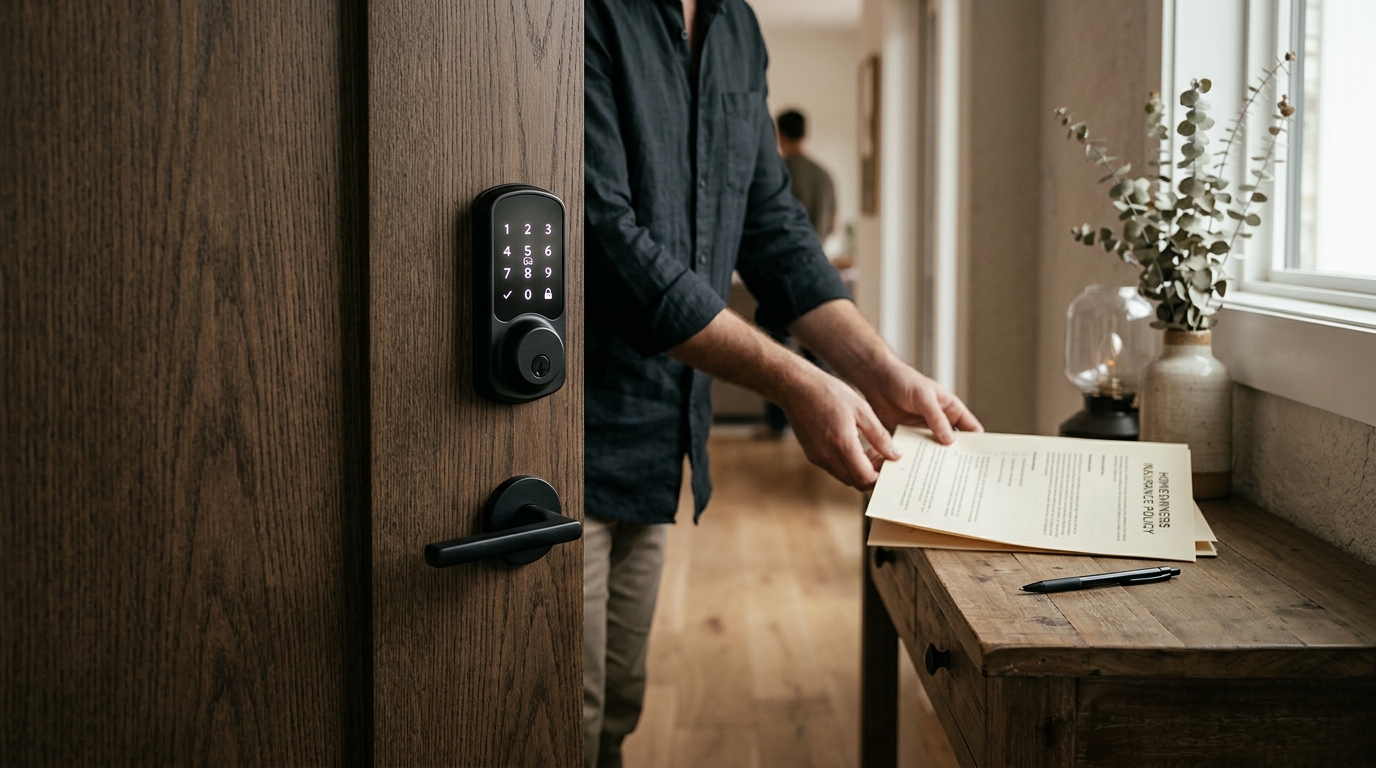
Short answer: no — smart locks do not void homeowners insurance in 2026 with any mainstream U.S. carrier (State Farm, Allstate, USAA, Liberty Mutual, Travelers, Farmers, Progressive, Nationwide, Geico, Erie). In fact, several carriers offer 1-5% premium discounts for properly-installed smart locks as part of broader "smart home" or "protective device" credits. But there ARE three narrow scenarios where you can create a coverage problem — and those are easy to avoid if you know what to watch for.
The short version
- Standard installs: No insurance impact, period. Same coverage as a regular deadbolt.
- Properly-installed smart locks + monitored security: Eligible for 1-5% premium discount with most major carriers.
- Three risk scenarios: (1) Lock removes existing physical key access entirely, (2) Lock fails ANSI grading required by policy, (3) You don't disclose the smart-home setup at renewal. Details below.
What insurers actually require (the 2026 reality)
Standard homeowners policies require that your entry doors have "adequate locking mechanisms." Almost every state's insurance code defines "adequate" as one of:
- An ANSI/BHMA Grade 2 or better deadbolt (the residential standard)
- A lock with a 1-inch throw bolt minimum
- A lock manufactured by a UL-listed manufacturer
Most smart locks from established brands (Schlage Encode, Yale Assure 2, August Wi-Fi, Lockly Vision, Kwikset Halo) meet ANSI Grade 2 standards and ship with the proper UL listing. They are functionally equivalent to a standard deadbolt PLUS smart functionality — your insurer doesn't care which one you have.
Smart-lock discounts: 1-5% off your premium
Several major carriers offer "protective device" or "smart home" credits that include smart locks:
- State Farm: 1-3% smart-home device credit (smart lock + monitored alarm + smart smoke)
- Allstate: Up to 5% with "Smart Home" bundle including smart lock + monitored security
- USAA: 2-5% protective-device discount (smart lock counts as one of 3+ qualifying devices)
- Liberty Mutual: Smart lock alone doesn't qualify; full security package does (2-3%)
- Travelers: 5% IntelliDrive Smart Home discount (smart lock + at least 2 other devices)
- Farmers: Smart Home Discount up to 5% for qualifying device bundles
- Hippo, Lemonade: 5-15% discount for smart-home enabled homes — these "insurtech" carriers actively reward smart devices and often partner with manufacturers
The pattern: Smart locks rarely qualify for a discount on their own — they typically need to be part of a 2-3 device bundle (smart lock + smart smoke detector + monitored security, or smart lock + leak detector + video doorbell). Call your carrier and ask: "What smart-home devices do I need to qualify for the protective-device discount?"
The 3 narrow scenarios that CAN create coverage issues
1. Removing all physical key access entirely
Some smart locks (the August Wi-Fi Smart Lock 4th gen, Aqara U200) install over the EXISTING deadbolt and keep the physical keyway. Others (Schlage Encode Smart Wi-Fi, some Lockly models) replace the deadbolt entirely. A subset of REPLACEMENT models can be configured with NO physical key — keypad/app/biometric only.
If you go fully key-less, two issues arise:
- Emergency access for first responders: Fire and EMS may need to force the door if the battery dies. Damage from forced entry is typically covered, but only if you can prove the lock was "operable" at the time — which is hard if no one can demonstrate it now.
- Lockout coverage exclusion: Some policies cover lockout costs ($75-$150 for a locksmith) but explicitly exclude "battery-dependent or electronic locks" from lockout coverage. Read your policy's "additional living expenses" section.
Fix: Pick a smart lock with a physical key backup (every Schlage, every Yale, every Kwikset), or maintain a hidden mechanical key in a key safe ($25 on Amazon) and document it for first responders.
2. Sub-grade hardware
Cheap unbranded smart locks sold on Amazon for $50-$80 often DON'T meet ANSI Grade 2 standards. If you install one and your home is burglarized through the front door, your insurer's investigator may classify the lock as "non-compliant" and reduce your theft payout by 10-25%, citing "negligent failure to maintain adequate locking."
Fix: Pick a name-brand smart lock (Schlage, Yale, August, Kwikset, Lockly, Eufy, Aqara, Level) — all of them ship ANSI Grade 2 or better. Look for "ANSI Grade 2" or "ANSI/BHMA 156.36" on the product page or box.
3. Failure to disclose at policy renewal
Most policies have a "material change to the premises" clause. Adding smart-home devices doesn't typically rise to that level — but if you make significant smart-home upgrades (whole-home security system, AI cameras, dedicated automation server room), some carriers want to know.
Fix: When you renew your policy, simply tell your agent "I added smart locks, a video doorbell, and a Nest thermostat." Three reasons this is worth doing: (1) it activates any discount you're eligible for, (2) it pre-empts any "non-disclosure" claim if something goes wrong, (3) it can lower your deductible structure for theft/break-in claims with several insurtech carriers.
What about smart locks on rentals?
Renters' insurance is even more accommodating — smart locks have essentially zero insurance impact for renters because the landlord's policy covers the structural lock + door. Your renters' policy covers contents. Adding a smart lock with the landlord's permission has no insurance downside.
Important: Get written permission from your landlord BEFORE installing a smart lock — this is a landlord/tenant issue, not an insurance issue. Some leases explicitly prohibit modifying door hardware.
The 5-minute insurance compliance checklist
- Pick a name-brand smart lock with ANSI Grade 2 rating.
- Pick a model with a physical key backup (or set up an external key safe for emergency access).
- Install per the manufacturer's instructions or hire a pro. Don't drill new holes that weaken the door frame.
- Test the lock from inside AND outside. Confirm the deadbolt fully engages (1" throw minimum).
- Email your insurance agent: "I installed a [brand + model] smart deadbolt with physical key backup on my front door. Are there any policy implications or discounts I should know about?"
That's it. 95% of installs need nothing beyond Step 1-3, and Step 5 either earns you a discount or confirms zero policy impact.
The bottom-line legal nuance
Insurance policies define "burglary" in a specific way: it requires "visible signs of forced entry." If a burglar somehow defeats a smart lock electronically (lock-bumping, replay attack, side-channel exploit — all extremely rare on properly-implemented modern smart locks) without visible forced entry, claims can get complicated. This is the same legal issue that existed with all electronic locks for decades — it's not specific to "smart" locks.
Practical takeaway: smart locks from name brands are no more vulnerable to this scenario than mechanical locks. Burglars overwhelmingly defeat doors via prybar, kicking, or window entry — not via electronic manipulation.
Sources & methodology
Carrier-specific discount data sourced from State Farm, Allstate, USAA, Liberty Mutual, Travelers, Farmers, Hippo, and Lemonade 2026 policy schedules. ANSI/BHMA hardware grading guidance from the Builders Hardware Manufacturers Association. Insurance code definitions cross-referenced against the NAIC Model Homeowners Insurance Policy and 2025-2026 state-level insurance regulations.
Bottom line
Smart locks don't void homeowners insurance. They often save 1-5% on your premium when bundled with 2-3 other smart-home devices. The three failure modes — going fully key-less, installing sub-grade hardware, and failing to disclose at renewal — are all easy to avoid. Pick a name-brand smart lock with a physical key backup, test it both sides, and email your agent at renewal. That covers 99% of homeowners.
Curious which other smart-home devices stack with the discount? Smart Home Upgrade Cost Guide 2026.
Planning to install a smart doorbell next? DIY smart doorbell install guide.
Planning to sell soon? Does smart home tech increase home value?