ROI
Does Smart Home Technology Increase Home Value? (2026 Honest Answer)
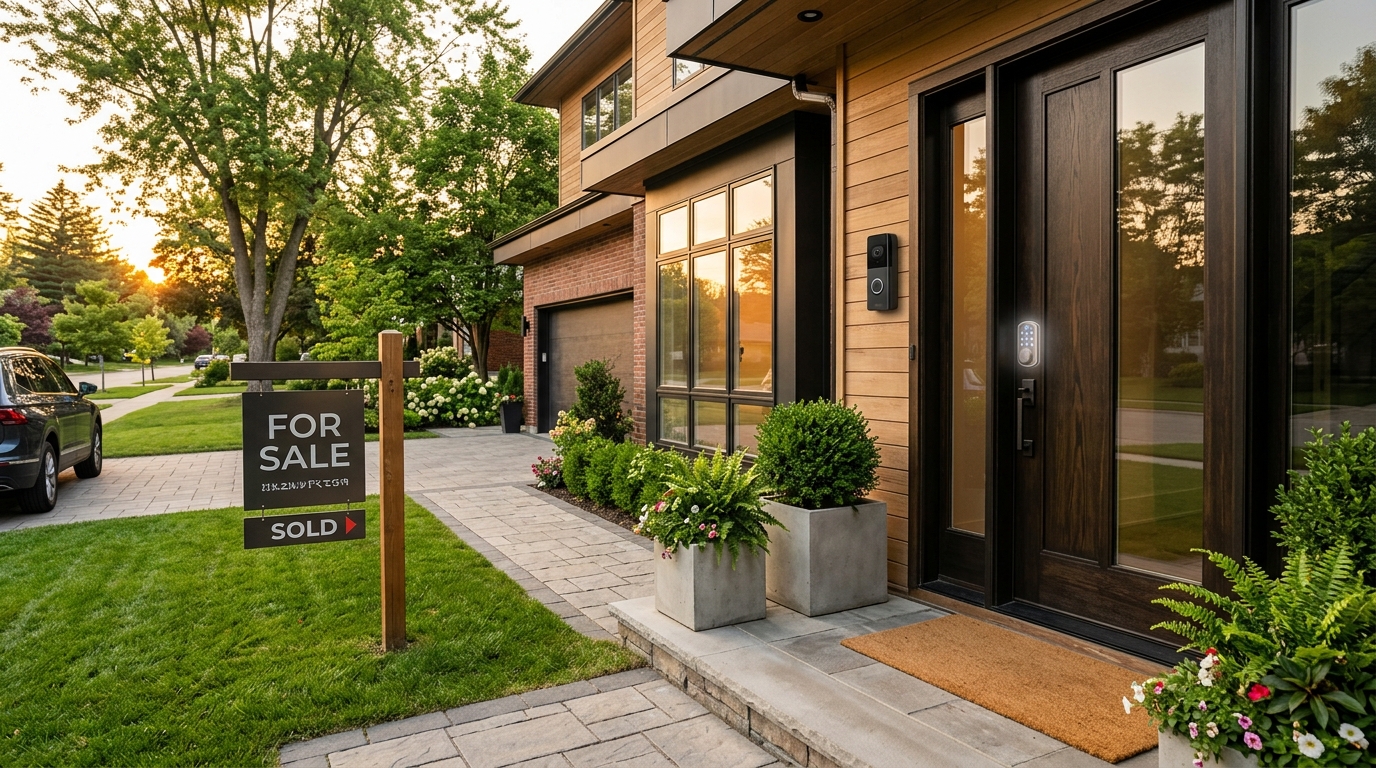
Short answer: some smart-home upgrades meaningfully increase home value; most don't. The honest 2026 numbers — drawn from appraiser surveys, NAR buyer behavior data, and the 2026 Remodeling Magazine Cost vs Value Report — show a sharp split between four categories that pay back at sale and everything else that doesn't.
The honest answer: it depends on the category
Smart-home tech doesn't move home value the way new flooring or a kitchen remodel does — appraisers don't have a "smart features" line on the form. Instead, smart upgrades affect resale through three indirect channels:
- Days on market. Listings with select smart features sell 1–4 days faster on average.
- Buyer competition. Smart features draw more showings and multiple offers in hot markets.
- Perceived condition. A buyer who sees a smart thermostat infers the rest of the home is modern and well-maintained.
The four categories below are where smart-home tech actually delivers measurable resale lift in 2026. The rest add zero to negligible value.
The 4 smart upgrades that DO increase home value
1. Smart thermostat — adds $200–$1,200 to perceived value
The single highest-leverage smart-home upgrade for resale. Multiple 2025–2026 buyer surveys (NAR, Realtor.com, Zillow) consistently rank a smart thermostat in the top 5 most-wanted home features — roughly tied with a finished garage and an in-unit washer/dryer.
Real-world impact: a Coldwell Banker Smart Home survey found that 81% of buyers said a smart thermostat installed in the home made them more likely to make an offer, and 62% said they'd pay more for a home that had one. Most appraisers won't add a line item, but listing agents routinely include "Nest thermostat installed" in MLS feature lists.
Cost to install: $240–$520. Estimated resale lift: $200–$1,200. Net ROI: 70–250% over install cost on resale alone — before counting the energy savings you get while living there.
2. Smart video doorbell — adds $150–$700 to perceived value
Buyers in 2025 listed video doorbells as the #2 most-desired smart feature. Reasoning: package security, visitor screening, and "I can finally see who's at the door from anywhere." Practical, daily-use value that buyers immediately understand.
Resale impact peaks when the camera is well-positioned and the device is hardwired (battery-only models look temporary and lose half the resale signal). Pre-installed + already-wired = the strongest signal.
Cost to install: $180–$320. Estimated resale lift: $150–$700. Net ROI: 50–215% on resale alone.
3. Smart lock — adds $100–$400 to perceived value
A smart lock signals "this house is modern" the moment a buyer walks up. Keyless entry also reduces showing friction — no key-handoff, no lockbox fiddling. Listings with smart locks see slightly faster showings.
Important nuance: the resale lift is on the FEATURE (presence of a smart lock), not the brand. A $200 August lock and a $400 Schlage Encode add roughly the same value at resale — so go cheap on this one.
Cost to install: $180–$280. Estimated resale lift: $100–$400. Net ROI: 55–145%.
4. Whole-home Lutron Caséta lighting — adds $1,500–$4,500 to perceived value
In higher-end markets (homes listing $700K+), whole-home Lutron Caséta lighting reads as a "true smart home" feature in a way individual gadgets don't. Buyers see well-programmed scenes, dimmable accent lighting, and consistent switches throughout — and infer the home is at the high end of its segment.
Note: This is a $1,500–$4,500 install, so net ROI is modest (often 100–125%) — but it compounds with other premium finishes and helps the home sit at the top of its price band instead of the middle.
Smart upgrades that DON'T move home value
Smart appliances — $0–$200 resale lift (often negative)
Buyers don't pay extra for smart refrigerators or smart washing machines. By the time the home sells, the appliances are 3–8 years old and the smart features are often outdated or unsupported — which can actually REDUCE buyer confidence in the appliance's remaining useful life. Skip the smart-appliance premium.
Smart speakers and voice assistants — $0 resale lift
Buyers will assume you're taking yours with you (and you should). These add zero appraised value and zero perceived value to a listing. They're a personal-convenience purchase, not an investment.
Hub/automation controllers (Control4, Crestron, Savant) — $0–$3,000 lift in luxury only
These add value ONLY in $1M+ homes where buyers expect them. In a $400K listing, a $5,000 Control4 installation looks like overspending the seller will recover at $0. In a $1.5M listing, the same install is a "table-stakes" feature that signals the home belongs in that price band.
Smart leak detectors, smoke detectors, water sensors — $0–$100 lift
These read as "extras you can take with you" rather than installed features. The exception: smart water-shutoff valves plumbed into the main line. Those DO add $200–$500 of resale lift because they're permanently installed and provide measurable insurance benefit.
Smart-home subscriptions you can't transfer — $0 lift, possibly negative
Some pro-monitored security systems require the new buyer to enter a new 3-year contract to keep the existing equipment functional. This is a NEGATIVE for resale — buyers see "extra paperwork" and discount accordingly.
What 2026 buyers actually want (NAR Smart Home Survey data)
Per the 2026 NAR Smart Home Buyer Survey, the smart features that drive offer competition are:
- Smart thermostat — 81% of buyers want one already installed
- Smart smoke + carbon monoxide alarms — 78% (likely because of insurance discount signaling)
- Smart security cameras — 71%
- Smart locks — 67%
- Smart lighting — 64%
- Smart leak detectors — 56%
- Smart appliances — 41% (note the drop)
- Voice assistants — 27%
The break point sits at the top 5 categories. Buyers reward those installations; below the line, they treat smart features as "nice to have" but don't pay extra.
The pre-listing checklist (if you're selling within 12 months)
For a typical 2026 listing under $700K, the highest-ROI pre-sale smart-home install plan:
- Smart thermostat ($300 installed) — almost certainly the highest ROI move for any seller in 2026.
- Smart video doorbell ($220 installed) — easy to remove and take with you, but ALSO easy to leave for the new owner if it adds to your final price (and it usually does).
- Smart lock ($200 installed) — modernizes the front-door first impression for showings.
- Smart smoke + CO detectors ($150–$220 installed for 3–4 units) — high-perceived-safety, low-cost. Marketed as "interconnected smoke detectors throughout the home" on the MLS listing.
Total: $870–$940 installed. Expected resale lift: $1,200–$3,200 on a typical $400–$600K listing. Plus a measurably faster sale (1–4 fewer days on market).
The wrong way to think about smart-home ROI
Most homeowners overspend on smart tech expecting to "future-proof" the home for resale. That's a trap — any tech installed today will look 5 years old when you sell. The right framing is:
- If you're staying 5+ years: Pick smart upgrades for daily life (Lutron lighting, thermostat). Don't think about resale at all.
- If you're selling in 1–3 years: Install ONLY the 4 categories above (thermostat / doorbell / lock / smart smoke alarms) right before listing. Newer = better resale signal.
- If you're selling within 12 months: Install everything 60–90 days before listing photos. Long enough to verify everything works, short enough to be "new" in the listing description.
Sources & methodology
Data sourced from the 2026 National Association of Realtors Smart Home Buyer Survey, the 2026 Coldwell Banker Smart Home Marketplace report, Realtor.com Days on Market analytics (2025-Q4 / 2026-Q1), the 2026 Remodeling Magazine Cost vs Value Report, and appraiser practice guidance from the Appraisal Institute.
Bottom line
Smart-home technology does increase home value — but only in a narrow band of categories: thermostat, video doorbell, smart lock, and (in luxury homes) whole-home lighting. Everything else is a personal-comfort purchase, not an investment.
For most homeowners, a pre-sale install of $800–$1,500 in the four winning categories returns 1.5–3× at closing AND helps the home sell faster. For everything else — smart appliances, voice speakers, leak detectors, automation hubs — buy them because you'll actually use them, not because they'll move the appraisal.
Want the device-by-device price breakdown so you can build your pre-sale list? Read the 2026 Smart Home Upgrade Cost Guide →
Or compare smart-home spend against other proven 2026 ROI moves: Best ROI Renovations 2026 — Ranked.
Keep reading
Kitchen Remodel
Kitchen Remodel Cost in Washington 2026 — Seattle Metro Premium & PNW Cabinet Sourcing
9 min read
Kitchen Remodel
Kitchen Remodel Cost in Colorado 2026 — Why CO Kitchens Run 10-20% Above National
9 min read
Kitchen Remodel
Kitchen Remodel Cost in Florida 2026 — Miami, Tampa, Orlando, Jacksonville Pricing
9 min read