Furnace
Oil-to-Heat-Pump Conversion — 2026 Cost Guide + Full Incentive Stack ($2K 25C + $8K HEEHRA)
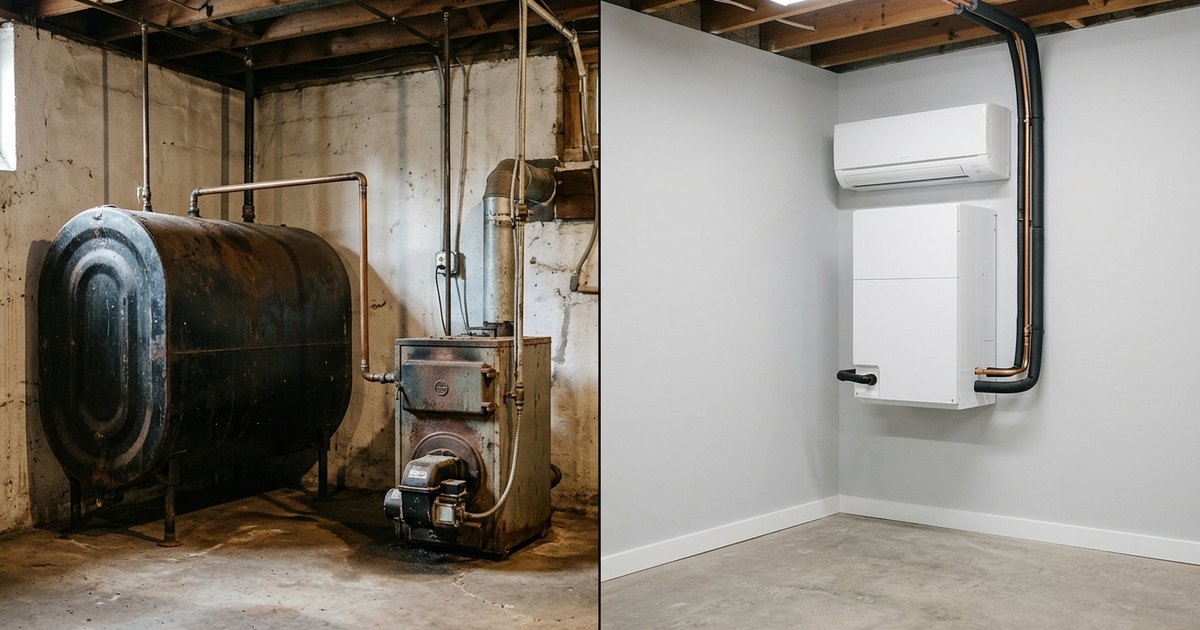
The oil-to-heat-pump conversion is the single highest-return HVAC project a Northeast homeowner can do in 2026. With oil prices structurally above $3.80/gallon, federal incentives at their post-IRA peak, and HEEHRA point-of-sale rebates flowing through state energy offices, the conversion now offsets 35-55% of the cost in incentives and pays the rest back in 4-8 years of operating-cost savings. Here is the full cost, incentive stack, and breakeven math for the 5.6 million US homes still heating with oil.
2026 installed-cost — typical 3-ton conversion
| Cost component | Low end | Typical (2,000 sq ft) | High end |
|---|---|---|---|
| Cold-climate heat pump (equipment) | $6,500 | $8,800 | $11,200 |
| Install labor + refrigerant lineset | $4,200 | $5,400 | $7,200 |
| Electrical service upgrade (200A panel) | $1,400 | $2,400 | $3,600 |
| Dedicated 240V circuit + disconnect | $600 | $900 | $1,400 |
| Oil tank removal (above-ground) | $800 | $1,500 | $2,400 |
| Oil tank removal (buried, if applicable) | $1,800 | $2,800 | $4,500+ |
| Ductwork retrofit OR ductless head install | $1,500 | $3,200 | $6,800 |
| Permit + final inspection | $250 | $400 | $650 |
| Total installed (above-ground tank) | $15,250 | $22,600 | $33,250 |
Buried-tank homes add $1,000-$2,100 to the high end. Homes with a recently-installed (5 years or newer) 200A panel and existing ductwork land near the low end. The "typical" column is calibrated to a 2,000 sq ft Cape or split-level with a 1980s-era oil boiler, above-ground tank, and either no central duct or partial ductwork needing supplementation.
The full 2026 incentive stack
Oil-to-heat-pump is the single best-stacked project in the federal residential energy code because it qualifies for the heat-pump-specific incentives AND the electrical-upgrade incentives in the same tax year. Here is the math:
- Federal 25C tax credit — heat pump: 30% of equipment + install, capped at $2,000 per year. Claim on IRS Form 5695, line for "Energy efficient home improvement credit." Carryforward rules updated in 2026 — unused credit now carries 3 years.
- Federal 25C tax credit — electrical panel upgrade: Up to $600 separately when the panel upgrade enables the heat pump. Same form, separate line.
- HEEHRA (Home Electrification and Appliance Rebate) — heat pump: Up to $8,000 for households under 150% Area Median Income. Point-of-sale (your installer applies it as a discount on the invoice). Currently live in MA, NY, ME, VT, NH, RI, CT in pilot or full-rollout form as of February 2026.
- HEEHRA — electrical panel: Up to $4,000 for panel + breaker work, also point-of-sale. Stacks with the heat-pump rebate up to $14,000 total HEEHRA limit per household.
- State income-tax credits: NY (NY-State Clean Heat), MA (Mass Save), VT (Efficiency Vermont) layer an additional $1,000-$3,500 depending on equipment and household income.
- Utility-level rebates: National Grid, Eversource, NYSEG, ConEd, Central Hudson all run heat-pump rebate programs in 2026 — typically $1,000-$3,000 per outdoor unit.
- Oil tank removal grants: ME and VT both run state programs (~$500-$1,500) for proper above-ground tank decommissioning. Buried-tank remediation programs are state-specific and means-tested.
Net cost after the full stack
| Household income tier | Gross install | Stack applied | Net out of pocket |
|---|---|---|---|
| Under 80% AMI (full HEEHRA) | $22,600 | $12,000 HEEHRA + $2,000 25C + $1,500 utility + $500 tank = $16,000 | $6,600 |
| 80-150% AMI (partial HEEHRA) | $22,600 | $6,000 HEEHRA + $2,000 25C + $1,500 utility + $500 tank = $10,000 | $12,600 |
| Above 150% AMI (no HEEHRA) | $22,600 | $2,000 25C + $2,500 utility + $1,500 state credit = $6,000 | $16,600 |
Operating cost — the part that funds the breakeven
- Pre-conversion (oil): A 2,000 sq ft New England home burns 650-900 gallons of oil per winter. At $3.80-$4.40/gallon, that is $2,500-$3,900/year in heating cost.
- Post-conversion (heat pump): The same home runs $950-$1,400/year in electricity for heating (assuming a cold-climate inverter unit and reasonable envelope).
- Annual operating savings: $1,500-$2,500/year, every year, for the 18-22 year life of the heat pump.
Breakeven timeline
| Income tier | Net out-of-pocket | Annual operating savings | Years to breakeven |
|---|---|---|---|
| Under 80% AMI | $6,600 | $2,000 | 3.3 years |
| 80-150% AMI | $12,600 | $2,000 | 6.3 years |
| Above 150% AMI | $16,600 | $2,000 | 8.3 years |
When NOT to convert
- You're selling in under 4 years. Even the highest-stack household won't fully recover the conversion in 3 years. Sellers planning a move should price the conversion into the listing instead.
- Your oil system is under 10 years old. Wait for end-of-life. Replacing a working modern oil boiler before its 20-year service life is wasteful even with the incentive stack.
- You have buried-tank contamination. If the soil under a leaking buried tank requires remediation, that cost can run $8,000-$45,000 — and it's not eligible for the heat-pump incentive stack. Address the contamination first, then plan the conversion separately.
- Your home has <R-19 attic insulation. Insulate first. A heat pump in a leaky envelope runs the strip heat too often and operating-cost savings collapse. The $1,200 25C insulation credit can be claimed the year before the conversion.
Oil-to-heat-pump conversion FAQs
Can I keep my oil boiler as backup? Yes — this is the "dual-fuel" path. The heat pump handles 90% of the heating season; the oil boiler runs only below 5-10°F. You lose the HEEHRA rebate (HEEHRA requires removing the oil equipment) but keep the resilience. Net cost lands about $4,000 higher.
Does HEEHRA require a means test? Yes. Income must be under 150% of Area Median Income for your county. The state energy office verifies income before issuing the rebate. Documentation: 2 most recent pay stubs or last year's tax return.
Will my installer apply HEEHRA correctly? Only contractors enrolled in your state's HEEHRA program can submit the rebate. Ask for proof of enrollment before signing. Several Northeast states publish enrolled-contractor lists.
What about the existing ductwork — is it sized right? Most oil-boiler homes have radiator or hydronic distribution and no ductwork, requiring either ductless mini-splits OR new duct installation. Some have a "split" system where central AC ducts exist alongside the oil boiler — those can re-use the ducts but need a manual J calc to verify CFM.
Get a state-adjusted estimate. Oil-to-heat-pump install cost varies by ~40% between cheap and expensive Northeast states. Run our furnace cost calculator with the "oil-to-heat-pump conversion" project type for state-adjusted pricing, the insulation calculator to right-size envelope work before conversion, or read the heat pump vs furnace cost comparison if you're still on gas instead of oil.