HVAC
Heat Pump vs Furnace — 2026 Cost Comparison + 10-Year Total-Cost-of-Ownership Math
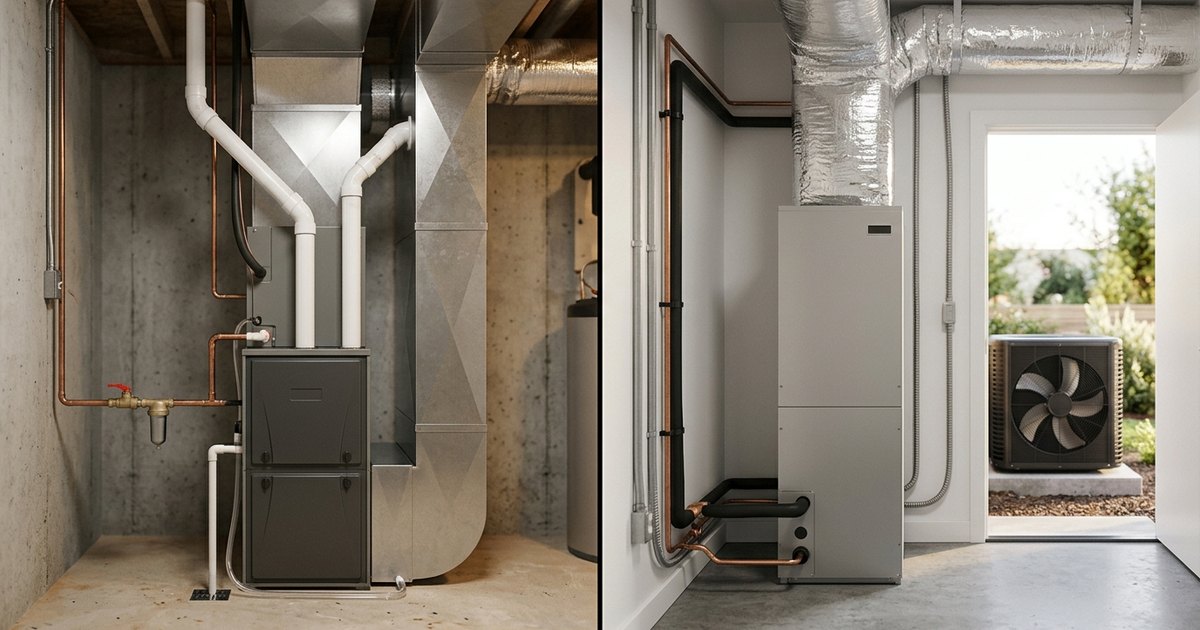
Heat pump or gas furnace? It is the most important HVAC decision a homeowner makes in 2026, and the right answer flipped roughly two years ago. With cold-climate inverter heat pumps now rated down to −15°F, federal 25C credit of $2,000, and HEEHRA point-of-sale rebates of up to $8,000 for income-qualified households, the heat pump now wins the 10-year total-cost-of-ownership math in 41 of 50 states — including most of the cold belt that used to require gas. Here is the full apples-to-apples comparison.
2026 installed-cost comparison (3-ton system, 2,000 sq ft home)
| Cost factor | High-efficiency gas furnace (96% AFUE) + central AC | Cold-climate heat pump (SEER2 18, HSPF2 9) |
|---|---|---|
| Equipment | $4,200-$6,800 | $6,500-$10,400 |
| Install labor | $3,800-$5,600 | $4,200-$6,400 |
| Electrical (panel + 240V circuit) | $0-$400 | $800-$3,200 (often required) |
| Gas line / venting | $600-$1,800 | $0 |
| Permit | $200-$500 | $200-$500 |
| Total installed (before incentives) | $8,800-$15,100 | $11,700-$20,500 |
| Federal 25C tax credit | Up to $600 (furnace only) | Up to $2,000 |
| HEEHRA point-of-sale (income-qualified) | $0 | Up to $8,000 |
| Utility / state rebate (typical) | $0-$300 | $500-$4,500 |
| Net cost after stack (income-qualified) | $7,900-$14,200 | $3,000-$7,500 |
Confirm current rebate amounts with your state energy office and utility — programs pause mid-year when annual funding allocations are exhausted. The federal 25C credit and HEEHRA stack are both per-equipment: a heat pump and a heat-pump water heater each qualify for their own $2,000 and $1,750 caps in the same tax year.
10-year operating-cost math (the part that actually decides it)
For a 2,000 sq ft home with mixed-climate winters (about 5,000 heating-degree-days — Mid-Atlantic, Pacific Northwest, parts of Mountain West):
- Gas furnace + central AC: ~$1,150-$1,450/year in gas + electricity at 2026 utility rates (gas $1.40-$1.80/therm, electricity $0.14-$0.17/kWh).
- Cold-climate heat pump: ~$680-$920/year all-electric. The lower number assumes adequate insulation; the higher assumes pre-retrofit envelope.
- Annual operating-cost advantage of the heat pump: $300-$600/year in mixed climates. $450-$850/year in cold climates with high gas prices (Northeast, parts of California). $200-$400/year in mild climates.
- 10-year operating savings: $3,000-$8,500 depending on climate and utility rates.
The 10-year total-cost-of-ownership verdict
| Climate | 10-yr TCO — gas furnace | 10-yr TCO — heat pump (income-qualified) | Heat-pump advantage |
|---|---|---|---|
| Cold (MN, ME, VT, ND) | $22,000-$28,000 | $11,000-$17,000 | $8,500-$13,000 cheaper |
| Mixed (NY, MA, OH, MI, PA) | $19,000-$24,000 | $10,500-$15,500 | $6,000-$10,000 cheaper |
| Mild (NC, GA, TN, KY) | $15,000-$20,000 | $8,500-$13,500 | $4,500-$8,000 cheaper |
| Hot (TX, AZ, FL, NV) | $13,000-$18,000 | $7,500-$12,500 | $3,500-$7,000 cheaper |
When the gas furnace still wins
- Very cold + high electricity prices. If you live in a state with electricity above $0.28/kWh (most of New England outside Mass Save territory, parts of Hawaii and Alaska) AND winters routinely hit −20°F, gas can still win on operating cost.
- Existing high-efficiency gas + recent install. If your gas furnace is under 10 years old and runs 95%+ AFUE, the cost-of-replacement math doesn't pencil. Wait until end of life.
- No electrical headroom AND can't upgrade. Pre-1965 homes with 100A panels often need a $3,000-$6,000 panel upgrade to support a heat pump. If a panel upgrade is impossible (multi-unit condo, historic district restrictions), gas is the realistic path.
- You're selling within 3 years. Heat pumps add resale value but at a 50-65% recovery rate. If you won't see the operating-cost savings, the gas furnace is the lower-out-of-pocket pick.
The hybrid (dual-fuel) middle path
For cold-climate homeowners not income-qualified for HEEHRA, a dual-fuel system (heat pump as primary, gas furnace as backup below 25°F) often delivers 75-85% of the heat-pump operating-cost savings while keeping resilience for polar-vortex weeks. Installed cost lands in the middle: ~$12,500-$17,000 before the partial 25C credit. The dual-fuel system is the highest-margin install for HVAC contractors, so it gets pitched aggressively — verify with our quote fairness calculator before signing.
Heat pump vs furnace FAQs
How cold can a modern heat pump actually heat? Mainstream cold-climate models (Mitsubishi Hyper-Heat, Daikin Aurora, Bosch IDS Premium) are rated to maintain full heating capacity at 5°F and continued operation to −15°F. Below that, COP drops below 2.0 and electric resistance strip heat (or the gas backup in dual-fuel) takes over for a few hours per year.
Will my electric bill go through the roof? Yes, your electric bill will roughly double in winter — but your gas bill goes to zero, and the net is the operating-cost savings shown in the TCO table. The shock is psychological, not financial.
Do I need to upgrade my electric panel? About 55-65% of homes built before 1990 do. Budget $1,200-$3,200 for a 200A panel upgrade. The HEEHRA program pays up to $4,000 for the electrical work specifically to remove this barrier.
What about a heat-pump water heater? Stack it. The 25C $2,000 cap on heat pumps is separate from the $1,750 cap on heat-pump water heaters. Combined HVAC + water heat-pump conversion typically takes a cold-climate home from $3,800/year in fossil-fuel heating to $1,200/year in electricity.
Get a state-adjusted estimate. Heat-pump install labor varies by ~52% between cheap and expensive states. Run our HVAC cost calculator for heat-pump pricing in your state, our furnace cost calculator for the gas comparison, or read the oil-to-heat-pump conversion guide if you're still on oil heat.