HVAC
Geothermal Heat Pump Cost Guide 2026 — Install, 25D 30% Credit & True 15-Year ROI
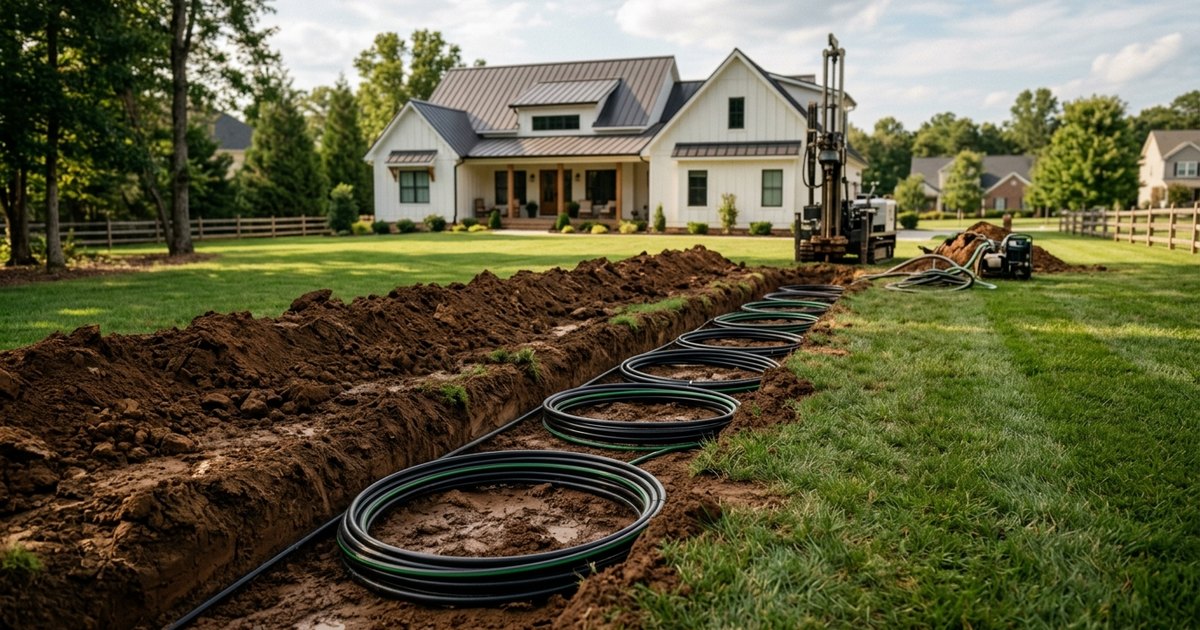
Geothermal (ground-source) heat pumps are the premium HVAC product — 2-3× more efficient than air-source heat pumps, 25-30 year equipment life, and the only HVAC eligible for the federal 25D residential clean energy credit at 30% with no dollar cap through 2032. The catch: installed cost runs $24,000-$48,000 before incentives. Here is the honest 2026 math on when geothermal makes sense, when it does not, and how the 15-year ROI actually pencils.
2026 installed cost — by loop type
The single biggest cost driver is the ground loop — how the system exchanges heat with the earth. Four configurations:
| Loop type | Land / well need | Installed cost (3-ton, 2,000 sq ft home) | Best for |
|---|---|---|---|
| Vertical closed loop | 4-6 boreholes, 200-400 ft deep each | $28,000-$45,000 | Small lots (suburban). Most common nationally. |
| Horizontal closed loop | ~1/2 to 1 acre, trenched 6-8 ft deep | $22,000-$36,000 | Rural lots with open land. Cheapest loop. |
| Pond / lake closed loop | Pond 8+ ft deep, 1/2 acre+, near house | $20,000-$32,000 | Waterfront / pond owners. Cheapest if applicable. |
| Open loop (water well) | High-yield well + discharge path | $24,000-$38,000 | Homes already on well water. Regional permitting varies. |
Cost breakdown — vertical loop, 3-ton, 2,000 sq ft
| Cost component | Range |
|---|---|
| Drilling 4-6 boreholes (200-400 ft) | $14,000-$22,000 |
| U-bend HDPE loop + grout | $2,400-$4,200 |
| Indoor unit (water-source heat pump) | $5,200-$8,800 |
| Ductwork modifications | $1,800-$3,600 |
| Electrical (panel + dedicated circuit) | $1,500-$3,500 |
| Permits + commissioning | $600-$1,400 |
| Total installed | $28,000-$45,000 |
The 25D credit — why geothermal is uniquely advantaged
Unlike air-source heat pumps (which qualify for the 25C credit capped at $2,000), geothermal heat pumps qualify for the 25D residential clean energy credit at 30% of total installed cost with no dollar cap through tax year 2032. This is the same credit that covers solar PV and small wind. There is no income limit, no AMI threshold, and unused credit carries forward indefinitely against future tax liability.
- $36,000 vertical loop install: $10,800 federal credit. Net cost: $25,200.
- $45,000 high-end install: $13,500 federal credit. Net cost: $31,500.
- Stacks with state credits: NY adds a $5,000 geothermal credit. MA Mass Save runs $3,000-$15,000 rebates. Iowa, Maryland, Montana all run dedicated geothermal incentives.
- Stacks with utility rebates: Tri-State G&T, ComEd, and several rural co-ops run $500-$2,500 per-ton rebates specifically for ground-source.
Operating cost — the part that makes the math work
Geothermal's steady-state COP runs 4.0-5.5 (compared to 2.5-3.8 for cold-climate air-source heat pumps and 1.0 for electric resistance). For a 2,000 sq ft home in mixed-climate winters:
- Geothermal heating + cooling: ~$520-$780/year all-in.
- Air-source heat pump (same home): ~$680-$920/year.
- Gas furnace + central AC: ~$1,150-$1,450/year.
- Oil boiler + window ACs: ~$2,400-$3,600/year.
True 15-year ROI — vs the three alternatives
| System | Net upfront cost | 15-yr operating cost | 15-yr total |
|---|---|---|---|
| Geothermal (after 25D + state) | $22,000 | $10,500 | $32,500 |
| Air-source heat pump (after 25C + HEEHRA) | $8,500 | $13,500 | $22,000 |
| Gas furnace + central AC | $11,500 | $21,500 | $33,000 |
| Oil boiler (existing, no replacement) | $0 | $48,000 | $48,000 |
Air-source heat pump still wins on 15-year total. Geothermal wins only when you stretch to 20-25 years — which is reasonable given geothermal's 25-30 year equipment life vs air-source's 18-22 years.
When geothermal is the right answer
- You plan to stay 15+ years. Geothermal's payback math only works on a long horizon. If you might move in under 12 years, air-source is a better economic pick.
- You're building new. Loop installation during construction is 30-40% cheaper than retrofit. New-build geothermal lands at $22,000-$32,000 instead of $28,000-$45,000.
- You have land for horizontal loop OR a pond. Skipping the boreholes drops cost by $8,000-$15,000.
- You can stack a state incentive. NY ($5K), MD, MT, IA all add $2,500-$5,000 on top of federal 25D. In those states, ROI vs air-source improves dramatically.
- You want the cleanest comfort. Geothermal delivers more consistent indoor temperature and is essentially silent indoors. Premium-comfort buyers value this beyond pure economics.
When NOT to do geothermal
- Tight urban lot, no land for horizontal loop, expensive bedrock for vertical drilling. Vertical drilling in NYC, Boston, or hard-rock New England can hit $35-$55/foot vs the $15-$25/foot national average. Net cost can spike to $55,000+.
- You are income-qualified for HEEHRA. Air-source heat pump with the full HEEHRA stack lands at $3,000-$7,500 net — geothermal cannot beat that even with 25D.
- You don't need both heat and cool. Mild climate where you only need cooling, geothermal's heating advantage is wasted.
- You can't use the tax credit. The 25D is non-refundable. If you owe no federal tax (retirees with low taxable income), you cannot capture the $10K+ credit. Carryforward applies, but if income stays low indefinitely, the credit may never be fully recovered.
Geothermal FAQs
How long does the ground loop last? HDPE loops are warrantied 50 years. Indoor heat-pump units run 22-28 years. The loop typically outlives the indoor equipment by 2-3 generations.
Will my yard be destroyed? Vertical loop: small drill rig footprint, mostly restored within 4-8 weeks. Horizontal loop: full lawn excavation, ~12-18 months to fully restore the lawn. Pond loop: minimal yard impact.
Can I add solar PV to make it net-zero? Yes. A 7-9 kW solar PV array typically offsets the electricity required to run a 3-ton geothermal, and both qualify for the 30% 25D credit independently in the same tax year.
What is the per-ton sizing rule? Rule of thumb: 1 ton per 500-700 sq ft. A 2,000 sq ft modern code-built home with R-49 attic and decent windows typically sizes to 3 tons. A leaky 1960s ranch may need 4 tons.
Is the 25D credit really uncapped? Yes — for geothermal, solar PV, solar water heating, small wind, and battery storage. There is no annual or lifetime dollar cap, only the 30% rate. Cap is unchanged through tax year 2032, then steps down.
Get a state-adjusted estimate. Geothermal install cost varies dramatically by drilling difficulty (50-200% between cheap and expensive markets). Run our HVAC cost calculator for your state, compare against air-source heat pump vs gas furnace, or read the central AC vs heat pump ROI guide if you're replacing AC only.