ROI
Garage Conversion vs Room Addition — The 2026 Cost-Per-Sqft Shootout
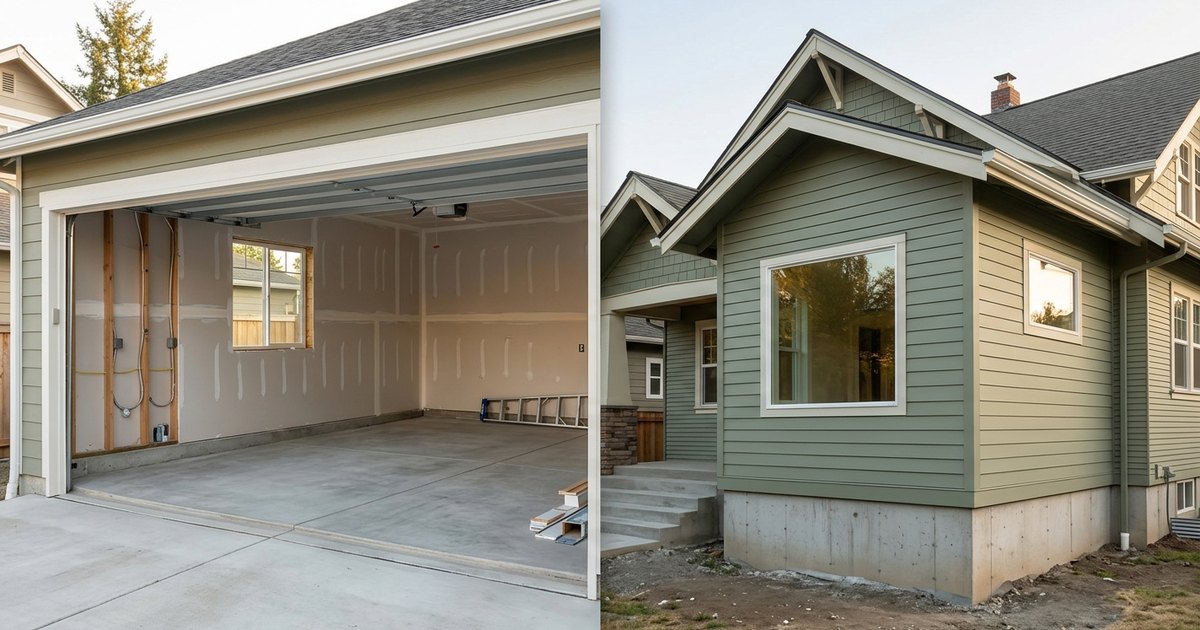
You need more space. Two paths: convert the garage (the shell exists, finish it inside), or build a new addition (more work, more cost, more flexibility). Both add living square footage, both can add bedroom count, and both can deliver real resale value. But on a per-sqft cost basis, the verdict is unambiguous: garage conversion runs $95-$220/sqft while room additions run $230-$550/sqft — a 2-3x cost gap that dominates most decisions. Here's when each one wins and what determines the actual ROI.
2026 numbers — head to head
| 2026 metric | Garage conversion (400 sqft) | Room addition (200 sqft) |
|---|---|---|
| Installed cost | $38,000–$88,000 | $55,000–$110,000 |
| Cost per sqft added | $95–$220 | $230–$550 |
| Appraisal-uplift at resale | $45,000–$120,000 | $40,000–$95,000 |
| ROI percentage | 65–78% | 55–72% |
| Timeline | 4–10 weeks | 12–24 weeks |
| Permit complexity | Low-medium | High (foundation, structural, MEP review) |
| Disruption to daily life | Low (sealed off) | Medium-high (tied to house mechanicals) |
| Net effect on parking | Negative (1-2 spots lost) | Neutral |
| Buyer impact (markets where parking matters) | -4–8% in parking-scarce markets | Neutral to positive |
| Reversibility (back to garage) | $12K-$30K to revert | Not reversible |
Sources: 2026 NAHB Cost Survey, Remodeling Magazine Cost vs. Value, Realtor.com 2025 buyer preference survey, AccessoryDwellings.org garage-conversion data.
Why garage conversion wins on cost-per-sqft
- The shell already exists. Foundation, exterior walls, roof structure, often even the slab and overhead door are there. You skip 35-45% of new-construction cost basis.
- Conditioning the existing space is cheaper. The volume of air to heat/cool is known. Insulation can be added to existing walls/ceiling at retrofit pricing.
- Utility extensions are short. The garage is attached to or directly adjacent to the house in most cases. Electrical sub-panel + HVAC zone extension are 10-20 feet of work.
- Permitting is lighter. No new footprint = no zoning review, no setback analysis, no lot-coverage check, no design review in most jurisdictions.
- Faster timeline = lower carry costs. 4-10 weeks vs 12-24 weeks. Construction loan interest savings of $2K-$8K just from the timeline gap.
Why room addition wins for certain situations
- Bedroom-count uplift in 2-story homes. If you need a new upstairs primary suite, a 2nd-floor addition is the only path. Garage conversion is ground-floor only.
- Kitchen-adjacent expansion. Need to expand the kitchen + dining? Most garages aren't adjacent — running plumbing/gas to a converted garage often costs more than the per-sqft advantage saves.
- Detached garages. A detached garage 30+ feet from the house effectively becomes an ADU, which triggers ADU-class permits, sewer line trenching, separate HVAC system — cost climbs toward $200-$400/sqft, eliminating the conversion advantage.
- Parking is critical for resale. In dense urban markets (DC, Boston, NYC, Philly, Chicago) and snow-belt suburbs (MI, MN, WI, NY), losing a garage spot reduces home value by $15K-$45K. The room-addition path keeps the garage intact.
- Greater design flexibility. Additions can be any size, any orientation, custom ceiling heights, vaulted ceilings, picture windows. Garages are confined to the existing rectangle.
The “convert one bay, keep one bay” play
The smartest garage-conversion strategy in suburban 2-car-garage markets: convert ONE bay (200 sqft) into living space, keep the other bay as garage or workshop. Costs $22K-$48K. Adds 200 sqft of GLA. Preserves one parking spot — which keeps resale value intact in 88% of US markets.
- Cost: $22,000-$48,000 (vs $38K-$88K for full conversion)
- Sqft added: ~200 sqft
- Cost per sqft: $110-$240
- Parking preserved: Yes (1 spot)
- Appraisal uplift: $22K-$58K
- Best for: Single-bedroom add, home office, gym, guest suite, in-law studio.
Garage conversion cost reality (line by line)
- Floor leveling + insulation: $2,500–$8,000. Garage floors slope toward the door; need self-leveling underlayment or sleeper system + sub-floor.
- Garage door removal + wall infill: $3,500–$9,000. Frame in a permanent exterior wall, often with new windows for natural light. Match siding/finish to house exterior.
- Insulation throughout: $2,500–$6,500. Walls + ceiling. Spray foam ideal in extreme climates; batts elsewhere.
- HVAC zone or mini-split: $3,500–$9,500. Existing HVAC rarely handles the load; need extension or independent zone.
- Electrical work: $2,500–$7,500. Outlets to current code (one per 12 feet of wall), lighting circuits, possibly sub-panel if doing a kitchen.
- Plumbing (if adding bathroom or kitchen): $4,500–$14,000. Sewer/water tie-in, fixtures, venting.
- Drywall + paint + trim: $4,500–$10,500. Full finish.
- Flooring: $2,800–$8,500. LVP, hardwood, or carpet over leveled subfloor.
- Egress window (if bedroom): $1,800–$4,500. Code requires for any sleeping room.
- Permits + design fees: $1,500–$5,500.
Room addition cost reality (line by line)
- Architect + engineering + permits: $8,000–$22,000. Permit fees alone can be $1,500-$4,500.
- Excavation + foundation: $12,000–$28,000. Footings + foundation walls + slab pour for slab-on-grade; basement-style for full-depth.
- Framing + sheathing: $18,000–$40,000. Stick-built construction with proper tie-ins to existing structure.
- Roof tie-in: $6,500–$18,000. New roof framing + shingles + flashing where it meets existing roof. Critical waterproofing detail.
- Windows + exterior doors: $5,500–$15,000. New openings, dual-pane.
- Siding + exterior finishing: $5,500–$14,000. Match existing siding (often impossible — plan to re-side a wall section).
- MEP rough-in: $12,000–$32,000. New HVAC ducting/zone, electrical circuits + sub-panel, plumbing if applicable.
- Insulation + drywall: $6,500–$15,000.
- Interior finishes: $12,000–$28,000. Flooring, paint, trim, doors.
- Contingency: 12-18% on new construction.
Hidden costs each project hides
Garage conversion — budget surprises
- Slab leveling. If the existing slope is >1.5%, self-leveling underlayment may not be enough. Sleeper-system subfloor adds $3K-$6K.
- Ceiling height shortage. Many older garages are 7'6'' clear at the eaves, less in the middle. Inadequate for habitable space after adding insulation + drywall + flooring. May need ridge raise ($8K-$22K).
- Code-required parking. Some jurisdictions require off-street parking per dwelling. Eliminating it can require adding a driveway pad ($3K-$8K) or denial of permit altogether.
- Insurance + property tax shift. Adding habitable sqft often triggers reassessment ($400-$2,200/year property tax) and home insurance review.
- Exterior aesthetic mismatch. Filling in the garage door looks like a garage door fill-in unless carefully done. $2K-$5K in exterior trim/siding matching.
Room addition — budget surprises
- Existing wall tie-in. Cutting into the existing exterior wall + roof can reveal old wiring, plumbing, and structural surprises. Add 10-15% contingency.
- Roof tie-in waterproofing. Failure to detail the new-to-old roof junction is the #1 source of post-construction leak callbacks. Insist on contractor warranty + ice/water shield in flashing zone.
- HVAC system undersizing. Existing HVAC may not handle the load of new sqft — new system or zone addition can be $6K-$18K.
- Septic capacity (if applicable). Adding bedrooms can push septic system over capacity in rural jurisdictions; new tank/field is $12K-$35K.
- Permits + fees. Plan review, multiple inspections, impact fees in some jurisdictions can total $3K-$12K.
The decision matrix
| Your situation | Winner | Why |
|---|---|---|
| 2-car garage in suburban market | Convert one bay | Keep parking + add 200 sqft at $22-48K. Best per-dollar return. |
| 2-car garage in urban / parking-scarce market | Addition | Garage parking too valuable to lose. Build out instead. |
| Need upstairs bedroom / primary suite | Addition (2-story or 2nd-floor) | Garage conversion is ground-floor only. |
| Need home office or guest room | Garage conversion | Ground-floor sqft is fine; saves $30K+ vs. addition. |
| Need to expand kitchen or family room | Addition (if garage isn't adjacent) | Plumbing/electrical extensions from kitchen to garage often offset cost advantage. |
| Detached garage, 30+ feet from house | ADU instead | Detached garage conversion becomes an ADU project; see ADU vs basement guide. |
| Building rental income unit | Either + bathroom | Both can be ADU-classified rental; see ADU vs basement apartment guide. |
| Selling within 18 months | Garage conversion (1 bay) | Faster + cheaper. Recoup more of the spend at sale. |
State + market variance
- Cold-climate states (MN, ND, ME, VT, MI, WI, MA, NY): Garage parking is highly valued by buyers. Convert one bay max. Room additions often preferred for full expansion needs.
- Warm-climate states (TX, FL, AZ, NV, southern CA, GA): Garage parking less critical. Full garage conversions more accepted. Best per-dollar ROI region for full conversions.
- ADU-friendly states (CA, OR, WA, CO, MA): Garage conversion can qualify as ADU under state law — opens door to rental income. ROI calculus flips toward conversion.
- Urban + transit-poor metros (LA, Atlanta, Phoenix, Houston, Dallas): Parking is critical. Convert one bay only, keep one for parking.
Run the numbers
- Basement finishing cost calculator — closest comparable calculator for conversion-style projects.
- Garage conversion to ADU cost guide (2026) — full state-by-state pricing for garage conversions specifically classified as ADUs.
- ADU vs basement apartment (2026) — if rental income is the use case.
- Best ROI renovations 2026 ranked — how addition/conversion compare against the rest.