ROI
ADU vs Basement Apartment — Which Has Better Rental ROI in 2026?
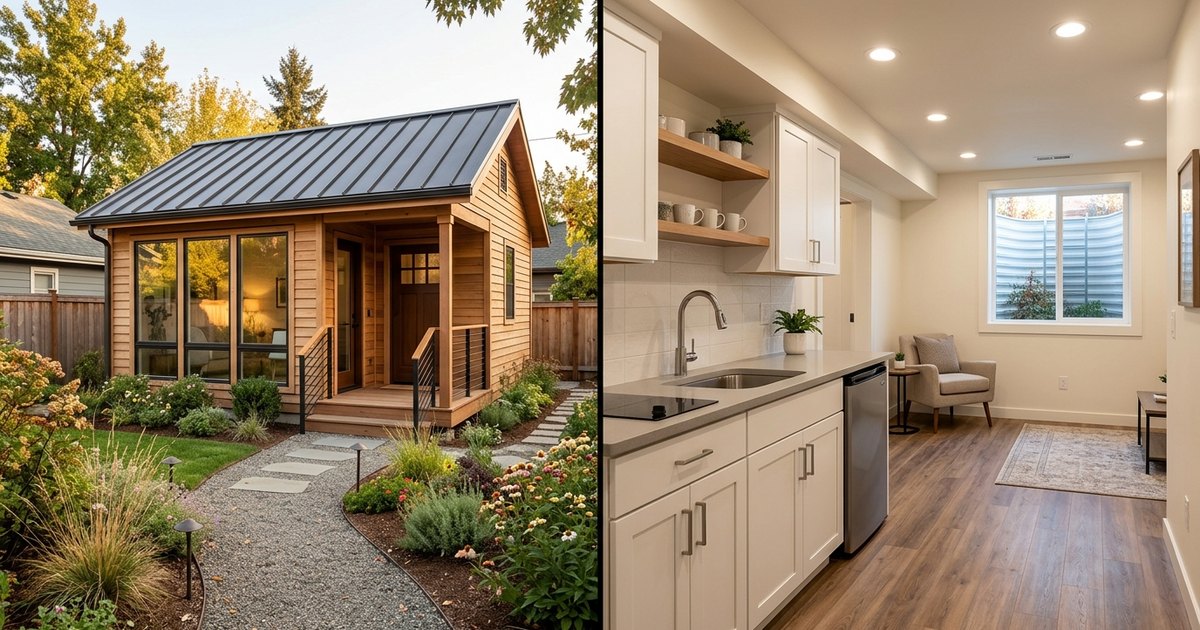
Two of the most asked-about rental income plays in 2026: build a detached ADU (Accessory Dwelling Unit) in the backyard, or convert the basement into a legal apartment. Both create new rental units. Both build long-term equity. But they have wildly different cost basis, timelines, cash-on-cash returns, and legal protections — and the honest 2026 verdict is unambiguous: basement apartments win on cash-on-cash return; ADUs win on absolute equity build and rental rate. Which one wins for you depends on hold period, cash availability, and what your local code actually allows.
2026 numbers — head to head
| 2026 metric (mid-range) | Basement apartment (800 sqft) | Detached ADU (700 sqft) |
|---|---|---|
| Total project cost | $55,000–$120,000 | $180,000–$420,000 |
| Cost per sqft | $68–$150/sqft | $260–$600/sqft |
| Monthly rent (national average) | $900–$2,100 | $1,400–$3,400 |
| Annual rental income | $10,800–$25,200 | $16,800–$40,800 |
| Cash-on-cash return | 12–22% | 7–14% |
| Appraisal-uplift at resale | $55,000–$130,000 | $110,000–$260,000 |
| ROI per dollar invested | $0.60–$0.78 | $0.55–$0.72 |
| Timeline (permit to occupancy) | 3–6 months | 9–18 months |
| Permit complexity | Medium | High |
| Privacy / separation | Low (shared walls/utilities) | High (truly separate) |
Sources: 2026 NAHB Cost Survey, Zillow Rent Index 2025, AccessoryDwellings.org permit data, Census Bureau ADU survey. Run our basement finishing calculator for the basement-apartment estimate; see our ADU construction cost by state for ADU pricing.
Why basement apartment wins on cash-on-cash return
- The shell already exists. Walls, floor, ceiling, foundation, HVAC stubs are there. You're finishing, not building. Per-sqft cost is 3-4x lower than ADU per-sqft cost.
- Utility connections are short. Sewer, water, gas, electric are already in the basement. ADUs require extending lines 30-80+ feet, often through hardscape, at $80-$220/linear foot.
- Permitting is lighter. Egress + waterproofing + plumbing + electrical rough-in. No new foundation, no new framing inspection, no setback/lot-coverage approval, no design review.
- Faster cash flow. 3-6 month timeline means rental income starts inside of 6 months. ADUs take 9-18 months — a year+ of carry costs with zero income.
- Lower interest carry. $80K project at 8% construction loan = $6,400/year interest; $300K project at 8% = $24,000/year interest. The ADU's higher rent has to overcome a 4x larger interest carry before cash flow even matches.
Why ADU wins on long-term equity build
- Truly separate unit. Tenants in a detached ADU don't share walls, entrances, or utilities with you. This commands 25-50% higher rent vs basement apartments and reduces turnover.
- Legal protection is stronger. Almost all 2026 state ADU laws explicitly require local jurisdictions to approve ADUs that meet basic standards. Basement apartments live in a grayer legal zone in many states.
- Resale value uplift is 2-3x larger. Buyers credit detached ADUs as a separate dwelling that adds bedroom-count to the lot. Basement apartments often count as “below-grade finished space” with reduced appraiser credit.
- Future flexibility. ADUs can be sold under condo conversion in some states (CA SB-9, OR HB-2001), or rented as short-term (Airbnb) where local rules permit. Basement apartments rarely qualify for short-term rental separately.
- Better tenant pool. Tenants willing to pay $2,800/mo for a detached ADU are generally higher-quality (longer stays, fewer evictions, better care of the space) than tenants accepting $1,400/mo in a shared basement.
The decision matrix — what you optimize for
| Your priority | Winner | Why |
|---|---|---|
| Cash-on-cash return (annual yield) | Basement | 12-22% beats 7-14%; lower cost basis dominates. |
| Total rental income over 5+ years | ADU | Higher rent rate compounds; ADU rental rate grows faster. |
| Absolute resale appraisal lift | ADU | $110-260K beats $55-130K; full separate-dwelling premium. |
| Time-to-cash-flow | Basement | 3-6 months vs 9-18 months; matters for cash-strapped owners. |
| Lower-cost / lower-risk project | Basement | $80K project failure recoverable; $350K ADU failure is not. |
| Privacy + separation (for you and tenant) | ADU | No shared walls. Higher-quality tenants. Lower turnover. |
| Family use (in-law, adult child returning home) | ADU | Separation matters more for permanent occupants than for short-term renters. |
| Short-term rental potential (Airbnb) | ADU | More jurisdictions allow STR on ADUs than on basement units. |
| House without a basement (TX, FL, AZ slab-on-grade) | ADU only | No basement = no basement apartment option. Garage conversion or ADU. |
| Small lot (under 4,000 sqft) | Basement | ADU setback + lot-coverage limits make it physically impossible. |
The basement apartment cost reality (line by line)
- Egress window install: $3,500–$7,500. Mandatory for any below-grade bedroom. Cut through concrete + window well + window + framing.
- Full bathroom: $12,000–$22,000. New plumbing rough-in including sewage ejector pump ($2,500–$5,500 of that). Tile, vanity, toilet, shower/tub.
- Kitchenette: $8,000–$18,000. Mini-kitchen with cabinets, counter, sink, hot plate or apartment-size range, under-counter fridge, dishwasher optional.
- Separate entry: $8,000–$18,000. New exterior door, walkway, sometimes new stairs. Adds privacy and is legally required for many ADU classifications.
- HVAC zone or mini-split: $3,500–$8,500. Tenant controls own temperature; you control your utility bill.
- Electrical sub-panel: $2,500–$5,500. Separate panel or sub-meter for fair utility billing.
- Fire-rated assemblies: $3,500–$8,000. 1-hour fire-rated separation between units (gypsum board upgrade + smoke detector tie-in).
- Code-required ceiling height work: $0 to $35,000+. Most jurisdictions require 7'0'' minimum ceiling. Older homes with 6'6'' basements may need excavation/underpinning — the deal-killer expense.
- Permits + design fees: $1,500–$6,500. Architect review, plan review, multiple inspections.
- Contingency: 10-15% on existing-structure work.
The ADU cost reality (line by line)
- Permit + design + engineering: $8,000–$28,000. Architect plans, civil engineering, geotechnical (some sites), plan review, permit fees.
- Foundation + slab: $18,000–$45,000. Excavation, footings, slab pour, vapor barrier.
- Framing + sheathing + roof structure: $25,000–$65,000. Stick-built or panelized.
- Roof + windows + doors: $15,000–$35,000. Shingles, trim, dual-pane windows, exterior doors.
- Siding + exterior finishes: $12,000–$32,000. Fiber cement or vinyl + soffits/fascia.
- MEP (mechanical/electrical/plumbing): $28,000–$65,000. HVAC system, electrical service from main + sub-panel, plumbing tie-in to sewer or new septic.
- Insulation + drywall: $12,000–$28,000. Spray foam or batts; level-4 drywall finish.
- Interior finishes: $25,000–$70,000. Flooring, paint, kitchen (full or kitchenette), bathroom, lighting, hardware.
- Site work: $8,000–$35,000. Walkway, driveway extension, landscaping, utility trenching.
- Contingency: 12-18% on new construction.
Hidden costs each project hides
Basement apartment — watch for these
- Ceiling height under code. If your basement is under 7'0'' finished, you either give up on it or face $25K+ excavation. Measure before committing.
- Sewer ejector pump. If the bathroom is below the main sewer line, you need a sewer ejector pump pit ($2,500–$5,500). Not optional and not always in initial bids.
- Insurance impact. Adding a legal rental unit to your homeowner's policy can shift you to a landlord/dwelling policy (+$400–$1,200/year). Disclose to your insurer.
- Property tax reassessment. Some jurisdictions reassess after permit close-out; can add $400–$2,200/year property tax.
- Code-compliant rear/side egress door. If you have only one path of egress from the basement, code requires a second (window OR door). Easy to miss in early plans.
ADU — watch for these
- Utility connection cost. Sewer/water/gas/electric trenching to the ADU can be $15K-$45K alone if the main connections are far from the build site.
- Setback / lot coverage limits. Even where ADUs are allowed, you must respect lot-coverage limits. Many lots can fit a 400-sqft ADU but not a 700-sqft one.
- Sewer/septic capacity. Septic systems may need expansion to accept a second unit ($8K-$28K).
- Parking requirements. Many jurisdictions still require off-street parking per unit. Adding a parking space can cost $4K-$15K depending on lot work.
- Design review. Some HOAs and historic districts add design-review committees that can add 3-6 months to timeline.
State + market variance
- ADU-friendly states (CA, OR, WA, CO, UT, MA, VT, ME): State law removes most local barriers. ADU permits in 60-180 days; financing options strong. ADU economics improve significantly.
- ADU-restrictive states (most of South + Midwest): Local zoning often prohibits or heavily restricts ADUs. Basement apartments may be your only option. Confirm with local building department before any planning.
- High-rent metros (SF, NYC, Boston, Seattle, Denver): ADU rents hit $2,800-$4,500/mo; basement rents $1,800-$3,200/mo. ADU cash-on-cash return closes the gap with basement in these markets.
- Low-rent metros (Detroit, Memphis, OKC, parts of TX/FL/GA): Basement apartment is the only economic play. ADU rents don't support construction cost basis.
- Cold-climate slab-on-grade homes (uncommon, but parts of MN/WI): No basement to convert. ADU or garage conversion only.
Run the numbers
- Basement finishing cost calculator — state-adjusted estimate for the basement apartment scenario.
- ADU construction cost by state (2026) — state-by-state ADU pricing and breakdown.
- Garage conversion to ADU cost guide (2026) — if you have a garage instead of a basement.
- Basement finish vs attic conversion (2026) — if rental isn't the use case, the home-use comparison.