ROI
Basement Finish vs Attic Conversion — Which Has Better ROI Per Dollar in 2026?
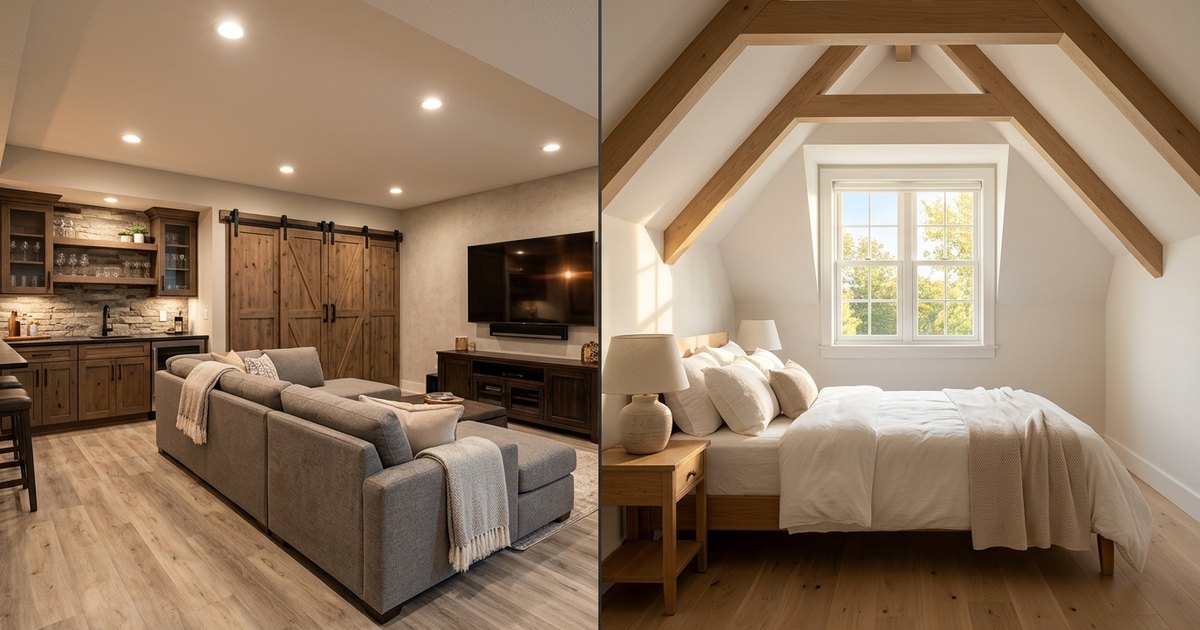
You have square footage already sitting in your house that you're not using. The question is whether to put your renovation money into the basement or the attic — both add living space, both add resale value, but the dollar math, the code requirements, and the failure modes are completely different. Honest 2026 verdict: basement finishing wins on cost per square foot, ROI percentage, and predictability. Attic conversion wins on light, views, and (sometimes) bedroom-count uplift. Here's how to tell which one is the right call for your house.
The 2026 numbers — side by side
| 2026 metric (mid-range) | Basement finish (1,000 sqft) | Attic conversion (700 sqft) |
|---|---|---|
| Installed cost | $45,000–$70,000 | $65,000–$135,000 |
| Cost per added sqft | $45–$70 | $95–$195 |
| Appraisal-uplift at resale | $35,000–$55,000 | $32,000–$70,000 |
| ROI percentage | 70–78% | 50–62% |
| ROI per dollar spent | $0.74 | $0.56 |
| Adds to legal GLA? | If walk-out / daylight | If meets code (7ft / egress / HVAC) |
| Bedroom-count uplift potential | Possible (egress req'd) | Yes (most common upgrade pathway) |
| Typical timeline | 6–10 weeks | 10–18 weeks |
| Permit required | Yes (always) | Yes (always — structural review usual) |
Sources: 2026 Remodeling Magazine Cost vs. Value Report, NAHB Cost Survey, NAR appraiser interviews, bedroom-count adjustment data from MLS comparable sales (2024-25). Run our basement finishing calculator for a state-adjusted basement estimate.
Why basement wins on pure ROI
Three structural reasons basement finishing has a 14–28 percentage point ROI advantage in 2026:
- The shell exists. Walls, floor, ceiling structure, and (usually) HVAC stubs are already there. You're finishing — not building. Material + labor cost is much lower per sqft because you skip foundation, framing, sheathing, and (most) HVAC distribution work.
- HVAC integration is easier. Most basement finishes need a single supply trunk extension + 4–6 register drops + 1 return; about $1,800–$3,500 of HVAC work. An attic conversion typically needs a new zone (separate thermostat), often a second condenser or a dedicated mini-split, and significant ridge / soffit insulation work — $8,000–$18,000 of HVAC + insulation work.
- Code path is lighter. Egress (one bedroom-eligible window with a window well if no walk-out), waterproofing, plumbing rough-in. Attic conversions usually trigger a structural review (existing floor joists rarely rated for habitable load), often require dormers to hit 7-foot ceiling height in 50% of the floor area, and frequently demand a code-compliant stair upgrade.
When attic conversion is the better call
ROI percentage isn't the only metric. Attic conversions out-perform basements in five scenarios:
- 1.5-story home built for it. Cape Cods, Victorians, A-frames, and many craftsman builds already have 7-foot ceiling height at the ridge and dormers. The attic was designed as half-finished space; finishing it costs almost as little per sqft as a basement.
- You don't have a basement (slab-on-grade in TX/FL/AZ/southern CA), or your basement is genuinely unfinishable (under 7-foot ceiling height, post-tension slab, recurring sump-failure flood history).
- Adding a primary suite at the top of the house. Light, views, sound separation from common areas, often a private entry stair. Especially valuable in dense urban lots where extending the footprint isn't possible.
- Income unit (ADU) potential. An attic with private exterior access can qualify as a Junior ADU in many jurisdictions, with annual rental income of $1,200–$2,400/month in most metros — flips the ROI math completely.
- Bedroom-count play. A code-compliant attic bedroom counts toward the home's bedroom count in MLS and appraisal. A 4BR → 5BR conversion in a strong school district can add $30–$60K to appraisal independent of square footage uplift. Below-grade basement bedrooms don't always get that credit.
What kills each project (the budget exploders)
Basement finishing — expect these line items
- Sump pump + perimeter drain. If you've EVER had water, do not skip this. $2,200–$5,800 properly done.
- Egress window install. Required for any below-grade bedroom. Concrete cutting + window well + window + framing: $3,500–$7,500. Mandatory if you want the bedroom to count.
- Moisture barrier + insulated framing. 2026 code requires R-13 minimum wall insulation; many jurisdictions require dimple-mat moisture barrier on the concrete face. $4–$7/sqft of wall.
- Plumbing rough-in for bathroom. If you're adding a bathroom (highly recommended — $9K bath build adds $14K appraisal uplift), expect $2,500–$5,500 of new plumbing rough-in including a sewage ejector pump.
- Ceiling height tightness. Below 7'0'' before finished ceiling = no bedroom credit. Below 6'8'' finished = code refusal in some jurisdictions. Measure before you commit.
Attic conversion — expect these line items
- Structural reinforcement. 50% of pre-1990 homes need joist sistering or a steel beam to bring the attic floor up to habitable live-load (40 psf). $3,500–$12,000.
- Dormers for ceiling height. If you don't have 7'0'' in ≥50% of the floor area, you need shed dormers or gable dormers. $14,000–$32,000 per dormer.
- HVAC zone + insulation. Separate thermostat zone, possibly a mini-split, ridge + soffit insulation upgrade. $8,000–$18,000.
- Stair upgrade. Pull-down attic stairs don't meet code for habitable space. A full-rise compliant stair (often where a closet is) costs $6,000–$14,000.
- Egress window or door. Bedroom requires it. On a 2nd-floor attic, that's a 22''x44'' window minimum or a doorway to a balcony with stair. $2,800–$8,500.
The “does this count as a bedroom?” checklist
This is where ROI lives or dies. For appraisal-recognized bedroom status, both attic and basement rooms must meet ALL of these:
- Minimum 70 sqft of floor area (some jurisdictions 80 or 90).
- Minimum 7'0'' ceiling height over at least 50% of the floor area.
- Egress window or door meeting IRC R310 (24'' clear height, 20'' clear width, 5.7 sqft total opening, sill no higher than 44'' above floor; basement window well sized per code).
- Permanent HVAC (no plug-in space heaters or window AC alone).
- Closet (debated — some appraisers require, most jurisdictions don't).
- Permitted + inspected. Self-certified renovations don't count.
If your project misses any of items 1–4, the appraiser calls it a “bonus room” or “rec room” — which contributes much less to appraisal than a bedroom does. Confirm code path with your building department BEFORE finalizing layout.
State + market variance
- Cold-climate states with full basements (MN, MI, WI, OH, PA, MA, NY, IL, MO): Basement is the obvious play. Finished basements are an EXPECTED feature in these markets; unfinished basements hurt resale. Buyer + appraiser data favors basement at ~73–78% ROI.
- Hot-climate states without basements (TX, FL, AZ, NV, southern CA, GA, LA): Most homes are slab-on-grade. Attic conversion is the only path — but ceiling heights are usually too low without dormers. ROI on attic conversion in these markets averages 48–58%, and the better play is often a 1-story addition or detached ADU at lower cost per sqft.
- Mixed states with walk-out lots (CO, KY, TN, VA, NC, WA, OR): Walk-out basements can hit FULL above-grade GLA in appraisal — sometimes ROI hits 82–90% on these. The single best return-on-renovation play available.
- High-density urban markets (NYC, SF, Boston, Chicago): Attic conversion + ADU combo can hit 90–110% recovery if rental potential is real. The market premium on extra legal bedrooms is large enough to flip the ROI math entirely.
The decision tree — in three questions
- Do you have a basement with 7'0''+ ceiling height and either a walk-out OR egress potential? Yes — finish the basement. No — proceed.
- Do you have an attic with 7'0''+ ceiling height in ≥50% of the floor area, structurally sound floor joists, and at least one path for egress (a 22x44 window or balcony door)? Yes — convert the attic. No — proceed.
- Are you willing to add dormers ($14–32K each) OR reinforce the floor structurally ($3.5–12K)? Yes — attic conversion still works. No — do an addition or ADU instead, both projects deliver better ROI than a code-fight attic.
Run the numbers
- Basement finishing cost calculator — state-adjusted estimate by size, finish tier, and bathroom-add toggle.
- ADU construction cost by state (2026) — reference numbers for attic-conversion projects done as ADUs.
- Basement finishing cost breakdown (2026) — deep dive on line items, egress, and bathroom-add ROI.
- Adding a bathroom to a finished basement — the highest-ROI add-on inside a basement project.