Smart Home
EV Charger Install Cost by State 2026 — Level 2 Home Install Pricing
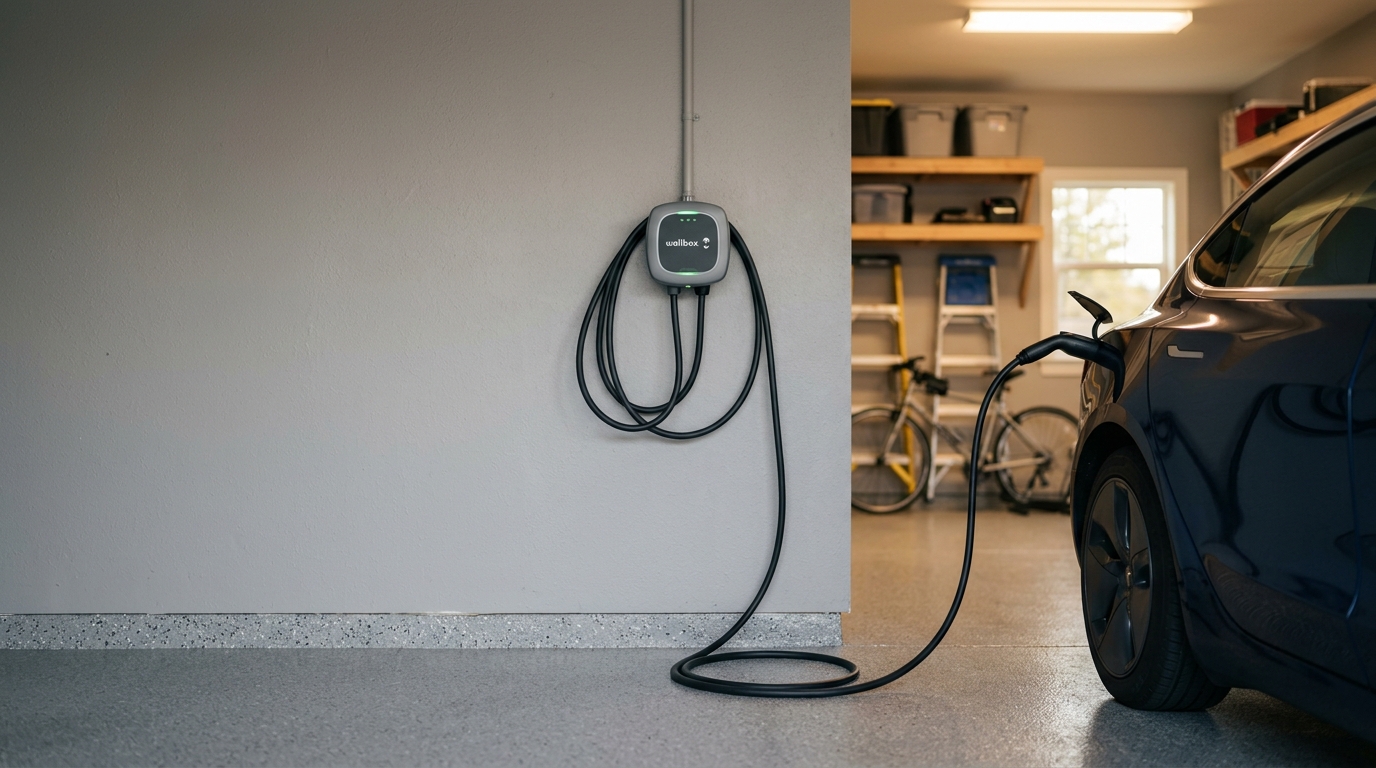
Installing a Level 2 home EV charger in 2026 runs $900-$3,200 all-in for the typical single-family home — equipment ($350-$800), electrician labor ($350-$900), permit ($60-$280), and sometimes a panel upgrade ($1,200-$3,500 if your existing panel is at capacity). Utility rebates + the federal 30% tax credit (capped at $1,000) can knock 30-70% off the net cost. Here's the real 2026 breakdown by state.
Cost breakdown — the 4 line items
1. The charger itself ($350-$800)
- Budget ($350-$500): Grizzl-E Classic, ChargePoint Home Flex 32A, Lectron 240V. Hardwired or 14-50 plug. Reliable but minimal app smarts.
- Mid ($500-$700): Wallbox Pulsar Plus, Emporia Level 2, Tesla Universal Wall Connector. App-controlled, energy-monitor, schedule-aware.
- Premium ($700-$900): ChargePoint Home Flex 50A, Tesla Wall Connector Gen 3, JuiceBox 48A. Higher amperage + bidirectional V2H support in some 2026 models.
2. Electrician labor ($350-$900)
Variable based on (a) distance from your main panel to the EV charger location, (b) whether the electrician can run conduit through unfinished basement vs. fishing through finished walls, (c) local labor rates.
- Easy install (panel within 30 ft of garage, unfinished basement): $350-$500
- Average (40-70 ft, partial finished wall): $500-$700
- Hard (75+ ft, fishing through 2 floors of finished walls): $700-$1,400
3. Permit ($60-$280)
Most jurisdictions require a permit for any new 240V circuit. Cost varies wildly: $60 in most of TX, FL, GA; $180-$280 in CA, NY, NJ, MA. Electrician usually handles the pull as part of the labor quote.
4. Panel upgrade (sometimes — $1,200-$3,500)
If your existing panel is 100A and already fully loaded (common in homes built pre-1990), you need either a panel upgrade to 200A OR a load-management device (Span Panel, Emporia Vue, NeoCharge) that diverts power dynamically.
- 200A panel upgrade: $1,800-$3,500 (includes utility coordination + meter swap)
- Load-management device: $400-$900 installed (often the better value if you only need 1 EV)
Cost by state — 2026 averages (no panel upgrade needed)
| State | Typical all-in | Top utility rebate | Net cost after rebates + 30% federal credit |
|---|---|---|---|
| CA (PG&E / SCE / SDG&E) | $1,400-$2,800 | $1,000-$2,000 (PG&E EV charger rebate; SCE up to $1,500) | $300-$900 |
| TX (Oncor / CenterPoint) | $900-$1,800 | $250-$500 (Austin Energy $1,200 highest) | $400-$1,100 |
| NY (Con Ed / National Grid) | $1,500-$2,800 | $500-$1,500 (NYSERDA $500; PSEG-LI $1,500) | $500-$1,100 |
| FL (FPL / Duke) | $900-$1,700 | $200-$500 (FPL EV Easy Bill Credit) | $400-$1,000 |
| MA (Eversource / National Grid) | $1,400-$2,500 | $700-$1,200 (MassEVIP residential) | $300-$900 |
| CO (Xcel) | $1,200-$2,200 | $500-$1,300 (Xcel EV Accelerate + state credit) | $300-$800 |
| WA (Seattle City Light / Puget) | $1,300-$2,400 | $300-$1,200 | $500-$1,200 |
| NJ (PSE&G / JCP&L) | $1,400-$2,600 | $1,500 (NJ Charge Up Residential) | $200-$900 |
| IL (ComEd) | $1,100-$2,100 | $500-$3,750 (IL EV charger rebate + state) | $0-$1,000 |
| Midwest no-program (OH, IN, MI, WI) | $900-$1,700 | $0 (state-by-state, mostly none) | $700-$1,400 |
| Southeast no-program (TN, AL, MS, KY) | $850-$1,500 | $0-$200 | $650-$1,300 |
Federal 30% tax credit — Form 8911
The federal Alternative Fuel Vehicle Refueling Property Credit (IRS Form 8911) gives you 30% of the cost (capped at $1,000 for residential) IF your home is in a "non-urban or low-income census tract" per the IRS's geocoded map. Roughly 60% of U.S. ZIP codes qualify. Check eligibility BEFORE you buy — the map updates annually.
How to claim utility rebates — the 5-step playbook
- Search "your utility name + EV charger rebate residential" before you buy. Verify the program is currently open (most run on yearly budgets that exhaust).
- Pre-approval: some programs (NJ Charge Up, CA SCE) require pre-approval BEFORE install.
- Use an approved electrician where required (most California utilities mandate this; most other states don't).
- Photo documentation: receipts, before/after install, model + serial #s.
- Submit within program window (typically 60-120 days). Check arrives 6-12 weeks later as bill credit or paper check.
Common gotchas
"My quote came in at $4,800 — way higher than your range"
Almost always a panel-upgrade situation. Ask the electrician: "Is this quote assuming a panel upgrade?" If yes, get a second opinion on whether a load-management device ($400-$900) would solve the problem cheaper.
"My utility rejected my rebate"
Most common: bought the wrong amperage tier (32A vs 50A), used a non-approved installer, missed the deadline, or installed outside the utility's service territory.
"I'm renting — can I install a Level 2?"
Yes with landlord written consent, but you almost certainly won't recover the install cost when you move. Better path: portable Level 2 charger (NEMA 14-50 plug, $400-$600) that you can take with you, paired with a single landlord-approved outlet install ($300-$500).
Bottom line
Budget $900-$1,700 in low-cost states, $1,400-$2,800 in CA/NY/MA before rebates. After utility rebates + federal 30% credit, most homeowners net out at $300-$1,000. Always check utility programs + federal eligibility BEFORE buying.
Related: smart sprinkler controllers + water rebates, best smart thermostats for 2026 ROI, state + utility rebate lookup tool →.