Hiring
Why Contractor Quotes Don't Match (And How to Actually Compare Them)
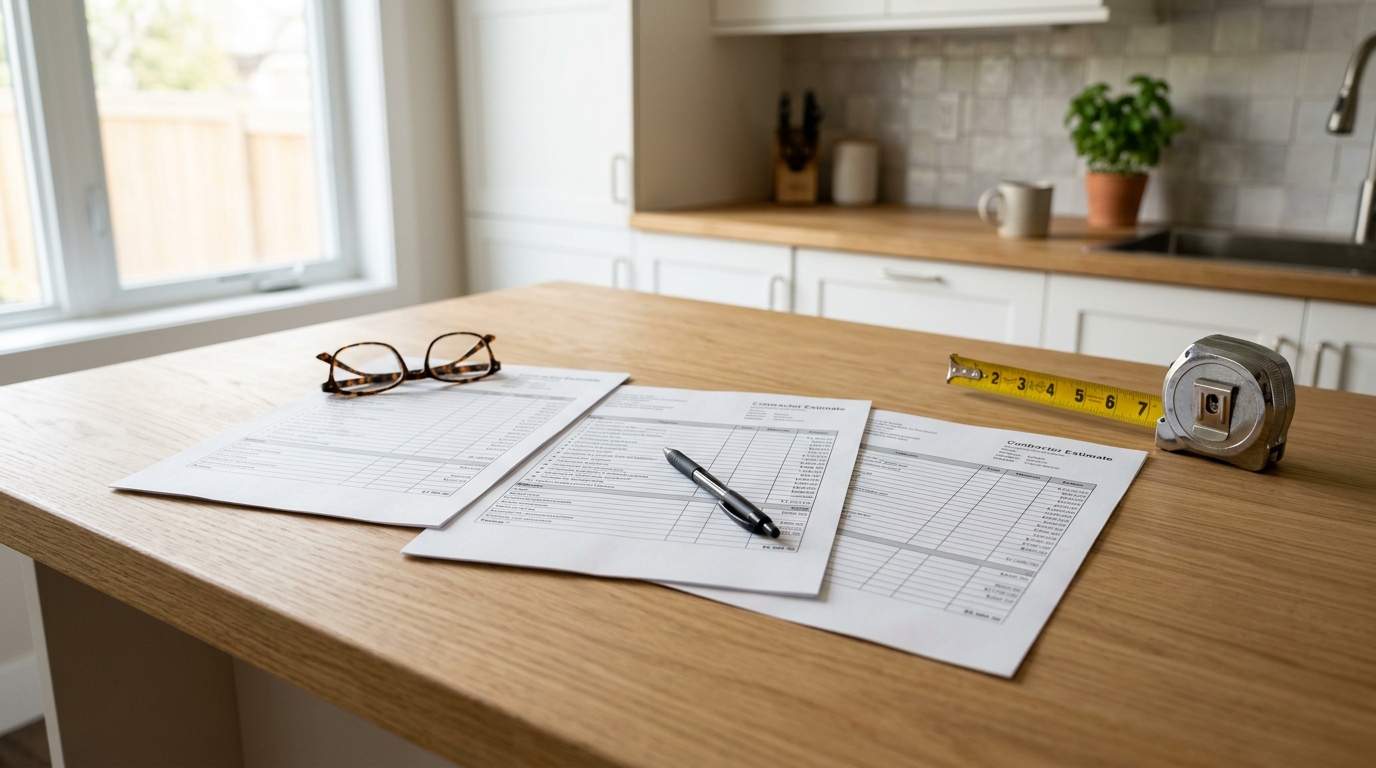
You ask three contractors for a kitchen remodel quote. Same scope, same finishes, same square footage. The bids come back at $32,500, $47,800, and $60,500. That's a $28,000 spread on the same kitchen — and your gut says someone is wildly off. The honest answer: none of them are. The bids are roughly the same project priced by people who format their estimates differently, with the gaps almost entirely explained by six line items you can normalize in about twenty minutes. Once you do, that $28,000 spread typically collapses to $6,000–$10,000 — and that's the real contractor-to-contractor variance worth paying attention to.
The problem: same project, wildly different numbers
Roughly 71% of homeowners report being "confused or overwhelmed" by contractor quotes per a 2025 Houzz survey, and the same survey found 38% chose the wrong contractor — usually the lowest bid — because they couldn't identify which quote was actually scoped completely. The pattern repeats across kitchens, bathrooms, and roofs: the headline number is the headline number, but the line items underneath it tell a completely different story.
Take a real example. Two contractors quote your bathroom remodel:
- Contractor A: $18,500 — clean-looking, single-page bid, headline number bold at the top.
- Contractor B: $26,800 — three-page itemized estimate with 47 line items.
A looks 31% cheaper. But Contractor A's quote doesn't mention demo, disposal, permits, or fixture removal — those are line items the homeowner will pay for separately, typically $4,800–$6,200 on a bathroom of this size. Contractor B included all of them. Once you add those back to A's headline number, the "cheap" bid is now $23,300–$24,700 — within $2,000 of B's number. The spread that looked like $8,300 was really $2,100. That's the entire game.
Why contractors format quotes differently
Some of the variance is intentional. Some isn't. Both are worth understanding before you start comparing.
Intentional formatting differences
- Low-ball anchoring. A small but persistent share of contractors deliberately leave demo, disposal, or fixture costs off the headline number to win the first conversation. The bid is technically correct (the work is listed on page 2 as "excluded from base quote"), but the homeowner reads the big number and walks past the exclusions. Change orders during the project recover the margin — typically 18–35% on top of the original quote.
- Scope-creep protection. Established contractors with longer warranty obligations often build in 12–18% contingency on the headline, assuming hidden conditions will show up. Newer crews omit contingency to look competitive — then issue change orders when problems appear (because they always do on a remodel of any size).
- Material substitution headroom. "Mid-grade quartz countertop" is a real spec on Contractor A's sheet at $42/sqft and on Contractor B's sheet at $86/sqft. Both numbers are real quartz prices — they're just for different brands and tiers within the same category. The quote line reads identical; the cost line is half.
Unintentional formatting differences
- Different estimating software. Buildertrend, JobNimbus, PlanSwift, and Excel templates all format line items differently. A contractor on Buildertrend has standard categories; one on a custom Excel sheet may bundle plumbing and electrical into a single "mechanicals" line.
- Demo-and-disposal assumptions. Some contractors automatically assume a clean job site (and bill it). Others assume the homeowner will handle disposal of cabinets and fixtures (and don't bill for what they aren't doing).
- Permits included vs. excluded. A kitchen permit in San Francisco can hit $1,500+; the same kitchen in Fresno is $400. Some contractors include permits in the bid; others pass them through at cost; others leave them entirely to the homeowner.
The 6 line items you must normalize
These are the six categories where 90% of the apparent spread between quotes actually lives. Before comparing dollar totals, write each quote's number for each category on a single piece of paper.
- Materials. Get the brand, model, and tier for everything — cabinets, countertops, flooring, fixtures. "Mid-grade quartz" is not a spec; "Caesarstone Statuario Maximus 2cm" is. If a contractor refuses to specify, that's a red flag.
- Labor. Hourly billing vs. fixed-price affects how change orders play out. Fixed-price is the cleaner comparison; if a contractor only quotes hourly, ask for an hours-estimate so you can compare expected total labor cost. Also confirm which trades (carpentry, electrical, plumbing, drywall, finish) are broken out separately.
- Demo and disposal. A bathroom gut runs $1,200–$3,500 in demo+disposal alone. A kitchen runs $2,800–$6,500. If this isn't a line item on the quote, ask explicitly: "Is demo and disposal included in this number, or invoiced separately?" — and get the answer in writing.
- Permits and inspection fees. Should be a separate line, either included or excluded. Pass-through at cost is fine; the issue is when permits aren't mentioned at all and surface as a $600–$1,800 surprise during the project.
- Contingency. 8–15% on remodels with existing structure is industry standard. If one contractor shows 15% contingency on the page and another shows none, the no-contingency quote is going to get hit with change orders — probably more than 15% worth. Add 15% to the no-contingency quote yourself before comparing.
- Timeline. Not a dollar line item, but consequential. A 4-week kitchen quote and a 10-week kitchen quote are not pricing the same product. Faster contractors often have a smaller crew running longer days (less risk of subs colliding); slower contractors typically run multiple jobs in parallel (more risk of you waiting). Both can be priced fairly — but you're buying different experiences.
How to actually compare
Five-step normalization process. About twenty minutes per quote once you've done it once.
- Pull the six line items from each quote into a single spreadsheet row per contractor. If any are missing on the quote, mark them as "not stated" (not zero) — that's your conversation list.
- Ask the contractor to fill in the missing line items in writing. A reputable contractor will revise the bid within 24–48 hours. Anyone who refuses to itemize is signaling that the original number isn't the real number.
- Normalize the material tier. Pick one quote's spec as the baseline; ask the other contractors what their number becomes at that spec. This usually moves the lower bids up $1,500–$5,000 and the higher bids down by similar.
- Add a uniform contingency. If one quote has 12% and another has 0%, add 12% to the 0% quote (this is the honest comparison; the 0% quote was always going to come out 12% higher in practice).
- Compare the normalized totals. After steps 1–4, the spread is almost always inside ±$8,000 on a $40,000 project. That residual spread is what you're actually deciding between — and it usually corresponds to crew quality, timeline, and warranty terms rather than scope differences.
Run the numbers
- Pre-Bid Scope Checklist — the upstream tool. Build a 17-section Scope of Work in 15 minutes and email it to contractors BEFORE they bid — so quotes come back standardised against the same scope instead of comparing apples to vapor.
- Quote Fairness Calculator — paste your contractor's number and project scope; we tell you whether it's inside ±15% of the state-and-project median, and which line items the quote appears to be missing.
- Compare up to 5 quotes side by side — the multi-quote normalization tool that walks you through all six line items for each contractor and surfaces the apples-to-apples total at the end.
- Contractor dispute calculator — if a job is already underway and a dispute has emerged, model your mediation / lien / litigation options before deciding how to escalate.
Get the printable Contractor Quote Worksheet (PDF)
We'll email the 3-page PDF — cover, the 6-line-item normalization worksheet you can print and fill in for each contractor, plus an appendix with 10 red-flag questions to ask before signing.
Free. One email. Unsubscribe in one click. No spam.