ROI
Stage Your Home vs Renovate Before Listing — The $20K Pre-Listing Decision in 2026
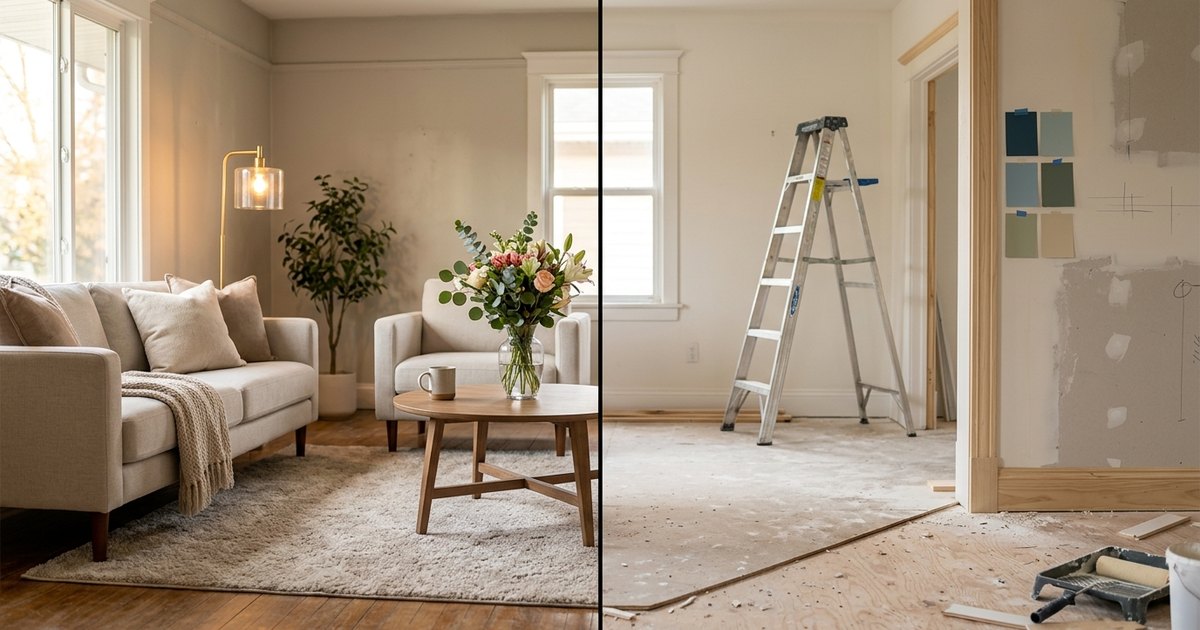
You have $20,000 and you're listing in 90 days. The two competing strategies in 2026 pre-listing playbooks: hire a stager to make the house look its best, or fix the things buyers will downgrade you for. Both work. Both have published 2.0–3.0x ROI. But they win in completely different scenarios, and most sellers should NOT spend the whole budget on one of them. The honest 2026 verdict: staging wins for cosmetically-good homes; renovation wins for homes with visible deal-breakers; combo wins for almost everyone in between.
The 2026 numbers — head to head
| 2026 metric ($20K, 90-day pre-listing) | Pro staging | Partial renovation |
|---|---|---|
| Typical cost | $5,000–$18,000 | $12,000–$20,000 |
| Sale-price uplift (median) | 9–15% (NAR), 5–9% (Realtor.com) | $24,000–$38,000 absolute lift |
| Per-dollar uplift ratio | 2.0–3.0x | 1.2–1.9x |
| Days-on-market reduction | 31–49% | 12–22% |
| Setup time | 2–7 days | 3–8 weeks |
| Reversibility | Fully reversible (rented furniture removed) | Permanent |
| Carry-cost savings (faster sale) | $4,000–$12,000 (avoided mortgage/utilities) | $1,500–$5,500 |
| Live-in impact | Low (1-3 day install) | High (3-8 weeks of work) |
| Best for... | Cosmetically-OK homes with dated furniture | Homes with visible deal-breakers |
Sources: NAR 2025 Home Staging Report, Realtor.com 2025 pre-sale market data, NAHB Remodeler Insights 2025.
Why staging wins on per-dollar ROI for most homes
- Online conversion is photo-driven. 95% of buyers begin their search online. Staged listings get 2.1–3.4× more click-through on Zillow / Realtor.com vs comparable unstaged listings. Renovation matters too, but at the click-through stage, the photo wins.
- Emotional priming. Buyers who walk into a staged home spend an average of 22% more time at the showing. Long showing time correlates with higher offer pricing.
- Furniture sells the room concept. A vacant 11x14 bedroom looks small. A staged 11x14 bedroom with appropriately-sized furniture looks generous. Sale price tracks perceived size, not measured size.
- Days-on-market savings stack. A 35% faster sale at the same price still earns $4-12K in saved carry costs (mortgage interest + utilities + insurance + property tax), on top of any sale-price uplift.
- Renovation reveals scope creep. A $12K kitchen partial discovers $4K of plumbing work nobody planned for, and now you've got $16K spent and a 14-week schedule slip. Staging has zero schedule risk — the budget is the budget.
The 5 scenarios where renovation wins
- Visible deal-breakers staging cannot hide. Popcorn ceilings, broken kitchen layouts, water-damaged bathrooms, peeling exterior paint, sagging porches, dated tile/fixtures in the primary bathroom. Staging amplifies what's good but can't mask what's broken.
- Lower-budget homes ($200-$400K starter market). At this price point, a $15K kitchen refresh shifts the appraisal anchor more than a $5K stage shifts buyer perception. The dollar-impact-per-dollar-spent flips because the comp set is more cost-driven.
- Luxury market ($1.5M+). Luxury buyers see through staging — they expect renovation-grade finishes throughout. Staging amplifies them but cannot replace them.
- Holding for 12+ months before listing. Renovate now so you enjoy the improvements while still benefiting from the sale lift. Stage closer to listing.
- Investment / rental property. Renovation captures both rental income (if you hold a few months) and sale price. Staging only captures sale price.
The $20K combo play — the strongest 2026 strategy
For 70% of sellers, the right answer is NOT “stage OR renovate” — it's an 80/20 budget split that delivers both. The recommended structure:
| Budget item | Cost | Why |
|---|---|---|
| Paint, full interior (mid-tier pro) | $3,500–$5,000 | Single best pre-sale ROI move; sets the visual baseline. |
| Lighting fixture replacement (8-12 fixtures) | $1,200–$2,200 | Modern fixtures throughout = single biggest age-perception shift. |
| Bathroom partial refresh (vanity, fixtures, paint) | $3,500–$5,500 | Primary bath is the #2 buyer rejection room. Fix it if dated. |
| Kitchen hardware + cabinet paint + 1 appliance | $2,000–$3,500 | Refresh, not remodel. Same-day install. Photos like a $20K project. |
| Curb appeal refresh (paint door, landscape, fixtures) | $1,500–$2,800 | 30-second-rule rule. Cheap, fast, photo-amplifying. |
| Occupied-staging consultation + 3 months rentals | $2,500–$4,500 | Edit existing furniture, add accent pieces, optimize photos. |
| Combo total | $14,200–$23,500 | Combined sale-price lift: $35,000–$52,000 |
The staging cost reality — what you're actually buying
Occupied staging (you still live there)
- Consultation only: $200-$500 for a 1-2 hour walk-through with written recommendations. You execute.
- Consultation + 1 day staging: $400-$1,500. Stager works with your furniture; you store the excess.
- Consultation + 3 months of rented accent pieces (rugs, art, throw pillows, lamps): $1,500-$3,500 total.
- Full occupied stage (multi-room transformation with rentals): $3,000-$7,500.
Vacant staging (home is empty)
- Partial vacant stage (3-5 key rooms): $2,500-$5,500 install + $1,000-$2,500/month rental.
- Full vacant stage (8-12 rooms): $5,000-$12,000 install + $2,000-$4,500/month rental.
- Luxury vacant stage ($1M+ home): $8,000-$18,000 install + $3,500-$7,500/month rental.
Most sellers should NOT do vacant staging unless the house is already empty. If you're moving out THEN listing, vacant staging is the play. If you're still living there, occupied staging (with rental accents) delivers 80-90% of the visual impact at 30-40% of the cost.
The renovation cost reality at $20K
$20K is NOT enough for any full-room renovation in 2026 (kitchen $42-72K, full bath $18-28K, full primary suite $35-60K). It IS enough for a meaningful partial renovation across multiple rooms. Three honest scopes you can hit at $20K:
- Bathroom partial + paint everywhere ($12K bath + $4K paint + $2K lighting + $2K contingency): Fixes the #2 buyer rejection room while resetting the visual baseline.
- Kitchen partial + lighting everywhere ($14K kitchen refresh + $4K lighting + $2K contingency): Cabinet paint, new hardware, 1 new appliance, modern lighting fixtures throughout the house. Photos like a $40K project.
- Full exterior reset + interior paint ($9K curb appeal + $5K paint + $3K lighting + $3K landscaping): Best play for homes where the bottleneck is “looks dated from the curb.”
The bottleneck test — stage or renovate?
Walk a friend through your house. Ask them this: “If you had $20K to spend on this house before listing, what would you fix first?”
- If they say “the bathroom” or “the kitchen” or “the master bedroom layout” — renovation wins. Spend $14-16K on the bottleneck + $4-6K on light staging.
- If they say “the place needs a fresh look” or “the furniture is dated” or “it feels lived-in” — staging wins. Spend $5-10K on staging + $10-15K on paint/lighting only.
- If they say “everything looks pretty good” — combo wins. Run the 80/20 combo play above.
- If they struggle to find anything to fix — spend less. $5-8K on staging + skip the renovation. Save the difference for closing costs / moving.
State + market variance
- High-velocity markets (Austin, Nashville, Tampa, Phoenix, Raleigh): Staging ROI hits 2.8-3.2x. Days-on-market reduction is the dominant value driver. Skew staging-heavy.
- Slow markets (Detroit, Cleveland, parts of upstate NY/IL): Renovation wins; staging alone won't move buyers who are already negotiating hard. Skew renovation-heavy.
- Luxury coastal markets (Bay Area, NYC, Boston, Miami): Both required. Single-strategy plays underperform combo plays by 15-25% in these markets.
- Rural / small-town markets: Staging often unnecessary. Buyers care about condition, not presentation. Skew 100% renovation.
Run the numbers
- Painting cost calculator — estimate the paint portion of your combo strategy.
- Bathroom remodel cost calculator — if bath partial is your renovation bottleneck.
- Kitchen remodel cost calculator — if kitchen partial is your renovation bottleneck.
- Curb appeal vs interior refresh (2026) — the higher-level pre-listing budget split decision.
- Best ROI renovations before selling your home (2026) — the complete pre-listing decision playbook.
- How much should you spend before listing? (calculator) — state-adjusted, ranked plan in 30 seconds.