Disaster
What Depreciation Means on Your Roof Insurance Claim (2026)
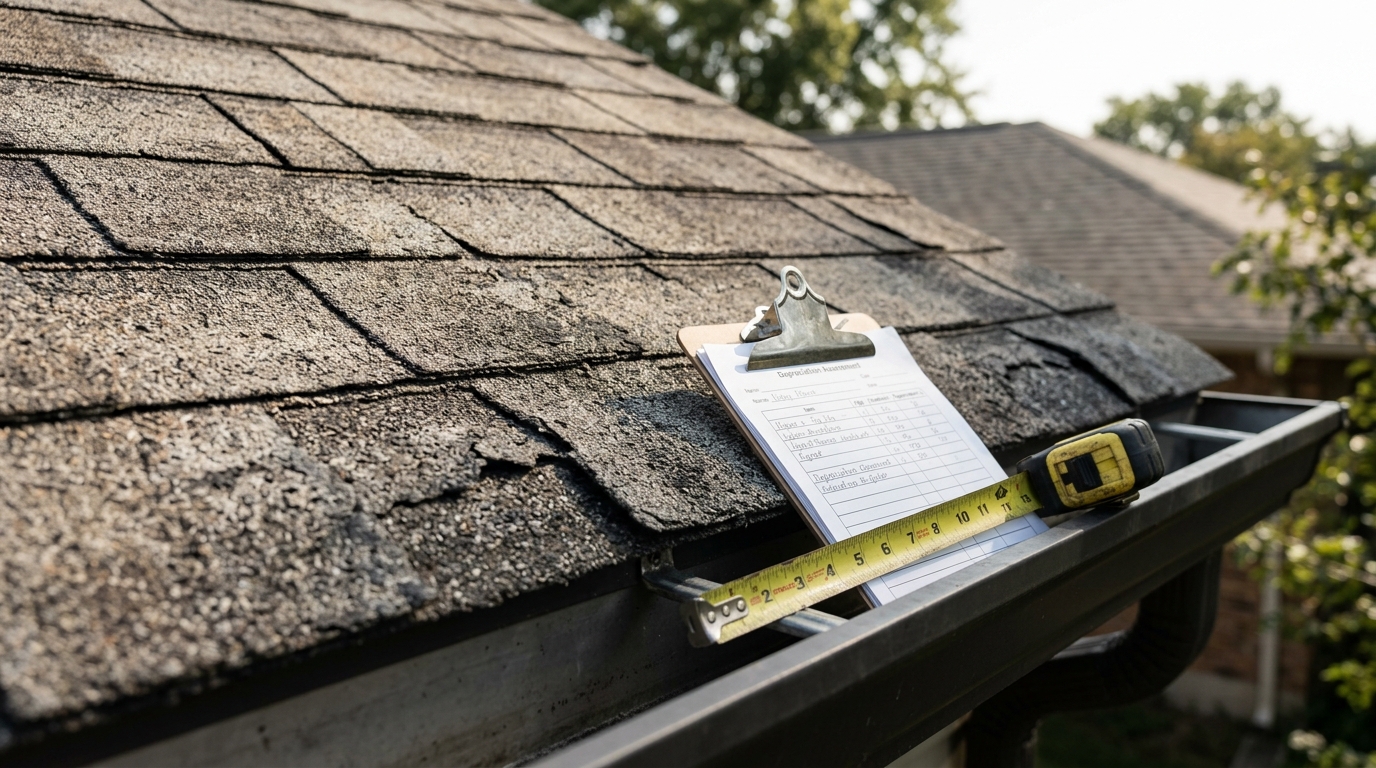
Your roof is 14 years old, a hailstorm totals it, the adjuster writes the claim for $14,000 — and the first check that hits your bank account is only $9,200. Where did the other $4,800 go? Depreciation. It hasn't disappeared, but recovering it requires you to do something specific the insurer rarely explains up front. This is the single most-misunderstood line item on a roof claim, and it shows up on essentially every partially-aged-roof file in the US.
The 90-second definition
Depreciation is the dollar value your roof has "used up" through age and wear. Insurers calculate it by taking the roof's replacement cost, dividing by the material's life expectancy, and multiplying by how many years you've used it.
A 30-year asphalt shingle roof that's 14 years old has used 14/30 = ~47%of its useful life. So on a $14,000 replacement quote, the depreciation is roughly $6,600 (47% × $14,000). The remaining $7,400 is the roof's actual cash value (ACV).
The two-check payout pattern
If your policy is RCV (replacement cost value — the standard for ~88% of US homeowners per the III), here's how the money actually flows:
- Check 1 — ACV ($7,400 in our example). Mailed within 30 days of claim approval. This is the depreciated value minus your deductible (usually $1,000-$2,500 for non-wind/hail; 1-2% of dwelling coverage for wind/hail in catastrophe states).
- Check 2 — recoverable depreciation ($6,600). Released only AFTER you complete the roof replacement AND submit final invoices showing actual money spent. Most insurers cap the recoverable amount at "what you actually paid the contractor" — so if you finish the job for $13,200 instead of the original $14,000 quote, you'll get $13,200 − $7,400 (already paid) = $5,800 back, not the full $6,600.
If your policy is ACV-only (older roofs in catastrophe states sometimes get rolled to ACV-only at renewal), you get ONLY the $7,400 check, and the depreciation is permanently kept by the insurer. This is why ACV vs RCV is the single most important coverage detail to know about your policy.
The 3 mistakes that forfeit the depreciation check
- Pocketing the ACV check and not replacing the roof. Roughly 1 in 6 homeowners on aged roofs do this when the ACV is enough to "make do" with patching. You forfeit the depreciation check entirely, and your next renewal will likely downgrade you to ACV-only coverage permanently.
- Underpaying the contractor "off the books". Some homeowners try to negotiate the contractor down to $11,000 cash, intending to keep the $3,000 difference. Insurers verify final invoices against bank/contractor records on RCV claims; mismatches trigger Special Investigation Unit (SIU) reviews and can void the claim entirely.
- Missing the depreciation-recovery deadline. Most policies give you 180 days to complete the work and submit recovery invoices. Missing it forfeits the remaining check. Hurricane/hail catastrophe claims often grant 12-month extensions, but you have to request the extension in writing before day 180.
Bridging the cash gap while you wait for check 2
The 60-180 day window between ACV check and depreciation check is when most homeowners feel financial pain — the contractor wants payment on completion, but your second check hasn't arrived. Three common bridges:
- Contractor payment plan. Most roofers will float the depreciation balance for 30-60 days if you sign an Assignment of Benefits (AOB). Check your state — Florida, Texas, and Louisiana have all tightened AOB rules in 2024-2025 due to fraud concerns. Verify the contract carefully before signing.
- Home equity loan (HEL). If you have equity, a 5-year HEL covers the shortfall at a fixed rate. The home equity loan calculator shows your monthly payment + DTI eligibility — typically $50-$100/mo on a $6,000 short-term bridge.
- Renovation financing comparator. The renovation financing comparator runs HEL vs HELOC vs cash-out vs personal loan side-by-side so you can pick the lowest-cost bridge.
What to ask your adjuster on the first call
- "What's the depreciation calculation method and roof age you're using?"
- "Is my policy RCV or ACV? If ACV, what's the trigger to flip it back to RCV?"
- "What's the deadline for completing work and submitting final invoices?"
- "Will you mail or email the depreciation-recovery worksheet?"
Get the answers in writing (email is fine). 60% of depreciation disputes come down to verbal vs written instructions; insurers' written word is what holds up in appraisal panels.
Run your numbers
- Roof replacement cost calculator — state-adjusted estimate so you can sanity-check the adjuster's RCV number.
- Home equity loan calculator — for bridging the ACV-to-depreciation gap.
- Renovation financing comparator — HEL vs HELOC vs personal loan with the same inputs.
- ACV vs RCV explained — the coverage-type breakdown that determines whether you ever see the depreciation check.
Get 3 free contractor quotes for your storm-damaged roof
Vetted local roofers who handle insurance claims. No spam, no obligation, no sales calls — we just send the quotes.
Most homeowners receive 3 quotes within 48 hours. Free service — funded by contractor referral fees, not by you.