ROI
Deck vs Patio — Which Adds More Home Value in 2026?
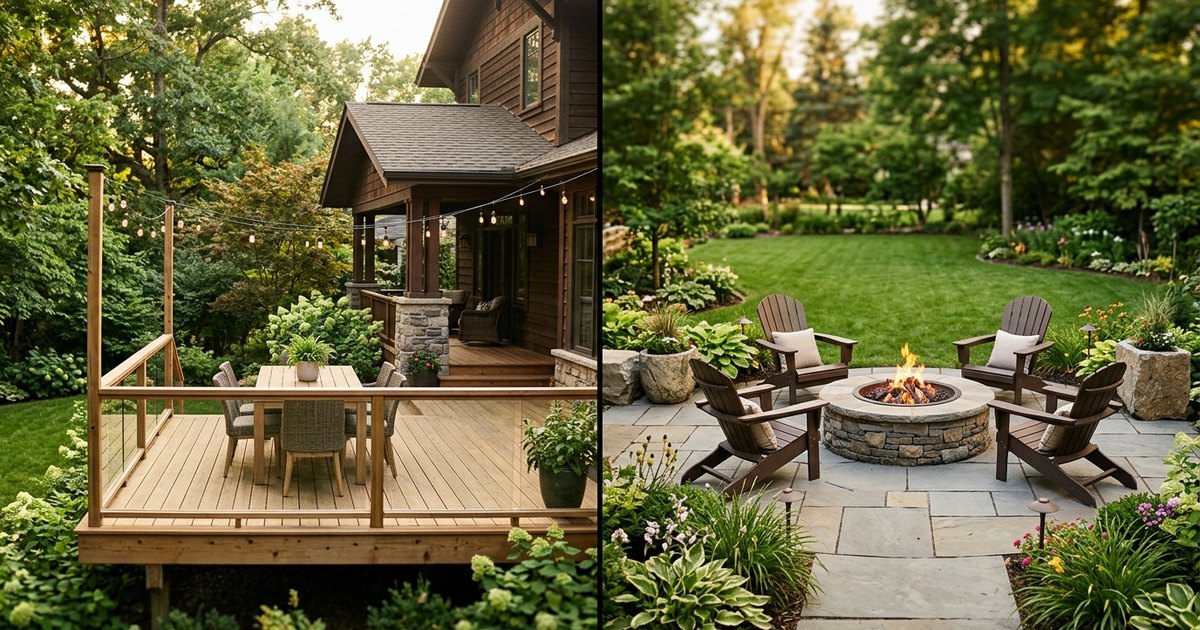
You have a backyard. You have a budget. The question is whether to spend it on a deck or a patio. Both add resale value, both extend your living space, and both have roughly equal ROI percentages. But they win in different climates, fail in different ways, and serve different households — and the right answer depends as much on your soil and your zip code as it does on personal taste. Here's the honest 2026 head-to-head.
2026 numbers — deck vs. patio at a glance
| 2026 metric (400 sqft) | Deck (composite, mid-range) | Patio (paver, mid-range) |
|---|---|---|
| Installed cost | $18,000–$26,000 | $10,000–$15,500 |
| Cost per sqft | $45–$65 | $25–$39 |
| Appraisal-uplift at resale | $11,000–$17,500 | $6,500–$11,000 |
| ROI percentage | 65–72% | 62–71% |
| Lifespan | 25–50 years | 30–60+ years |
| Annual maintenance | $0–$100 | $50–$200 (re-sand joints) |
| Permit required | Yes (raised deck) | Usually no (ground-level) |
| Buyer appeal rank (Realtor.com 2025) | #3 outdoor feature | #11 outdoor feature |
Sources: 2026 Remodeling Magazine Cost vs. Value, NAHB outdoor living survey, Realtor.com 2025 buyer survey. Pricing assumes mid-range tier (composite deck, concrete paver patio).
The verdict by climate — your zip code decides
Cold + wet climates (Northeast, Midwest, Pacific NW): Deck wins
- Drainage is hard on a patio in clay/silt soils with freeze-thaw cycles. Pavers heave 1–3 inches per decade; concrete cracks at 8–15 years even with control joints properly cut.
- Decks shed snow + leaves faster than patios. Walking on a snow-covered deck is safe; walking on iced-over pavers usually isn't.
- Composite decks shrug off moisture. PT wood + good drainage details lasts 20+ years even in WA/OR/ME.
- Resale: Northeast + Midwest buyers expect a deck on a single-family home. Patio-only builds get marked down 3–5% in MLS pricing in these markets.
Hot + dry climates (AZ, NV, TX, southern CA, NM): Patio wins
- Composite deck boards hit 145°F+ in afternoon Phoenix sun. Unwalkable barefoot from May–October. Wood decks split and cup faster.
- Pavers + concrete absorb less radiant heat. Lighter-color pavers (sand, beige, travertine) stay 25–35°F cooler than composite boards in identical sun.
- Pergola / shade structure adds-on works better on patio. Patio + 12x14 pergola ($4,500–$8,500) is a far better hot-climate build than deck + pergola.
- Resale: Sun Belt buyers actively prefer flat-paver / xeriscape combos over decks. Decks look out-of-place in desert architecture.
Mild climates (NC, GA, TN, central CA, VA, NM): Either works
- Decision is aesthetic + lot-driven: sloped lot → deck (cantilevered solves grade changes for less money than a retaining wall + patio); flat lot → patio.
- Resale is a wash: appraisers credit either at similar comps when finished to a similar tier.
The 30-year lifecycle cost
Headline install cost can mislead. Maintenance and replacement over 30 years can flip the verdict. Modeling a 400-sqft build, mid-range tier, mid-cost state:
| 30-yr cost | PT wood deck | Composite deck | Stamped concrete | Paver patio |
|---|---|---|---|---|
| Install (year 0) | $13,500 | $22,000 | $10,500 | $12,500 |
| Maintenance (annual) | $250 (seal/stain) | $50 | $80 | $120 |
| Major repair (year 12-18) | $3,500 (board replace) | $500 (board swap) | $2,800 (crack repair / overlay) | $1,200 (re-level + re-sand) |
| Replacement (year) | Year 20 ($18K) | None in 30 yr | Year 28-30 ($14K) | None in 30 yr |
| Total 30-yr cost | $42,500 | $24,000 | $15,700 | $17,300 |
| Cost per year | $1,420 | $800 | $520 | $575 |
Stamped concrete is the cheapest 30-year outdoor space on paper — but it cracks visibly even with control joints, and buyers discount it accordingly at resale. Composite deck is the best 30-year value for resale-conscious owners; paver patio is the best 30-year value for live-in-it owners.
When to do both — the combo play
On a sloped lot, a back-door deck (8x12 or 10x14) transitioning to a ground-level patio for dining is the highest-functioning outdoor build at the $14–22K total budget point. The deck handles grill / entry / planters; the patio handles the table and lounge furniture (where having a non-bouncy surface matters more). 2025 NAHB resale data shows deck+patio combos appraise 11–18% higher than either solo build at the same total budget.
Typical combo: 8x12 PT wood deck ($4,500–$6,500) + 300 sqft paver patio ($8,500–$12,000) + transition steps and edging ($1,200–$2,400). Total $14,000–$21,000. Functions like a $30K solo deck and appraises like one too.
What kills each project
Deck failure modes (5 patterns)
- Ledger board attachment. The single most common deck failure. Improper flashing causes house-side rot. Inspect every 3 years.
- Joist hangers undersized or unprotected. Galvanized hangers in coastal/salt-air zones rust through in 8–12 years. Stainless steel is mandatory within 1 mile of saltwater.
- Composite color streaking. Some early composite brands (Trex Accents 2007–2010, others) had color-bleed issues. Modern composites (capped) don't do this but be wary of unbranded big-box products.
- Permit not pulled / not inspected. Insurance won't cover collapse on an unpermitted raised deck. Always permit.
- Stair structure failure. Stair stringers undersized or cut from non-PT lumber rot from underneath. Inspect/replace at year 15.
Patio failure modes (5 patterns)
- Sub-base done wrong. 4-inch compacted gravel base is the floor for proper paver work. Cheap installers cut this to 2''. Result: heave, slumping, uneven joints by year 5.
- Pitch wrong. Patio should pitch 1'' per 8 feet away from house. Pool of water at the foundation = $10K+ basement waterproofing fix later.
- Concrete control joints. Concrete needs control joints every 8–10 ft to crack at the joint instead of randomly. Most DIY pours skip this.
- Joint sand washout. Pavers need polymeric sand in joints. Regular sand washes out in 18 months and lets weeds + ants in.
- Tree root proximity. Big trees within 15 ft of patio lift pavers / crack concrete within 8–15 years.
State-cost variance
- Low-cost states (TX, FL, GA, AL, MS, OK, SC, NC, TN): Deck $40–$52/sqft, patio $20–$30/sqft. Decks more popular in TN/GA/NC; patios more popular in FL/TX/AL.
- High-cost states (CA, NY, MA, NJ, WA, HI): Deck $55–$85/sqft, patio $32–$55/sqft. Permit fees alone run $400–$1,500 for raised decks in CA/NY.
- Mid-cost states (IL, CO, AZ, MI, OH, VA, OR): National medians apply within ±10%.
Run the numbers
- Deck cost calculator — state-adjusted estimate by size, materials (PT / cedar / composite / PVC), and elevation.
- Patio / hardscape cost calculator — estimate by surface type (paver / stamped concrete / flagstone) and sub-base.
- Deck addition ROI guide (2026) — deeper resale recovery numbers by state and tier.
- Best ROI renovations 2026 ranked — how deck/patio stack up against the rest.