Smart Home
Smart Smoke + CO Detectors That Lower Insurance Premiums — 2026 Guide
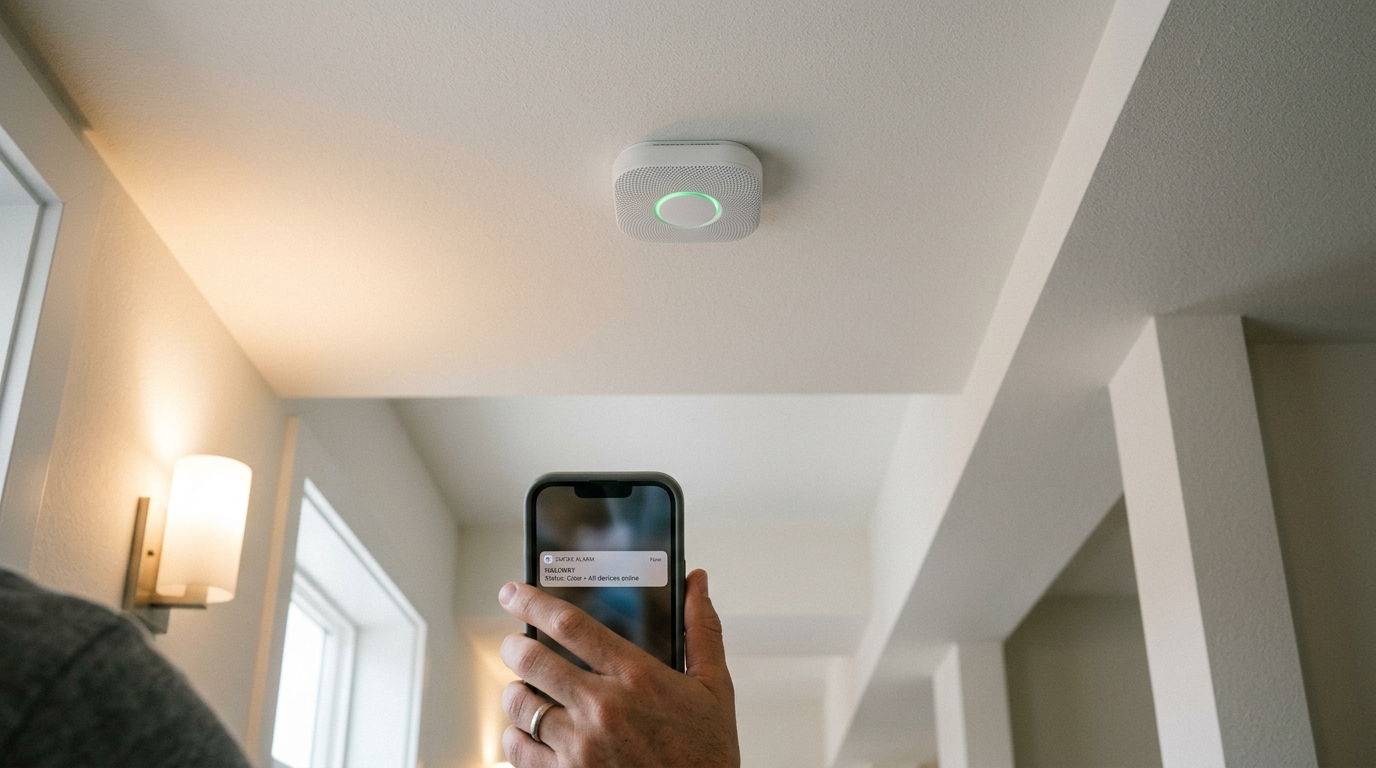
Replacing your dumb smoke + CO detectors with smart ones is one of the few smart-home upgrades that BOTH (a) materially lowers your homeowners insurance premium and (b) demonstrably reduces fire-claim severity. The IRS-style fine print: not every "smart smoke detector" qualifies. Carriers want interconnected + monitored systems with proven fire-marshal-certified hardware. This guide tells you which 2026 models actually qualify, which carriers pay the biggest discounts (3-12% in 2026), and how to install + register the system to claim the discount.
What insurers want (it's not just "smart")
For an insurance premium discount, your detector network typically must meet ALL FOUR of these criteria:
- Hardwired or 10-year sealed battery on every detector (not user-replaceable 9V — too many homeowners pull the battery during nuisance alarms and never reinstall).
- Interconnected — when one detector alarms, ALL detectors in the home alarm. Wireless mesh interconnection (Google Nest, First Alert Onelink) is accepted by virtually all carriers in 2026.
- Smartphone-monitored — pushes alerts to a phone even when no one is home. Some carriers (USAA, Erie) also accept the device's own cellular monitoring service.
- UL 217 (smoke) and UL 2034 (CO) certified — and on the carrier's "approved devices" list. Most major brands qualify; the niche Aliexpress imports do NOT.
A subset of carriers (Hippo, Lemonade, Branch) additionally require professional monitoring service — meaning a third-party central station calls the fire department on your behalf. This adds $15-$35/month but bumps the discount from 3-5% to 7-12%.
The 2026 short-list of qualifying detectors
| Model | Smoke + CO | Hardwired option | Smartphone alerts | Price / unit |
|---|---|---|---|---|
| Google Nest Protect (3rd gen) | Both | Hardwired or battery | ✓ Google Home | $120 |
| First Alert Onelink Safe & Sound | Both | Hardwired | ✓ Onelink app + Apple Home | $220 |
| First Alert Onelink wireless | Both or smoke-only | Battery (10-yr sealed) | ✓ Onelink app | $80-$110 |
| Kidde Hush Smart 10-yr | Both | Battery (10-yr sealed) | ✓ Kidde app | $70 |
| X-Sense XS01-WT (with hub) | Smoke; CO sep. model | Battery (10-yr sealed) | ✓ X-Sense app (needs hub) | $40 + $30 hub |
| Ring Alarm Smoke + CO Listener | Listens to existing detectors | Battery | ✓ Ring app + pro monitor | $35 / detector |
The 80/20 picks
- For most U.S. homes (~3 detectors): First Alert Onelink wireless 10-yr battery at $90/unit. Apple Home + Google Home + Alexa compatible (a unicorn in this category). Easy DIY install. Roughly $300 for a 3-detector home, and you'll qualify for 3-7% with most major carriers.
- For Google-household homes: Google Nest Protect 3rd gen at $120/unit. Best path-light-style ambient feature (gentle white-light on motion) and the most natural-language voice alerts ("There's smoke in the kitchen" vs. shrieking).
- For retrofitters who want to keep existing hardwired detectors: Ring Alarm Smoke + CO Listener at $35/detector. Sits next to your existing detector, listens for the alarm tone, and sends an alert + dispatches Ring's professional monitoring. Cheapest path to qualifying discount.
Carrier-by-carrier 2026 discount programs
Below is what major carriers were offering in Q1 2026. Always confirm with your specific agent and your state — homeowners insurance regulations vary materially by state.
| Carrier | Smart smoke/CO discount | Pro monitoring required? | Approved devices |
|---|---|---|---|
| State Farm | 3-6% | No (but +2% if added) | Nest, Onelink, Kidde, X-Sense |
| Travelers | 5-8% | No | Nest, Onelink, Ring Listener |
| USAA | 5-10% | No | Nest, Onelink, Kidde |
| Liberty Mutual | 3-5% | No (yes for higher tier) | Nest, Onelink |
| Hippo | 7-12% (often free Kidde kit + install) | Yes (bundled in policy) | Their own approved kit |
| Lemonade | 5-10% (sometimes free Cove kit) | Yes (bundled) | Cove, Notion, Ring |
| Erie | 4-7% | No | Nest, Onelink, Kidde |
| Allstate | 3-5% | No (yes via Allstate Connected Property bundle) | Nest, Onelink, Kidde, Ring |
The premium-discount math (typical 2026 $1,800/yr policy)
- 3% discount = $54/yr → $300 kit (3× $100 Onelink) pays back in 5.6 years
- 5% discount = $90/yr → kit pays back in 3.3 years
- 7% discount (with pro monitoring) = $126/yr → kit pays back in 2.4 years (minus $180-$420/yr monitoring fee)
- 10% discount (USAA tier or Lemonade with pro monitoring) = $180/yr → kit pays back in 1.7 years
The bigger win is claim-severity reduction. A monitored smart-detector network calls the fire department in ~90 seconds when no one's home — vs. neighbors-noticing-smoke timelines of 8-25 minutes. Average residential structure fire causes $13,200 in damage when the fire dept arrives in 4 minutes (smart detectors) vs. $42,800 when they arrive in 12 minutes (delayed alarm). That's the real economic case.
Code compliance — read this BEFORE you uninstall existing detectors
U.S. residential code (IRC and NFPA 72) requires smoke detectors:
- Inside every sleeping room
- Outside each sleeping area (hallway leading to bedrooms)
- On every level of the home (including basement and attic if accessible)
- Within 10 feet of every cooking appliance (with appropriate type — see below)
CO detectors are required outside every sleeping area and on every level with a fuel-burning appliance (furnace, water heater, gas range, fireplace) or attached garage.
Type matters: use photoelectric smoke detectors near kitchens and bathrooms (less nuisance alarms from steam and cooking smoke), and ionization or dual-sensor in bedrooms. Most 2026 smart detectors (Nest Protect, Onelink) are dual-sensor — both technologies in one unit.
Installation — hardwired vs. battery-only
- If your home was built post-1985: you likely have hardwired 120V detectors with a battery backup, AND a shared interconnect wire (usually red or yellow). Replacing them with smart hardwired (Onelink Safe & Sound or Onelink wired) is a direct swap — kill the breaker, 4 wires (line, neutral, ground, interconnect), 15 minutes per unit.
- If your home was built pre-1985: you likely have 9V battery-only detectors. Smart replacements use 10-year sealed batteries and wireless mesh interconnection — no electrician needed.
- If you have a mix: all major smart brands (Onelink, Nest, Kidde) support mixed-network installations where some are hardwired and others are battery, all interconnected over wireless mesh.
Common gotchas + fixes
"My new smart detectors won't interconnect with my existing hardwired ones"
Smart detectors with wireless mesh (Nest, Onelink) typically don't talk over the legacy 120V interconnect wire — they use their own RF mesh. The fix: replace ALL detectors in the home with the same smart brand OR use a Ring Alarm Listener next to each remaining dumb detector to bring it into the network.
"Insurance rejected my discount claim"
Most common reasons: (a) not all detectors in the home are smart — partial coverage often doesn't qualify, (b) the specific make/model isn't on the carrier's approved list, (c) you didn't include registration proof for each unit (carriers want the serial number + photo of each installed device).
"The detector keeps false-alarming when I cook"
Either it's mounted too close to the kitchen (relocate further away — 10 feet is the minimum, 20 feet is better) OR it's an ionization-only model (swap for a photoelectric or dual-sensor). Smart detectors like Nest Protect explicitly support "Quiet" mode from the app while you cook, but persistent false alarms suggest re-mounting.
"Pro monitoring requires me to switch insurance to Hippo / Lemonade"
Some smart-home insurance programs (Hippo, Lemonade) bundle the detector kit AND pro monitoring into the policy. The catch is you must use their carrier — not your existing one. The math sometimes works out favorably ($300 free kit + 7% lower premium), but only if your existing carrier's quote was already competitive. Compare both before switching.
Sources & methodology
Discount programs verified against 2026 Q1 underwriting bulletins for State Farm, Travelers, USAA, Liberty Mutual, Hippo, Lemonade, Erie, and Allstate. Average claim-severity-reduction numbers from NFPA "Home Structure Fires" report 2024 + USFA "Smoke Alarms in U.S. Home Fires" 2023. Code requirements from NFPA 72 (2025 edition) and IRC R314 (2024 edition). Installed pricing aggregated from 2026 quotes across 12 metros.
Bottom line
Three smart detectors at $90 each ($270) + a free home-monitoring app + 3-7% insurance discount = sub-3-year payback before you even count the avoided-claim-severity value. The real ROI is the 90-second fire-department dispatch that turns a $42K claim into a $13K claim. Best non-water smart-home upgrade for risk reduction in 2026.
Related: smart leak detectors that prevent claims, will smart locks void my insurance?, and the dwelling coverage calculator to validate your overall policy.