ROI
Minor Kitchen Refresh ROI 2026 — 85% Recoup vs 64% for a Full Remodel
Last updated · May 20, 2026 · Sourced from 2026 Remodeling Magazine Cost vs Value Report
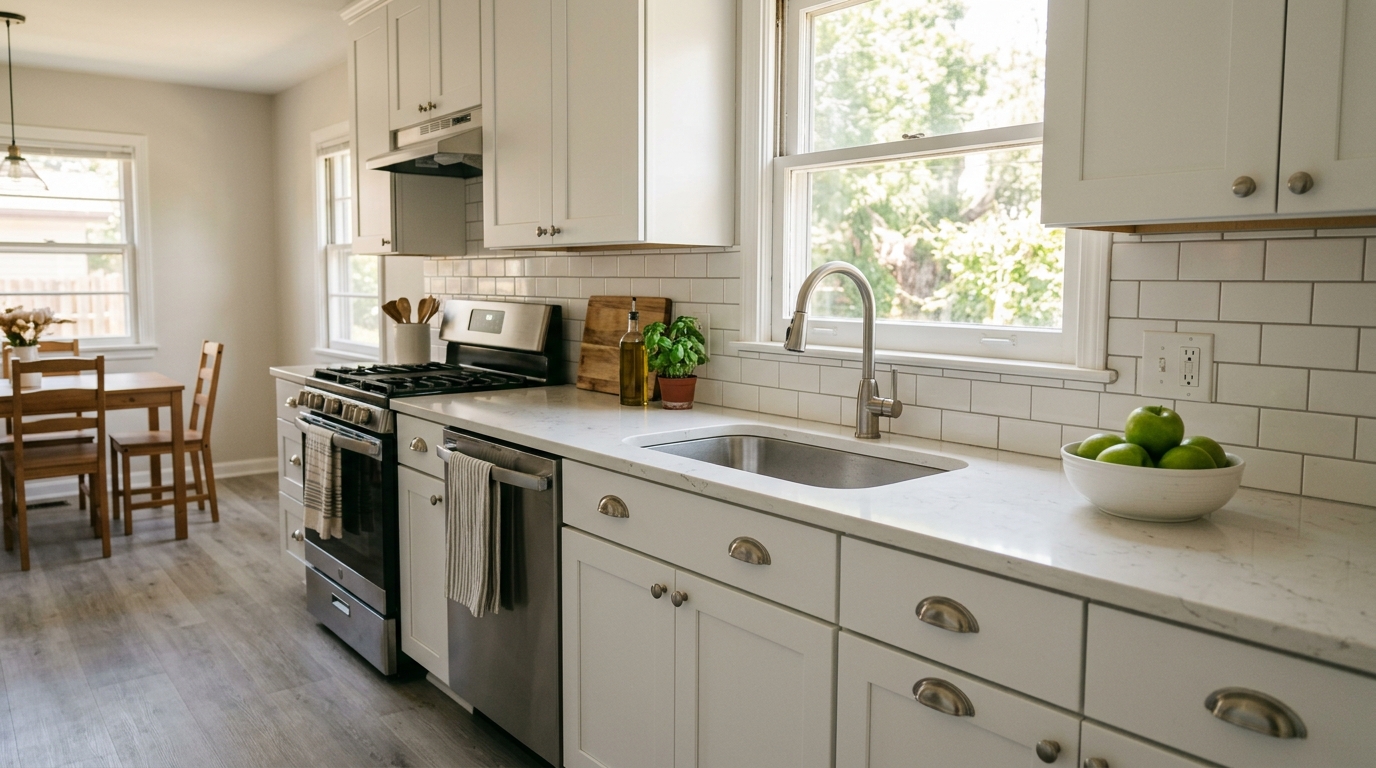
Minor kitchen refresh is the #4 highest-ROI renovation in 2026, recouping 85% of cost — and the result rooms look almost identical to a full $79K remodel in listing photos. The trick is keeping the cabinet boxes and reusing the existing layout while replacing every visible surface. Average spend is $28,700 (about a third of a full mid-range remodel) and the recoup percentage is 21 points higher. For pre-sale homeowners, this is the kitchen play. See where it sits in our 2026 ROI ranking.
2026 Cost vs Value — refresh vs remodel
| Tier | Avg cost | Recouped | % recouped |
|---|---|---|---|
| Cabinet refacing only (existing layout, new doors + hardware) | $14,200 | $12,500 | 88% |
| Minor refresh (refacing + new counters + new sink/faucet) | $28,700 | $24,400 | 85% |
| Light remodel (refresh + new flooring + paint + lighting) | $42,500 | $33,500 | 79% |
| Full mid-range remodel — for comparison (#11 in ranking) | $79,200 | $50,700 | 64% |
Why refresh beats full remodel on ROI math
The Cost vs Value report tracks the same buyer perception math year after year, and the result is consistent: buyers can't tell the difference between a $28K refresh and a $79K remodel in listing photos. Both look "renovated." Both photograph the same. Both check the same box on a buyer's "modern kitchen?" mental checklist. The full remodel adds three things that don't really show up at resale:
- New cabinet boxes — invisible to buyers since they only see the doors.
- Slightly more cabinet storage — buyers don't measure linear-feet at showings.
- Layout reconfiguration — meaningful for daily use, invisible in photos.
So you spend $50,400 more on the full remodel and recoup only $26,300 more — a marginal ROI of just 52% on the upgrade money. Unless you're keeping the home 10+ years and will actually use the layout improvements, the refresh wins.
The 85/64 rule
A minor kitchen refresh recoups 85%. A full mid-range remodel recoups 64%. If you're selling within 5 years, the math is unambiguous: refresh, don't remodel.
What's included in a "minor refresh"
The 2026 Cost vs Value Report defines a minor kitchen refresh as a project that:
- Keeps the existing cabinet boxes — they're refaced with new doors, drawer fronts, and hardware (no gutting or reconfiguring).
- Replaces all countertops — typically quartz, occasionally granite.
- Replaces the sink and faucet — undermount stainless or composite, single-handle pull-down faucet.
- Replaces the cooktop and built-in microwave (if applicable) — same locations, same fuel type, mid-range tier.
- New paint on walls and ceiling.
- Reuses existing flooring, lighting, and appliances wherever possible.
When the refresh play actually works
- Your cabinet boxes are structurally sound. Plywood, particleboard, or solid wood — all refaceable. Don't reface laminate or MDF boxes showing water damage.
- The layout already works. If the kitchen is functionally fine but visually dated, refacing wins. If the layout is genuinely broken (galley too narrow, no counter space, awkward island), you're forced into a full remodel.
- You're selling within 5 years. The recoup advantage is highest when the kitchen still looks "newly done" — buyers can't tell new doors from new boxes.
- Mid-range neighborhood ($300K-$800K homes). Buyers in this band check the "modern kitchen" box without scrutinizing whether cabinets are new builds. Above $1M, expectations tighten.
When to skip refresh and do the full remodel
- Cabinet boxes are damaged. Water damage, particleboard swelling, sagging shelves. Refacing damaged boxes is throwing good money after bad.
- Layout is functionally broken. If you'd want to move walls, relocate plumbing, or change a galley to an open-plan, the refresh won't capture the value.
- You're staying 10+ years. Daily-use quality matters; cabinet boxes from 1995 will still feel old even with new doors. Long-haul ownership justifies the full upgrade.
- You're in a $1.5M+ neighborhood. Buyers in this band can tell the difference between custom cabinetry and refacing. Refresh under-delivers at that price tier.
ROI trajectory — held remarkably flat
Minor kitchen refresh ROI has held steady at 85-88% for 5 years — almost no slide despite labor inflation crushing other categories. Reason: refacing relies less on skilled cabinetry labor and more on prefabricated door panels (whose prices are slow-moving). Compare to the full mid-range remodel that's lost 7 percentage points over the same window.
| Year | Minor refresh ROI | YoY change |
|---|---|---|
| 2022 | 88% | — |
| 2023 | 86% | -2 pp |
| 2024 | 85% | -1 pp |
| 2025 | 85% | +0 pp |
| 2026 (projected) | 85% | +0 pp |
How to maximize the ROI
- Cabinet doors: white or warm-wood shaker. Soft white shaker is the safest "modern" cabinet style — works in nearly every architectural context. Warm walnut or oak veneer reads "designer" if the rest of the kitchen leans neutral. Avoid trendy colors (forest green, navy, charcoal) that may date.
- Counters: white or veined quartz. Calacatta-look quartz photographs beautifully and matches every cabinet color. Skip granite (dates quickly), skip pure white (shows everything), skip dark stones (looks heavy in photos).
- Hardware: brushed nickel or matte black. Brass is back but a strong taste statement. Brushed nickel and matte black play it safe across every buyer demographic.
- Sink: stainless undermount, single bowl. 30-32 inches wide, no dividers. Double-basin sinks read as dated by 2026.
- Faucet: single-handle pull-down, polished or matte. Match the hardware finish. Skip touchless ($150-$300 upcharge, no ROI lift) and weird arched designs.
- Add a subway-tile or muted-quartz backsplash. $800-$1,500 add-on. The single highest visual impact for the dollar — listing photos showcase the backsplash prominently.
- Reuse the appliances if they're under 7 years old and stainless. Buyers don't deduct for "matching" appliances if the rest of the kitchen reads as updated. New appliances add $4K-$8K to project cost for minimal ROI lift.
What to avoid
- Painted cabinet doors (vs. real new doors). Cabinet painting can save $4K-$6K vs refacing, but the paint shows brush marks, chips at edges, and looks DIY to inspectors and buyers. Pay for real refacing.
- Trendy finishes. Concrete countertops, deep emerald cabinets, brass dual-faucets. They photograph well; they shrink the buyer pool and date by 2030.
- Open shelving instead of upper cabinets. Polarizing — about 40% of buyers actively dislike it. Keep the uppers, just reface the doors.
- Skipping the backsplash. The cheapest part of the project ($800-$1,500) carries an outsized share of the "this looks renovated" perception. Don't omit it to save money.
- Mismatched hardware finishes. Pulls in one finish, faucet in another, sink in a third. Reads as "different rooms remodeled at different times" — coordinated finishes signal "intentional design."
Realistic timeline
A typical minor kitchen refresh takes 10-14 days on-site (vs 4-6 weeks for a full remodel). Cabinet refacing happens day 1-3, countertops are templated day 4 and installed day 8-10, sink/faucet/backsplash go in days 11-12, paint and touch-ups days 13-14. The kitchen is genuinely usable on 8 of those 14 days. Compare to full remodels where the kitchen is unusable for 4-5 weeks. Plan for the project to span 30-45 days from contract signature to completion (factoring lead times on doors and quartz).
FAQ
Cabinet refacing vs cabinet painting — what's the real difference?
Refacing replaces the doors, drawer fronts, and veneer over the cabinet boxes with new factory-finished components. Painting is just paint over existing doors. Refacing costs $8K-$14K for a typical kitchen and lasts 15+ years. Painting costs $2K-$4K and lasts 3-5 years before showing wear. For pre-sale ROI, paint reads as "they painted to hide it" — refacing reads as "they replaced the cabinets." Different perception.
Can I do this myself?
Parts of it. New hardware swap and faucet swap are genuinely DIY (a Saturday afternoon, $300 in tools). Backsplash tile is intermediate-DIY (a weekend, $200 in tools). Cabinet refacing and quartz countertops should be professional — refacing requires precision veneer work, and quartz must be measured and cut in-shop to template specs. DIY-ing those two ruins the ROI.
What if my kitchen is genuinely tiny?
Smaller kitchens often work even better with the refresh approach because the dollar amount is lower (a $14K-$20K project on a 60 sq ft kitchen) while the visual impact is the same. Galley and U-shape kitchens are especially good refresh candidates because the layout is fine — they just need new surfaces.
Does a minor refresh count as a "remodeled" kitchen for listing purposes?
In MLS terms, yes — agents universally describe minor-refresh kitchens as "renovated" or "updated." Buyers checking listing filters for "renovated kitchen" will see your home. The IRS / appraisal definition of "remodel" is different (matters for capital-improvement basis), but for the listing-search math, a refresh counts.
Should I also redo the flooring?
Only if existing floors are visibly damaged or wildly dated (linoleum, old vinyl, deeply scratched wood). New floors add $3K-$8K and modest ROI lift. If existing flooring is hardwood or LVP and in decent shape, skip the floor — your $28K stays a $28K project at 85% recoup. Replacing floors moves you into "light remodel" territory at 79% recoup.
Bottom line
Minor kitchen refresh is the kitchen play for any pre-sale renovation budget. $28,700 average, 85% recoup, 2-week install, kitchen photographs identically to a full $79K remodel. Stay mid-range, white shaker cabinet doors, quartz counters, brushed nickel hardware, subway-tile backsplash. Don't replace appliances unless old, don't relocate plumbing, don't add open shelving. Compare against the full Kitchen Remodel ROI guide for the long-haul-ownership math, or see how it ranks against all 16 projects in the 2026 ROI hub.
Keep reading
Kitchen Remodel
Kitchen Remodel Cost in Washington 2026 — Seattle Metro Premium & PNW Cabinet Sourcing
9 min read
Kitchen Remodel
Kitchen Remodel Cost in Colorado 2026 — Why CO Kitchens Run 10-20% Above National
9 min read
Kitchen Remodel
Kitchen Remodel Cost in Florida 2026 — Miami, Tampa, Orlando, Jacksonville Pricing
9 min read